White Rice: Traditional Staple, Not the Bad Guy
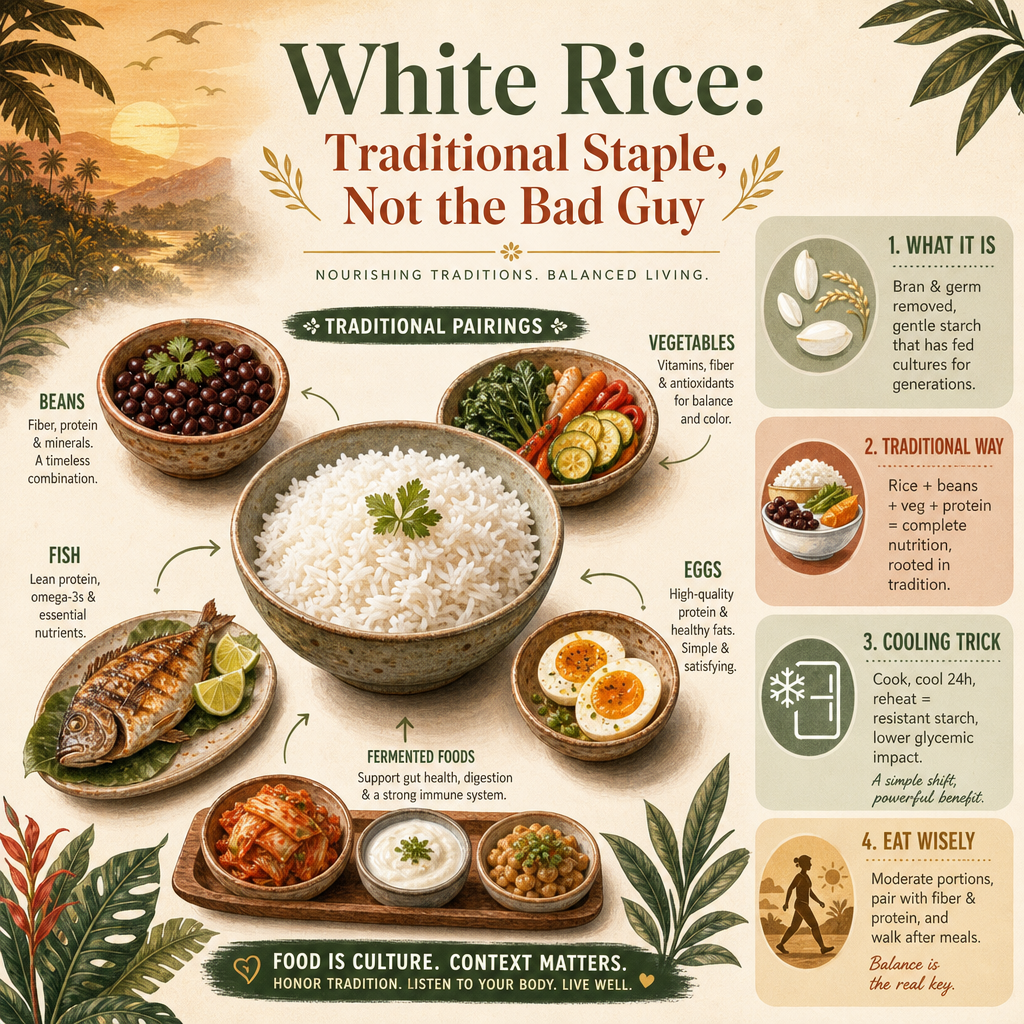
White rice is not the villain it is made out to be — it is a gentle, gluten-free staple that shines when eaten the traditional way: moderate portions with beans, vegetables, fermented foods, and protein. Plus the cooling trick that turns rice into resistant starch.
Quick answer
- White rice is not the villain it's often made out to be. It's a gentle, gluten-free starch that has fed cultures for generations — the problem isn't the rice, it's eating oversized portions alone, without the traditional pairings (beans, vegetables, fermented foods, protein) and an active lifestyle that once surrounded it.
What is white rice, really?
White rice is regular rice with the bran and germ removed, which makes it cook faster, last longer in storage, and feel easier to digest for many people. That processing lowers fiber and some nutrients, but it also reduces compounds such as phytic acid that can interfere with mineral absorption. Cooked white rice is mainly carbohydrate, with a little protein, very little fat, and a naturally gluten-free profile.
On its own, white rice is not a superfood, but it is also not poison. It is a simple, gentle starch that works best when it supports a meal built around more nutrient-dense foods.
How do traditional cultures actually eat rice?
Across many cultures, rice is usually eaten as "rice plus something," not as a huge bowl eaten alone. That "something" may be beans, lentils, leafy vegetables, pickled foods, fish, eggs, or meat — all of which add fiber, protein, minerals, fats, and protective plant compounds. In that kind of meal, rice acts as the base that makes the rest of the plate satisfying and practical, while the other foods provide much of the nutrition.
This is one reason white rice should not be judged in isolation. A moderate serving of rice in a balanced, active lifestyle behaves very differently from an oversized serving eaten with soda, fried foods, and little movement.
Why does white rice get such a bad reputation?
Research linking high white-rice intake to metabolic problems usually reflects modern eating patterns where rice is eaten in large amounts and crowding out vegetables, legumes, and other fiber-rich foods. The risk is higher when those meals are also paired with sedentary living, refined snacks, sugary drinks, and low overall diet quality. In other words, the problem is often not the rice itself but the loss of the traditional food pattern that once surrounded it.
That is why blanket advice to "never eat white rice" misses the point. A food that served as the staff of life for much of the world did not suddenly become toxic; its effects changed as the surrounding lifestyle changed.
The cooling trick: turning rice into resistant starch
One useful improvement is to cook rice, cool it in the refrigerator, and then reheat it later. When rice cools, part of its starch changes into resistant starch through a process called retrogradation, and resistant starch behaves more like fiber than fast-digesting carbohydrate. This can lower the blood sugar impact of the rice and may also support gut bacteria compared with eating the same rice freshly cooked.
Studies on cooked white rice cooled at about refrigerator temperature for around 24 hours found that the cooled-and-reheated rice produced a lower glycemic response than fresh rice. Reheating does not remove all the benefit, so leftovers can still be useful from a metabolic point of view. This does not transform white rice into a health food by itself, but it is a practical way to make it a little friendlier for blood sugar control.
How to eat white rice more wisely
A simple way to use white rice well is to treat it as part of a meal rather than the whole meal. Good pairings include beans or lentils, vegetables, fermented foods, and a source of protein, because these help slow digestion and improve the overall nutrient density of the plate. Portion size also matters, especially for people who sit most of the day or already struggle with blood sugar control.
Helpful habits include:
- Keep rice to a moderate portion instead of piling it on.
- Pair it with vegetables, legumes, and protein.
- Use cooled and reheated rice when possible for a lower glycemic effect.
- Walk or move after meals so the body can use the incoming energy better.
- Rotate rice with potatoes, sweet potatoes, plantains, beans, and other staples so it does not push everything else off the plate.
White rice is not the villain. It is a traditional staple that works well when it is used in a traditional way: moderate portions, balanced meals, and an active life.
Frequently asked questions
Is white rice bad for blood sugar?
On its own, white rice digests quickly and can spike blood sugar. Pairing it with protein, fat, fiber, and vegetables — and cooling then reheating leftovers — significantly softens that response.
Is brown rice always healthier than white rice?
Not always. Brown rice has more fiber and minerals but also more phytic acid, which can block mineral absorption, and can be harder to digest. For many people, white rice paired well is a gentler choice.
Does cooling and reheating rice really lower the glycemic response?
Yes. Cooking, refrigerating for around 24 hours, then reheating converts some starch into resistant starch, which digests more slowly and feeds beneficial gut bacteria.
How much white rice is a reasonable portion?
A cupped-hand portion (about 1/2 to 1 cup cooked) alongside protein and vegetables is a sensible starting point for most people, adjusted for activity level.
Is white rice safe for people with gluten sensitivity?
Yes. White rice is naturally gluten-free and is one of the gentler starches for sensitive digestive systems.
Should diabetics avoid white rice entirely?
Not necessarily. Moderate portions of cooled-and-reheated rice, paired with protein, fat, and fiber, and followed by a short walk, can fit into a well-managed plan — but individual response varies, so monitoring is wise.
Related reading
- Fatty Liver and Blood Sugar Imbalance: Natural Solutions
- Anti-Nutrients in Vegetables: Oxalates, Phytates & How to Reduce Them
- Aging Is an Energy Problem
Educational content only. Not medical advice. Consult a qualified practitioner for personal dietary guidance.