Aging Is an Energy Problem: What Mitochondria, Stress & Lifestyle Reveal About Healthy Aging
Aging is as much an energy-management problem as a genetic one. How mitochondria, chronic stress, sleep, movement, nutrition, and purpose shape healthspan — with a practical start-here protocol.
Maya Mountain Naturals Editorial · Published July 2026 · 12 min read
Quick answer
- Aging is not only a genetic countdown — it is also an energy-management problem, shaped by how well your cells generate, use, and recover energy.
- Mitochondria sit at the center: they power cells but also drive stress adaptation, metabolic flexibility, and repair capacity.
- Chronic stress is biologically expensive; when it becomes constant, the body spends energy on vigilance and inflammation instead of restoration.
- The most reliable anti-aging levers are lifestyle: daily movement, strength training, protected sleep, blood-sugar–stable nutrition, and lower chronic stress.
- Herbs, nutrients, and light-based tools are supportive add-ons — not replacements for the fundamentals or for medical care.
This article is educational only. It is not medical advice. "Traditionally used to support" language reflects historical and lifestyle use, not treatment claims. Persistent fatigue, mood changes, or unexplained decline deserve professional evaluation.
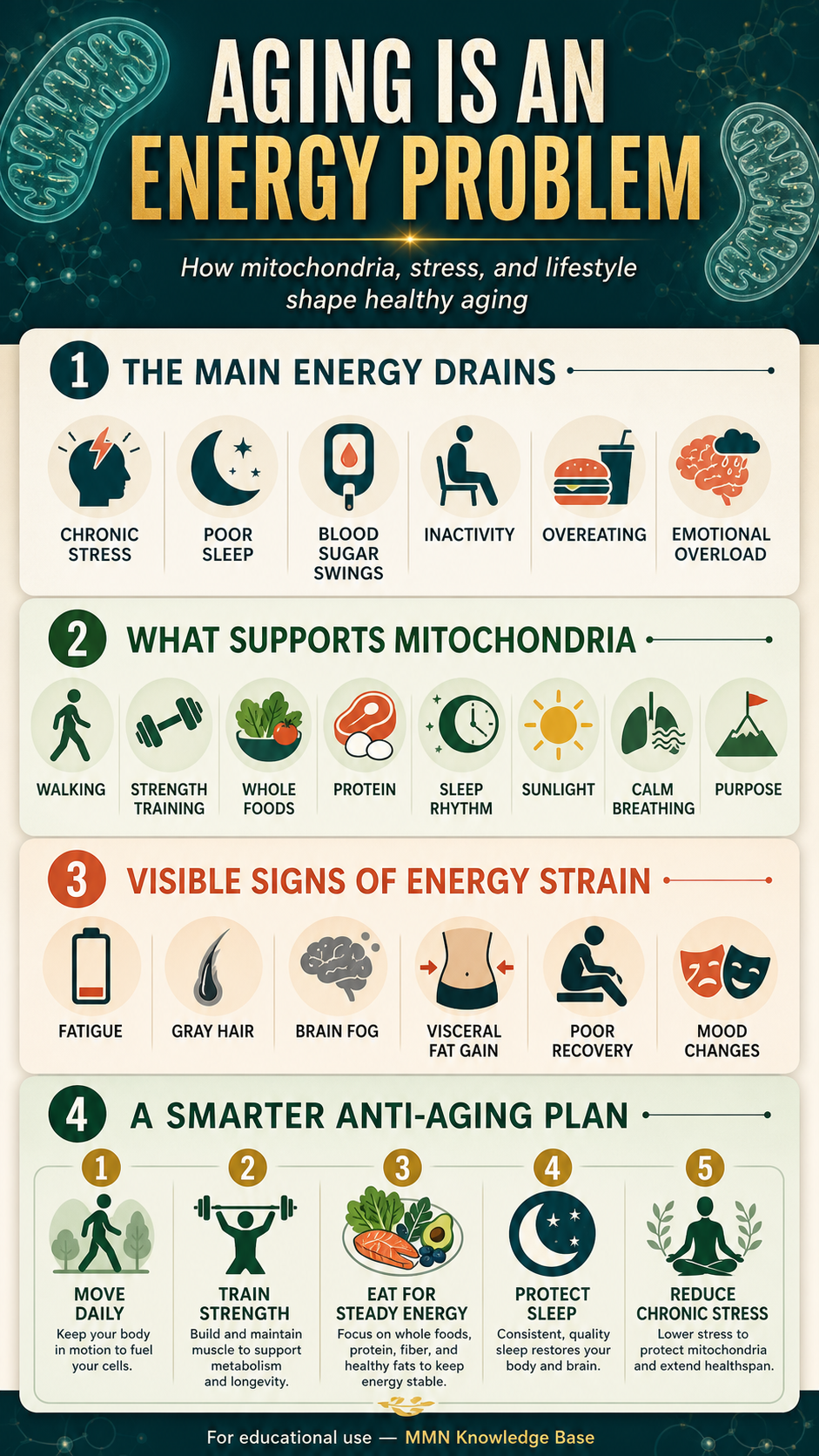
Why Is Aging an Energy Problem, Not Just a Genetic One?
Aging is often described as a genetic countdown, but a more practical view is that it is also an energy-management problem. Dr. Martin Picard frames mitochondria as central to how the body responds to stress, allocates energy, adapts to challenge, and maintains repair capacity, while broader healthy-aging research emphasizes movement, nutrition, sleep, emotional health, social connection, and prevention as the most reliable foundations for preserving healthspan.
This perspective explains why people can feel "older" long before chronological age alone would predict it. When stress is chronic, sleep is fragmented, blood sugar is unstable, movement is too low, and recovery is poor, the body may shift more of its resources toward survival and compensation rather than restoration and resilience.
Why Do Mitochondria Matter So Much?
Mitochondria are widely known for producing cellular energy, but they also participate in signaling, stress adaptation, metabolic flexibility, and the regulation of cellular function. Longevity research describes healthy aging as dependent on early prevention, lifestyle intervention, and repeated monitoring of physiological systems rather than waiting for disease to become obvious.
That makes mitochondria a helpful lens for understanding the overlap between fatigue, mood, metabolic dysfunction, visible aging, and resilience. The central argument is that stress, emotions, exercise adaptation, and even purpose may influence mitochondrial function — and therefore affect how quickly the body seems to age.
How Does Chronic Stress Drain Your Energy?
One of the most valuable ideas here is that chronic stress is biologically expensive. The body can handle short bursts of stress, but when stress becomes constant, more energy appears to be directed toward vigilance, hormonal signaling, inflammation control, and adaptation instead of repair, recovery, and long-term maintenance.
This helps explain why chronic stress often shows up as poor sleep, emotional flatness, central fat gain, irritability, scattered focus, slower recovery, and a sense of being tired even after eating enough. Prioritizing physical and mental health is a core part of healthy aging, not a side issue.
Practical anti-stress strategies with the best real-world value include:
- Reduce cognitive overload — especially constant alerts, multitasking, doomscrolling, and decision fatigue.
- Build daily recovery rhythms — walking, prayer, breathwork, journaling, stretching, or quiet time outdoors.
- Protect sleep timing and darkness at night, because inconsistent sleep undermines recovery and metabolic control.
- Treat emotional strain as physiological strain — unresolved stress can be as draining as poor diet or inactivity.
Is Low Mood Partly an Energy Problem?
Low mood may reflect, at least partly, a problem of low available energy rather than being "all in the head." Depression, stress, and mitochondrial function may be more connected than many people realize.
This does not mean every mood disorder is mitochondrial in origin. It means that low energy, poor stress tolerance, unstable blood sugar, insufficient movement, circadian disruption, and chronic inflammation can aggravate both emotional and physical exhaustion — so mood support should include metabolic and lifestyle support alongside appropriate professional care.
How Does Exercise Train Your Mitochondria?
Mitochondria adapt to demand. Regular aerobic training can increase mitochondrial density in muscle, while resistance training helps preserve muscle mass, metabolic reserve, and healthy aging capacity over time.
Healthy-aging guidance consistently recommends a mix of aerobic exercise, strength training, balance work, and mobility rather than a single fitness style. Adults are generally advised to accumulate 150 to 300 minutes of moderate activity weekly, or 75 to 150 minutes of vigorous activity, with muscle-strengthening activity added regularly.
A practical weekly template:
- Walk, cycle, swim, or perform similar aerobic activity on most days.
- Strength train two to three times weekly — legs, hips, back, core, pushing, and pulling movements.
- Add balance and mobility work, especially after age 40 or with stiffness, instability, or low activity.
- Avoid the "weekend warrior" pattern of long inactivity followed by excessive exertion; consistency creates adaptation more reliably than extremes.
Can Stress Really Affect Gray Hair and Visible Aging?
The gray-hair connection is attention-grabbing but should be handled carefully. The claim is not that gray hair is easily reversible in everyone — it is that stress biology and pigment changes may be linked, and that at least some aspects of graying may not be as fixed as once assumed.
The broader point is more useful: visible aging can reflect internal stress load. Rather than promising reversal, it is wiser to view gray hair, low energy, and poor recovery as possible signals of cumulative physiological strain rather than only cosmetic changes.
Why Doesn't Eating More Give You More Energy?
Eating more food does not automatically produce more usable energy. A person can consume plenty of calories and still feel depleted if insulin resistance, poor sleep, chronic stress, inflammation, or sedentary behavior are impairing the body's ability to generate and use energy well.
Aging-focused nutrition should emphasize energy efficiency, blood sugar stability, and nutrient density rather than quantity alone. Healthy-aging sources consistently recommend a pattern built around fruits and vegetables, nuts and seeds, seafood or other quality proteins, and minimally processed foods, with Mediterranean-style eating often highlighted for heart and brain health.
Practical nutrition recommendations:
- Build meals around protein, fiber, colorful plants, and healthy fats.
- Reduce ultra-processed foods, large sugar loads, and routine overeating.
- Pay attention to how meals affect energy, cravings, and mental clarity — not only taste or fullness.
- Use meal timing and portion size to support stable energy, especially with blood sugar swings or afternoon crashes.
How Can Natural-Health Tools Support Healthy Aging?
A natural-health approach fits this topic well when it stays grounded. Lifestyle habits remain the main levers, while herbs, nutrients, and light-based therapies are better framed as supportive tools rather than stand-alone solutions.
Reasonable supportive ideas:
- Mineral sufficiency — especially magnesium-rich foods and other nutrient-dense whole foods that support energy metabolism.
- Polyphenol-rich foods and herbs — berries, green tea, rosemary, turmeric, and other colorful plant compounds that may help with oxidative-stress balance (without claims that they "fix mitochondria" by themselves).
- Adaptogenic herbs, used cautiously and individually, because people under chronic stress respond very differently depending on sleep, blood sugar, stimulant use, and constitution.
- Red light therapy as an adjunct — worth exploring, but it should not distract from sleep, movement, emotional regulation, and metabolic fundamentals.
For safety, persistent fatigue, rapid decline in exercise tolerance, mood changes, unexplained weight loss, major sleep disruption, or neurological symptoms deserve proper medical evaluation. Natural strategies are most helpful when they complement — not replace — diagnosis and appropriate care.
Does Purpose Really Affect Physical Energy?
Purpose and meaningful goals may affect the way energy is organized in the body. Even when the exact mechanism is still being explored, the practical insight holds: people often experience less scattered effort and better resilience when their attention is organized around something worthwhile.
Healthy-aging research also stresses social relationships, emotional health, and staying mentally engaged. A meaningful life is often more energy-efficient than a fragmented one, because less effort is wasted on internal conflict, indecision, and chronic psychological resistance.
- Reduce scattered attention by limiting unnecessary inputs.
- Focus on a few meaningful goals rather than too many competing demands.
- Stay socially connected and mentally active; isolation and disengagement are linked to worse aging outcomes.
- Treat purpose as part of health maintenance, not just personal development.
What Is the Healthiest Anti-Aging Strategy?
The most reliable anti-aging strategy is not a supplement stack or a single biohack. It is reducing chronic energy drains while steadily increasing the body's ability to generate, use, and recover energy through movement, sleep, nutrition, stress regulation, emotional resilience, and preventive monitoring.
A practical "start here" protocol:
- Walk daily, especially after meals when possible.
- Strength train two to three times each week.
- Protect sleep consistency and reduce evening overstimulation.
- Eat for metabolic stability, not just convenience or stimulation.
- Lower chronic stress inputs, not only stress reactions.
- Notice whether habits produce calm energy or scattered fatigue.
- Use herbs, nutrients, and devices as secondary supports, not primary solutions.
Frequently asked questions
Is aging really an energy problem?
In practical terms, yes — alongside genetics. How efficiently your cells generate, use, and recover energy strongly influences how you feel and function. Chronic stress, poor sleep, blood sugar swings, and inactivity drain that energy, while movement, sleep, nutrition, and purpose help restore it.
What are mitochondria and why do they matter for aging?
Mitochondria are the parts of your cells that produce energy, but they also guide stress adaptation, metabolic flexibility, and repair. When they function well, the body has more capacity for restoration and resilience; when they struggle, fatigue, mood changes, and faster visible aging can follow.
Can chronic stress make you age faster?
Chronic stress is biologically expensive. When stress is constant, the body directs energy toward vigilance and inflammation instead of repair and recovery, which can show up as poor sleep, central fat gain, brain fog, slower recovery, and persistent tiredness.
Does eating more food give you more energy?
Not necessarily. You can eat plenty of calories and still feel depleted if insulin resistance, poor sleep, stress, inflammation, or inactivity impair how your body makes and uses energy. Nutrient density and blood-sugar stability matter more than quantity.
What is the best anti-aging routine?
There is no single biohack. The most reliable approach is reducing chronic energy drains while increasing energy capacity: walk daily, strength train two to three times weekly, protect sleep, eat for metabolic stability, and lower chronic stress. Herbs, nutrients, and devices are secondary supports.
Can supplements or red light therapy reverse aging?
They may offer supportive benefits but are not stand-alone solutions. Lifestyle fundamentals remain the main levers, and any tool should complement — not replace — sleep, movement, nutrition, stress regulation, and appropriate medical care.
This article is a thematic synthesis and practical interpretation drawing on Dr. Martin Picard's discussion of mitochondria and aging, combined with broader healthy-aging and longevity sources. It is not a verbatim transcript review or a validation of every numerical claim.