Beyond Cholesterol: The Real Root Causes of Heart Disease & Natural Allies
A major 2026 review challenges the cholesterol theory of heart disease. Discover the true upstream drivers — insulin resistance, inflammation, endothelial dysfunction, oxidative stress — and the diet, herbs, and nutrients that target them. Educational only.
Maya Mountain Naturals Knowledge Base · Published July 2026 · 14 min read
Quick answer
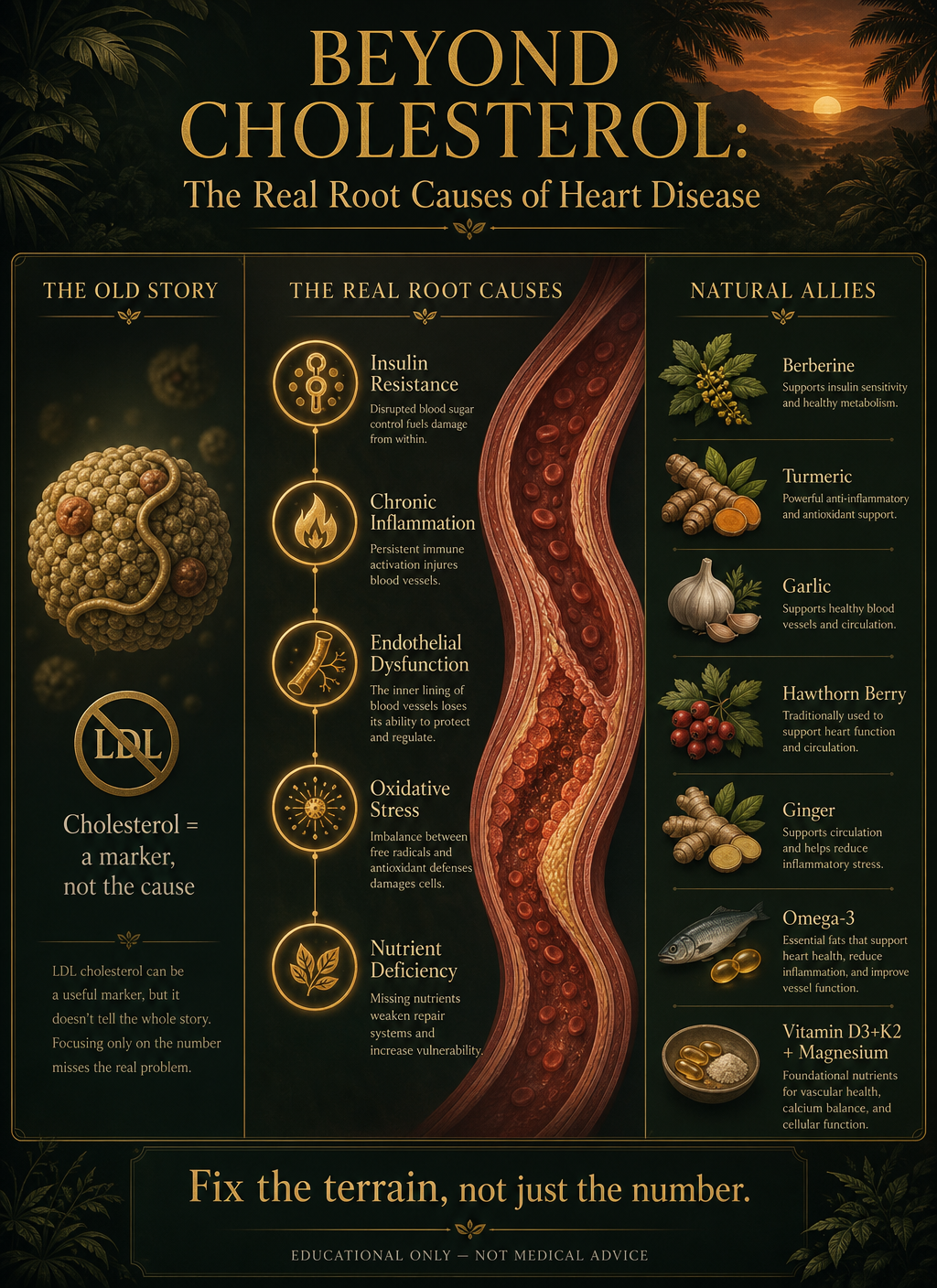
- For sixty years cholesterol was blamed for heart disease. A major July 2026 review of ~280 studies argues cholesterol markers (LDL, ApoB, oxLDL) are mostly downstream symptoms — not the root cause.
- The real upstream drivers are insulin resistance and metabolic dysfunction, chronic inflammation, endothelial dysfunction, oxidative stress, and nutrient/environmental factors.
- This is why aggressively lowering LDL leaves large "residual risk" — statins don't fix the metabolic terrain that started the damage.
- Diet comes first: cut refined carbs, sugar and processed seed oils; prioritize whole foods; watch your triglyceride-to-HDL ratio.
- Evidence-backed herbal and nutritional allies — berberine, turmeric, garlic, hawthorn, ginger, omega-3s, and the D3+K2+magnesium triad — target inflammation, insulin resistance, and endothelial health directly.
This article is educational only. It is not medical advice and does not diagnose, treat, cure, or prevent any disease. Do not stop, start, or change any medication or supplement without consulting a qualified healthcare professional — several supplements discussed can interact with prescription drugs.
Plain-Language Summary
For more than sixty years, doctors told us that high cholesterol was the primary cause of heart disease. A major new review published by the Orthomolecular Medicine News Service (OMNS) in July 2026, authored by Dr. Richard Z. Cheng, MD, PhD, challenges this assumption head-on. After analyzing approximately 280 peer-reviewed studies spanning six decades of cardiovascular research, the review concludes that cholesterol and its related biomarkers are largely symptoms and markers of a deeper disease process — not the root cause itself.
The review asks a pointed question: if each new cholesterol marker (LDL, ApoB, oxidized LDL, lipoprotein(a), etc.) was supposed to be the "true" cause of heart disease, why did researchers keep needing to find a better one? The answer is that medicine has been measuring increasingly refined versions of downstream biology — the damage already done — rather than identifying what started the fire in the first place.
Most importantly, the review notes that even after decades of increasingly powerful cholesterol-lowering drugs, a large portion of cardiovascular risk stubbornly remains. This "residual risk" is the clearest evidence that something upstream — something we haven't fully targeted — continues to drive arterial disease.
The Lipid Biomarker Hierarchy: What Each One Actually Tells You
The review systematically places each major lipid biomarker in its correct position within the disease process:
| Biomarker | Traditional Role | True Biological Role |
|---|---|---|
| Total Cholesterol | "The cause" | Weak exposure marker |
| LDL-C (LDL cholesterol) | Primary target | Exposure marker / particle traffic |
| ApoB | More precise LDL count | Exposure biomarker |
| LDL-P (LDL particle number) | Best LDL predictor | Exposure biomarker |
| Small Dense LDL (sdLDL) | "Bad" LDL | Intermediate mechanism: endothelial injury |
| Oxidized LDL (oxLDL) | Plaque builder | Intermediate mechanism: oxidative damage |
| Triglycerides (TG) | Metabolic risk | Reflects metabolic/insulin health |
| HDL-C | "Good cholesterol" | Reflects metabolic health, not independent driver |
| Lipoprotein(a) [Lp(a)] | Genetic risk factor | Partial upstream causal contributor (genetic) |
The key insight is that only Lp(a) — a genetically determined particle — has strong evidence for being causally upstream. All the others function more like warning gauges that go off after the engine has already started to fail.
The Real Upstream Drivers: Where Heart Disease Actually Begins
If cholesterol isn't the ignition switch, what is? The review and the broader body of emerging science point to a cluster of interconnected upstream biological disturbances:
1. Insulin Resistance and Metabolic Dysfunction
This is arguably the most important upstream driver. Insulin resistance — where cells stop responding properly to insulin — creates a cascade of damage throughout the cardiovascular system. When insulin signaling breaks down in vascular cells, two critical pathways diverge: the protective PI3K/Akt pathway (which produces nitric oxide and keeps vessels relaxed and healthy) is suppressed, while the damaging MAPK pathway (which promotes inflammation, cell proliferation, and vasoconstriction) remains active. This imbalance directly initiates endothelial dysfunction — the earliest measurable step in atherosclerosis.
Hyperinsulinemia (chronically elevated insulin, a consequence of insulin resistance) independently promotes monocyte adhesion to artery walls, oxidation of lipoproteins, and platelet aggregation — all early atherogenic events. Metabolic syndrome, the cluster of insulin resistance, abdominal obesity, high triglycerides, low HDL, and high blood pressure, is now recognized as one of the most powerful predictors of cardiovascular disease.
Nearly 88% of American adults have some degree of metabolic dysfunction, making this the single most prevalent upstream driver in modern populations.
2. Chronic Low-Grade Inflammation
Inflammation is not merely a consequence of atherosclerosis — it is a driver of it. The artery wall becomes inflamed before plaque appears. Inflammatory cytokines such as TNF-α, interleukin-6 (IL-6), and C-reactive protein (CRP) promote endothelial permeability, smooth muscle cell proliferation, and macrophage foam-cell formation — the building blocks of arterial plaque.
Adipose tissue dysfunction, particularly excess visceral (abdominal) fat, acts as an endocrine organ, releasing pro-inflammatory adipokines that sustain this chronic inflammatory state. The key distinction: inflammation damages the artery wall first, and cholesterol-containing particles accumulate at the damage site as part of a repair response — not as the initiating cause.
3. Endothelial Dysfunction
The endothelium — the single-cell-thick lining of your arteries — is the gatekeeper of cardiovascular health. When it becomes dysfunctional (from oxidative stress, high glucose, insulin resistance, or inflammatory signals), it loses its ability to produce adequate nitric oxide (NO), a critical molecule that keeps vessels dilated, prevents clot formation, and blocks smooth muscle proliferation.
Endothelial dysfunction is now considered the earliest measurable step in the development of atherosclerosis, preceding visible plaque by years or even decades. It is triggered by exactly the same upstream forces described above: insulin resistance, chronic inflammation, and oxidative stress.
4. Oxidative Stress
Oxidative stress — an excess of reactive oxygen species (ROS) relative to the body's antioxidant defenses — is both a cause and amplifier of vascular damage. It oxidizes LDL particles (turning them into the far more dangerous oxLDL), impairs nitric oxide production, triggers inflammatory signaling, and damages endothelial cells directly. Diets high in refined carbohydrates, processed seed oils, and ultra-processed foods are primary generators of systemic oxidative stress.
5. Environmental and Nutritional Factors
The review's Integrative Orthomolecular Systems Medicine (IOM) framework also identifies micronutrient insufficiency, environmental toxicant exposure, and chronic infections as upstream contributors. Key micronutrient insufficiencies linked to cardiovascular risk include magnesium, vitamin D, vitamin K2, and omega-3 fatty acids. Environmental toxins (heavy metals, persistent organic pollutants) directly damage endothelial cells and promote oxidative stress.
Why Lowering Cholesterol Doesn't Eliminate Risk
This is the central logical argument of the review. If LDL cholesterol were the root cause of heart disease, then more aggressive LDL lowering should progressively eliminate cardiovascular events. It doesn't. Substantial "residual cardiovascular risk" persists even in patients with extremely low LDL levels on intensive statin therapy. This residual risk is the fingerprint of upstream disturbances — primarily metabolic dysfunction and inflammation — that statins do not address.
The analogy is instructive: lowering blood glucose in a diabetic patient doesn't necessarily reverse the underlying insulin resistance. Similarly, lowering LDL doesn't necessarily correct the endothelial dysfunction, oxidative stress, or metabolic dysregulation that initiated the disease.
Diet First: The Foundation of True Prevention
No supplement or herb replaces dietary intervention. The anti-inflammatory, metabolically restorative dietary approach is the cornerstone of upstream cardiovascular prevention:
- Eliminate refined carbohydrates and added sugars — the primary drivers of insulin resistance, endothelial glycation damage, and oxidative stress
- Remove industrially processed seed oils (canola, soybean, sunflower, corn) — highly unstable polyunsaturated fats that oxidize easily and generate inflammatory compounds
- Prioritize whole, unprocessed foods — vegetables, quality proteins (pasture-raised meats, wild fish), healthy fats (olive oil, avocado, coconut, grass-fed butter), and fiber-rich foods
- Adopt a low-carbohydrate or Mediterranean-style diet — both demonstrably lower triglycerides, raise HDL, improve insulin sensitivity, and reduce inflammatory markers
- Monitor the triglyceride-to-HDL ratio — a ratio below 1.5 indicates metabolically healthy lipid patterns; above 3.5 indicates insulin resistance and small dense LDL
Herbal Allies and Nutritional Supplements
These allies work by targeting the actual upstream drivers: inflammation, oxidative stress, insulin resistance, and endothelial dysfunction. They are best used as adjuncts to a clean diet and healthy lifestyle, not replacements.
Berberine (Berberis vulgaris, Coptis chinensis)
One of the most evidence-backed herbal compounds for cardiovascular-metabolic health. Berberine activates AMPK (the cellular energy sensor), which simultaneously improves insulin sensitivity, reduces inflammation, and supports endothelial function. Studies show it protects against hyperglycemia-induced endothelial injury by reducing oxidative stress and ER stress in vascular cells. It also reduces LDL, triglycerides, and blood pressure while being frequently compared to metformin in its glucose-lowering effects. Typical dose: 500 mg, 2–3x daily with meals.
Turmeric / Curcumin (Curcuma longa)
Curcuminoids — the active compounds in turmeric — directly suppress NF-κB, the master inflammatory switch that drives endothelial dysfunction and vascular inflammation. A systematic review and meta-analysis confirmed that turmeric/curcumin supplementation significantly lowers CRP, TNF-α, and IL-6 while raising antioxidant capacity and reducing malondialdehyde (a lipid oxidation marker). Bioavailability is greatly enhanced with piperine (black pepper extract) or phospholipid complexes. Typical dose: 500–1000 mg standardized curcumin, 2x daily with food and piperine.
Garlic (Allium sativum)
Garlic's organosulfur compounds — particularly allicin from raw/fresh garlic and S-allyl cysteine from aged garlic extract — work through multiple cardiovascular mechanisms simultaneously. Allicin directly protects coronary endothelial cell function and prevents vascular calcification. Aged garlic extract (AGE) has been shown to inhibit coronary artery calcification progression in clinical studies. A comprehensive meta-analysis confirmed garlic supplementation significantly reduces systolic and diastolic blood pressure, fasting blood glucose, insulin resistance (HOMA-IR), triglycerides, total cholesterol, and LDL while raising HDL — while also reducing CRP, TNF-α, and increasing antioxidant capacity. Typical dose: 600–1200 mg aged garlic extract daily, or equivalent fresh garlic (2–4 raw cloves).
Hawthorn Berry (Crataegus spp.)
One of the most traditionally validated heart herbs in both Western and Chinese medicine. Hawthorn's flavonoids and oligomeric proanthocyanidins (OPCs) improve coronary blood flow, reduce peripheral vascular resistance, and exert direct antioxidant effects in arterial tissue. It has positive inotropic (heart-strengthening) effects and supports healthy vascular tone without significant side effects at standard doses. Particularly valuable as a tonic herb for chronic cardiovascular support. Typical dose: 300–600 mg standardized extract (1.8% vitexin) 2–3x daily.
Ginger (Zingiber officinale)
Ginger's gingerols and shogaols address multiple upstream cardiovascular drivers. It demonstrates significant anti-platelet aggregation activity (reducing thrombotic risk), anti-inflammatory effects through COX and LOX pathway inhibition, lipid-lowering properties, and antioxidant activity. A systematic literature review confirmed ginger inhibits platelet aggregation through multiple mechanisms, and there is evidence of positive inotropic effects. Typical dose: 1–2 g dried root powder or standardized extract daily.
Omega-3 Fatty Acids (EPA/DHA)
EPA and DHA from fish oil or algae reduce systemic inflammation, lower triglycerides, improve endothelial function, and reduce soluble inflammatory markers in atherosclerosis. EPA in particular reduces VLDL production and improves lipid particle quality. High-dose pharmaceutical EPA (icosapentaenoic acid) has demonstrated cardiovascular event reduction in high-risk patients in major clinical trials. Typical dose: 2–4 g combined EPA+DHA daily with food.
The Vitamin D3 + K2 + Magnesium Triad
These three nutrients work synergistically and their deficiencies are common in populations with high cardiovascular disease rates:
- Vitamin D3 regulates hundreds of genes involved in immune and vascular function; deficiency is strongly associated with cardiovascular risk
- Vitamin K2 (MK-7 form) activates Matrix GLA Protein (MGP), which prevents calcium from depositing in arterial walls — a direct mechanism for preventing atherosclerotic calcification
- Magnesium is a cofactor in over 300 biochemical reactions, activates vitamin D, supports healthy blood pressure, heart rhythm, and nitric oxide synthesis
Without K2, supplemental D3 may direct calcium into arteries rather than bones. The three work best together. Typical doses: D3 2,000–5,000 IU/day; K2 MK-7 100–200 mcg/day; Magnesium glycinate or malate 300–400 mg/day.
Nattokinase
Extracted from natto (fermented soybeans), nattokinase has direct fibrinolytic activity — it breaks down fibrin (clot protein) and reduces blood viscosity and fibrinogen levels. Clinical trials show modest but consistent reductions in blood pressure at 2,000 FU/day. It addresses the downstream clotting/blood viscosity aspect of cardiovascular risk. Important note: one 2021 RCT found no effect on subclinical atherosclerosis progression at 3 years, and nattokinase is not recommended by major cardiology societies. It should not be combined with anticoagulant medications. Best used as a supportive adjunct, not a primary intervention.
A Root-Cause Framework for Heart Health
The paradigm shift proposed by Dr. Cheng's review is best understood as a four-level disease model:
UPSTREAM BIOLOGICAL DRIVERS (where to focus prevention)
├── Insulin resistance / metabolic dysfunction
├── Chronic inflammation
├── Oxidative stress
├── Endothelial dysfunction
└── Micronutrient deficiencies / environmental toxins
EXPOSURE BIOMARKERS (measuring the damage environment)
├── LDL-C, ApoB, LDL-P
└── Triglycerides, HDL-C
INTERMEDIATE PATHOGENIC MECHANISMS (damage in progress)
├── Oxidized LDL (oxLDL)
└── Small dense LDL (sdLDL)
CLINICAL MANIFESTATIONS (the disease itself)
├── Atherosclerotic plaque
├── Coronary artery disease
└── Heart attack / stroke
Conventional medicine largely targets the bottom three levels. Root-cause medicine targets the top.
Practical Takeaways for the Reader
- Your cholesterol number alone is not your cardiovascular destiny. Half of all heart attack patients have "normal" LDL levels.
- Ask for better markers. Get your triglyceride-to-HDL ratio (below 1.5 is ideal), fasting insulin, HbA1c, and CRP tested alongside standard lipid panels.
- Fix the metabolic terrain first. Reducing refined carbohydrates and sugar is the single highest-leverage dietary intervention for upstream cardiovascular health.
- Reduce chronic inflammation through diet, stress management, quality sleep, and targeted herbs like turmeric and berberine.
- Support endothelial health with the D3/K2/Magnesium triad, omega-3s, garlic, and regular physical activity.
- Consider a Coronary Artery Calcium (CAC) scan — a low-cost ($100–200) imaging test that directly measures calcified plaque in your coronary arteries, providing far more actionable information than any single blood lipid marker.
Sources: Cheng RZ, "Beyond Cholesterol: A Comprehensive Integrative and Systems Medicine Reassessment of Lipid and Lipoprotein Biomarkers in ASCVD." Preprints 2026, 2026070008. Supporting research from PMC/NIH, Frontiers in Pharmacology, JAMA Cardiology, AHA Journals, and other peer-reviewed sources as cited. This content is for educational purposes only and does not constitute medical advice.
---
References
- Mind Body Synergy | Low-Carb Nutrition & Wellness Coaching for a Healthier You - For decades you were told cholesterol clogs your arteries. The science tells a different story. Hear...
- Insulin resistance and cardiovascular disease - PMC - NIH - Impaired insulin cellular signaling in IR alters glucose metabolism and endothelial dysfunction and ...
- Insulin Resistance and Atherosclerosis - The epidemic of obesity in the developed world over the last two decades is driving a large increase...
- Insulin Resistance, Hyperinsulinemia and Atherosclerosis - PMC - Insulin resistance describes the lack of activity of a known quantity of insulin (exogenous or endog...
- Insulin resistance, metabolic stress, and atherosclerosis - PMC - Atherosclerosis, a pathological process that underlies the development of cardiovascular disease, is...
- Adipokine Dysregulation and Insulin Resistance with Atherosclerotic Vascular Disease: Metabolic Syndrome or Independent Sequelae? - Adipokine dysregulation and insulin resistance are two hallmark sequelae attributed to the current c...
- It's Not Cholesterol. Inflammation Is What's Actually Causing Heart ... - ... cardiovascular disease is actually an inflammatory process driven by insulin resistance and meta...
- Inflammation, not Cholesterol, Is a Cause of Chronic Disease - Since the Seven Countries Study, dietary cholesterol and the levels of serum cholesterol in relation...
- Inflammation and metabolic dysfunction: links to cardiovascular diseases | American Journal of Physiology-Heart and Circulatory Physiology | American Physiological Society - Abdominal obesity is a major risk factor for cardiovascular disease, and recent studies highlight a ...
- Endothelial Cell Dysfunction and the Pathobiology of Atherosclerosis - Dysfunction of the endothelial lining of lesion-prone areas of the arterial vasculature is an import...
- Endothelial Dysfunction in Atherosclerosis: Experimental ... - Atherosclerosis is a cardiovascular disease that involves complex and multifactorial processes that ...
- Endothelial dysfunction in atherosclerosis: from classical pathways ... - Endothelial dysfunction is a pivotal factor in the pathogenesis of atherosclerosis, driving plaque f...
- Natural Drugs as a Treatment Strategy for Cardiovascular ... - Oxidative stress (OS) refers to the physiological imbalance between oxidative and antioxidative proc...
- Berberine in Cardiovascular and Metabolic Diseases - PMC - NIH - Cardiovascular and metabolic diseases (CVMD) are the leading causes of death worldwide, underscoring...
- Promising Antioxidative Effect of Berberine in Cardiovascular ... - Berberine (BBR), an important quaternary benzylisoquinoline alkaloid, has been used in Chinese tradi...
- Berberine and its derivatives: mechanisms of action in myocardial vascular endothelial injury - a review - PubMed - Myocardial vascular endothelial injury serves as a crucial inducer of cardiovascular diseases. Mecha...
- Berberine modulates cardiovascular diseases as a ... - Atherosclerosis is potentially correlated with several cardiac disorders that are greatly associated...
- Curcuminoids: Implication for inflammation and oxidative stress in cardiovascular diseases - PubMed - It has been extensively verified that inflammation and oxidative stress play important roles in the ...
- Antioxidant and anti-inflammatory effects of curcumin/turmeric supplementation in adults: A GRADE-assessed systematic review and dose–response meta-analysis of randomized controlled trials - Turmeric and its prominent bioactive compound, curcumin, have been the subject of many investigation...
- Garlic reduces multiple cardiovascular risk factors - ICNS - Garlic supplementation significantly reduced systolic and diastolic blood pressure, fasting blood gl...
- Roles and mechanisms of garlic and its extracts on atherosclerosis - Aged garlic extract (AGE) inhibits coronary artery calcification progression, glucose levels, and bl...
- Allicin in garlic protects against coronary endothelial dysfunction and right heart hypertrophy in pulmonary hypertensive rats | American Journal of Physiology-Heart and Circulatory Physiology | American Physiological Society - We recently reported that coronary endothelial cell (CEC) dysfunction may contribute to the developm...
- Garlic and Hypertension: Efficacy, Mechanism of Action, and Clinical ... - Allicin prevents vascular calcification, promotes endothelial cell migration, and lowers blood press...
- Hawthorn (Crataegus spp.) in the treatment of cardiovascular disease - The medicinal properties of hawthorn (Crataegus spp., a genus comprising approximately 300 species) ...
- Ginger in the Prevention of Cardiovascular Diseases - by B Cerdá · 2022 · Cited by 18 — Antiplatelet aggregation activity of ginger Platelet aggregation a...
- Roscoe): A hot remedy for cardiovascular disease? - Ginger is now exciting considerable interest for its potential to treat many aspects of cardiovascul...
- The Effects of Fish Oil on Cardiovascular Diseases - Fish oil is rich in unsaturated fatty acids, i.e. eicosapentaenoic acid (EPA) and docosahexaenoic ac...
- The Effects of Fish Oil on Cardiovascular Diseases - PMC - NIH - Fish oil is rich in unsaturated fatty acids, i.e., eicosapentaenoic acid (EPA) and docosahexaenoic a...
- Omega-3 fatty acids alter soluble markers of endothelial ... - Several studies have indicated that omega-3 poly-unsaturated fatty acids in fish oil have protective...
- Vitamin K2 + D3 for Heart Health | Dosing & Evidence - Vitamin K2 (MK-7) directs calcium away from arteries; D3 optimizes absorption. A cardiologist on the...
- What Are the Effects of Vitamins D3 and K2 on Coronary Artery Disease? - Vitamins D3 and K2 play an important role in promoting optimal cardiovascular health. Learn how they...
- Long-Term Use of D3, K2 & Magnesium – Is It Safe or Slowly Killing You? | Dr. William Li - Long-Term Use of D3, K2 & Magnesium – Is It Safe or Slowly Killing You? | Dr. William Li
Are you t...
- Nattokinase vs Serrapeptase: Systemic Enzymes for… | Optmzd - Nattokinase thins blood and dissolves clots while serrapeptase targets inflammation and scar tissue....
- Nattokinase: A Promising Alternative in Prevention and Treatment of ... - Cardiovascular disease (CVD) is the leading cause of death in the world and our approach to the cont...
- Critical Clinical... - The combination of nattokinase and serrapeptase lacks high-quality evidence supporting cardiovascula...
Frequently asked questions
Does this mean cholesterol doesn't matter at all?
Not quite. Cholesterol-carrying particles are still involved in plaque, but the review argues they are mostly exposure markers and downstream players rather than the ignition switch. Only lipoprotein(a) — a genetically determined particle — has strong evidence as a truly upstream causal contributor. The more actionable picture comes from metabolic and inflammatory markers.
What is the single most important upstream driver of heart disease?
Insulin resistance and metabolic dysfunction. When insulin signaling breaks down in blood-vessel cells, protective nitric-oxide pathways are suppressed while inflammatory, vasoconstricting pathways stay active — initiating the endothelial dysfunction that is the earliest measurable step of atherosclerosis. Nearly 88% of American adults have some degree of metabolic dysfunction.
Why doesn't lowering LDL eliminate heart-attack risk?
Because substantial "residual cardiovascular risk" remains even in people with very low LDL on intensive statin therapy. That leftover risk is the fingerprint of upstream problems — metabolic dysfunction, inflammation, oxidative stress — that cholesterol-lowering does not address.
What diet changes matter most for the "terrain"?
Eliminating refined carbohydrates and added sugars, removing industrially processed seed oils, prioritizing whole unprocessed foods, and adopting a low-carbohydrate or Mediterranean-style pattern. A triglyceride-to-HDL ratio below 1.5 signals metabolically healthy lipids; above 3.5 suggests insulin resistance.
Which supplements have the best evidence for cardiovascular support?
Berberine (improves insulin sensitivity via AMPK), turmeric/curcumin (suppresses NF-κB inflammation), garlic (blood pressure, glucose, calcification), hawthorn (coronary blood flow and tone), ginger, omega-3 EPA/DHA, and the vitamin D3 + K2 + magnesium triad. These are adjuncts to a clean diet — not replacements — and several interact with medications.
What tests should I ask for beyond a standard lipid panel?
Consider your triglyceride-to-HDL ratio, fasting insulin, HbA1c, and CRP to gauge the metabolic and inflammatory terrain. A low-cost Coronary Artery Calcium (CAC) scan directly measures calcified plaque and is often far more actionable than any single lipid number. Discuss with your clinician.