Borax & Boron Series — Part 3: Practical Guide to Safe Use
How do you use borax safely as a boron source? Part 3 covers borax safety, food sources of boron, the classic dilution method, dose ranges, who should be cautious, and synergistic nutrients.
Maya Mountain Naturals Knowledge Base · Borax & Boron Series — Part 3 of 3 · 11 min read
Educational use only. This article is shared for education and general interest. Nothing here is medical advice, and nothing here claims that borax or boron diagnoses, treats, cures, or prevents any disease. Always consult a qualified health professional before starting or changing any supplement, mineral, or detox protocol.
How do you use borax safely as a boron source?
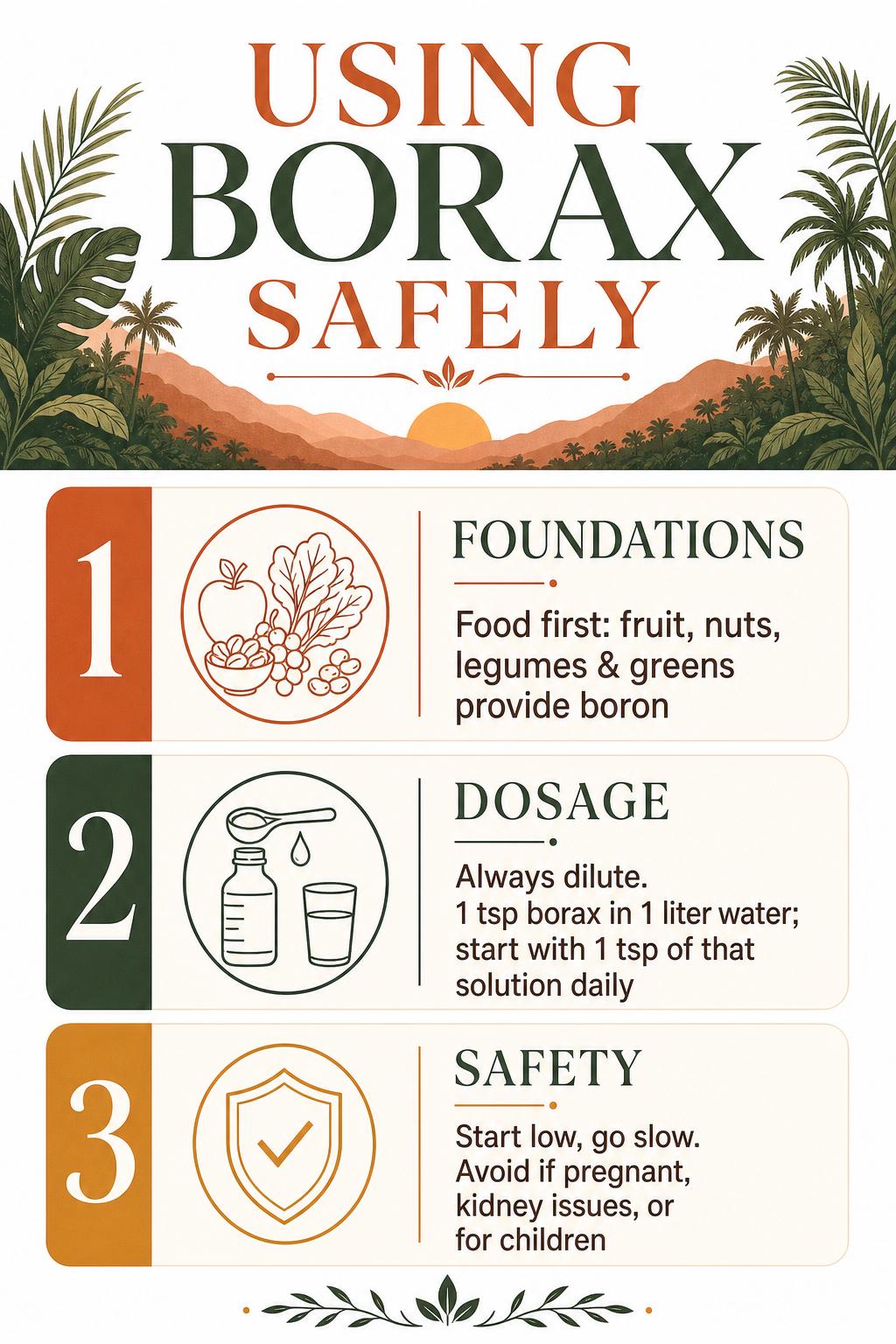
The grounded approach is food first, then tiny diluted doses: build a boron-aware plate of fruit, nuts, legumes, and greens, and — only if you choose to use borax — always dilute it (about 1 teaspoon of borax in 1 liter of water, then start with just 1 teaspoon of that solution per day). The guiding principle is start low, go slow, and certain groups should avoid it entirely.
Quick answer
- Borax is less acutely toxic than table salt by standard lab measures, but it should still be respected and never taken as dry powder.
- Avoid or use only under professional guidance if you are pregnant or trying to conceive, have kidney disease, are dosing children, or have hormone-sensitive conditions.
- Food first: raisins, prunes, apples, grapes, avocados, almonds, peanuts, chickpeas, and leafy greens are natural boron sources.
- Classic dilution method: dissolve ~1 tsp borax in 1 liter of water; take ~1 tsp of that concentrate daily — a few milligrams of boron.
- Start low, go slow. Common ranges run 3–6 mg/day for maintenance; higher amounts are short-term and supervised.
- This is a map of the territory, not a prescription.
By now you've seen why boron matters and how it touches joints, bones, hormones, brain, and mineral balance. This final part is about practicality: how boron is usually taken, what the safety data actually says, and how to approach borax in a grounded, low-risk way if you choose to use it.
How toxic is borax, really?
Toxicology uses a measurement called LD50 — the dose that would kill half of a test group of animals. The smaller the number, the more toxic the substance.
In those terms:
- Borax is less acutely toxic than table salt.
- You would need to ingest very large amounts of dry borax at once to approach dangerous territory.
- The wellness doses people use for boron support are tiny by comparison.
Regulatory agencies have set conservative upper limits for daily boron intake in humans. Typical wellness doses — especially when you start low and increase slowly — sit comfortably under those limits.
That said, there are still important cautions and groups who should not experiment casually.
Who should be cautious or avoid borax?
Strongly consider avoiding boron supplementation, or using it only under direct professional guidance, if you:
- Are pregnant or trying to conceive
- Have known kidney disease or significantly reduced kidney function
- Are considering giving supplements to children
- Are on hormone-sensitive medications or have hormone-sensitive cancers
- Have a history of unusual reactions to minerals or detox protocols
In these cases, food-only approaches or supervised protocols are safer than experimenting alone.
What foods are naturally high in boron?
Before looking at borax or supplements, it's wise to build a boron-aware plate. Foods naturally higher in boron include:
- Dried fruits like raisins and prunes
- Fresh fruits such as apples, pears, grapes, avocados, and peaches
- Nuts and legumes, especially almonds, peanuts, and chickpeas
- Leafy greens and other vegetables grown in mineral-rich soils
A day that includes a couple of servings of fruit, a handful of nuts or seeds, and some legumes can easily bring you into the 2–3 mg per day range that shows up in cognitive and bone research.
What is the classic borax dilution method?
For those who choose to use borax directly as a boron source, a common approach is to make a very dilute solution and measure from there:
- Dissolve about 1 level teaspoon of borax in 1 liter of clean water.
- Shake or stir until fully dissolved. This becomes a concentrate you use by the teaspoon, not by the glass.
- Start with just 1 teaspoon of this solution per day, taken in water or tea.
- Observe your body for a week or two before considering any increase.
That single teaspoon of concentrate delivers only a few milligrams of boron — small but meaningful, and typically under the upper safety limits.
Many people stay at 1 teaspoon per day for maintenance. Some slowly work up to 2–3 teaspoons per day, spaced out, when focusing on long-standing concerns like arthritis — always watching how their body responds.
What dose ranges do people use in practice?
People and practitioners often use rough ranges like these (including boron from both food and any borax solution or supplement):
- 3–6 mg boron per day: general maintenance, cognitive support, mild joint concerns
- 6–9 mg per day: more active support for joints, mineral and fluoride balance, hormonal support
- Above 10 mg per day: usually short-term and supervised, based on specific goals
The key principle is start low, go slow. Jumping straight to the higher end can trigger detox-type reactions (fatigue, mild headache, odd joint sensations) in sensitive people.
If you ever feel significantly worse rather than mildly uncomfortable, back the dose down or stop and consult a practitioner.
What are practical tips for taking borax safely?
- Always dilute: never take dry borax powder by mouth. Use a dilute solution.
- Take with food: this can reduce any stomach discomfort from the alkaline solution.
- Hydrate well: especially if you are using boron as part of a detox plan.
- Cycle usage: some people prefer 5 days on, 2 days off each week to give the body a rest.
- Keep away from children and pets: store borax like any household chemical or supplement.
When using supplements instead of borax (such as calcium fructoborate or boron citrate), simply follow label directions and your practitioner's guidance.
Which nutrients work well alongside boron?
Boron plays best on a team, not alone. If you're working intentionally on bones, joints, hormones, or mineral balance, it's wise to think about:
- Magnesium: foundational for hundreds of reactions, including vitamin D and calcium handling.
- Vitamin D3: works with boron to keep bones strong and support immunity.
- Vitamin K2: helps direct calcium into bones and away from arteries and joints.
- Zinc: supports immune function and hormone balance alongside boron.
A mineral-aware lifestyle — good food, sunlight, movement, stress management, clean water — will always do more than any single supplement by itself.
What can you expect over time?
When boron has been low for a long time and you restore it gently, people often report:
- Easing of morning joint stiffness
- More comfortable knees, fingers, and spine
- Clearer thinking and better recall
- More stable mood and better sleep
- Fewer recurring fungal concerns
These changes are usually gradual — think weeks and months, not days. Keeping a simple symptom journal can help you and your practitioner see patterns more clearly.
Bringing it all together
Borax is simply a natural mineral salt that happens to be a very economical way to deliver boron. Boron itself is a quiet regulator traditionally used to support how the body handles calcium, vitamin D, hormones, brain function, and mineral balance.
Used recklessly, like any substance, borax can cause problems. Used thoughtfully — in tiny doses, diluted, with respect for your body's pace — it can be a supportive tool inside a broader holistic program.
At Maya Mountain Naturals, the core philosophy is simple: restore what the modern world quietly removed, in forms the body recognizes, at doses that respect biology. Boron fits that philosophy well when approached with care.
Frequently asked questions
Frequently asked questions
Is borax safe to take internally?
By standard lab measures borax is less acutely toxic than table salt, but it must always be heavily diluted, used in tiny doses, and avoided by certain groups. Consult a professional first.
How do you make a borax solution for boron?
A common method is dissolving about 1 teaspoon of borax in 1 liter of clean water, then taking just 1 teaspoon of that concentrate per day.
How much boron per day do people use?
Typical ranges are 3–6 mg/day for general maintenance and 6–9 mg/day for more active support; above 10 mg/day is usually short-term and supervised.
Who should not use borax?
People who are pregnant or trying to conceive, have kidney disease, want to dose children, or have hormone-sensitive conditions should avoid it or use it only under professional guidance.
Can I just get boron from food?
Yes. Raisins, prunes, apples, grapes, avocados, almonds, peanuts, chickpeas, and leafy greens can easily provide a few milligrams of boron per day.
What nutrients pair well with boron?
Magnesium, vitamin D3, vitamin K2, and zinc all work alongside boron for bone, hormone, and mineral balance.
Is this medical advice?
No. This article is educational only and is not a prescription. Always consult a qualified health professional before starting any protocol.