Borax & Boron Series — Part 1: The Forgotten Mineral
What is borax and why does boron matter? Part 1 of our Borax & Boron series covers what borax is, where it comes from, how modern diets lost boron, and why it matters for joints, bones, and hormones.
Maya Mountain Naturals Knowledge Base · Borax & Boron Series — Part 1 of 3 · 9 min read
Educational use only. This article is shared for education and general interest. Nothing here is medical advice, and nothing here claims that borax or boron diagnoses, treats, cures, or prevents any disease. Always work with a qualified health professional before starting any new supplement or protocol.
What is borax, and why is boron worth knowing about?
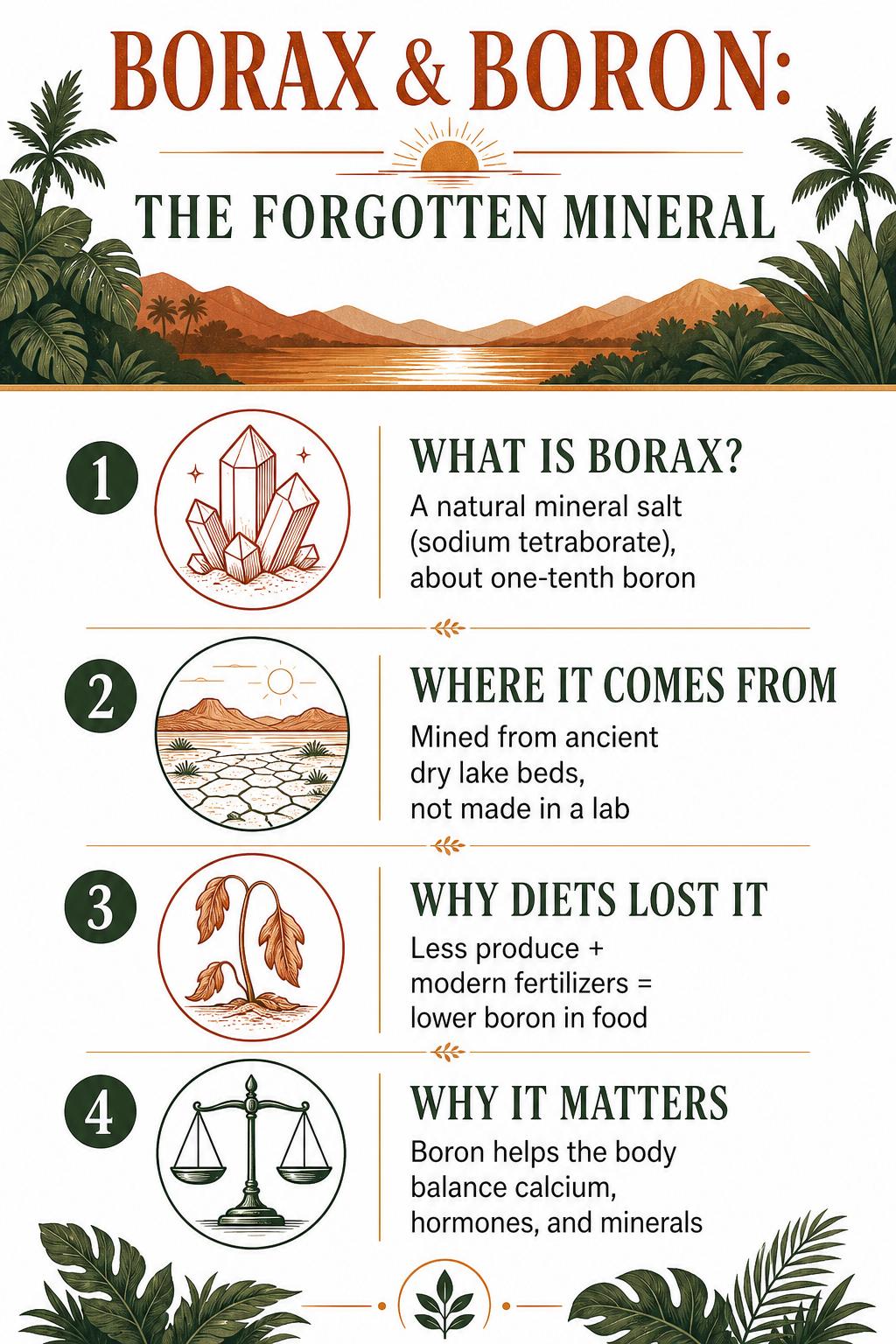
Borax is a naturally occurring mineral salt (sodium tetraborate) that is mined from ancient dry lake beds, and it is roughly one-tenth boron by weight — a trace mineral that modern diets have quietly lost. Boron is traditionally valued as a quiet "coordinator" that helps the body manage calcium, hormones, and other minerals, which is why borax and boron keep reappearing in stories about joints, bones, and hormone balance.
Quick answer
- Borax is a natural mineral salt called sodium tetraborate decahydrate — mined, not manufactured in a lab.
- In the stomach it converts into boric acid plus ordinary salt; the part the body uses is boron, a trace mineral.
- Borax is about one-tenth boron by weight, so a tiny amount of borax delivers a meaningful amount of boron.
- Traditional fruit-, nut-, and vegetable-rich diets supplied roughly 2–5 mg of boron per day; modern processed diets often supply far less.
- Boron is studied for its role in bone, joint, hormone, brain, and mineral balance — explored in Part 2.
- This is an educational overview, not a health recommendation.
What exactly is borax?
Borax is a naturally occurring mineral salt called sodium tetraborate decahydrate. It is mined from ancient lake beds and desert deposits, not built in a lab.
In the stomach, borax reacts with stomach acid and converts into boric acid plus ordinary table salt. From there, the active piece the body cares about is boron — a trace mineral that shows up in healthy plants, fruits, nuts, and soils.
Because borax is only about one-tenth boron by weight, a very small amount of borax can supply a meaningful dose of boron.
Where does borax come from, and how long have people used it?
Borax has been used by people for more than a thousand years.
It appears in historical medical texts from the Middle East as a healing compound long before anyone knew what "boron" was. Later it became a workhorse ingredient in glassmaking, metallurgy, and laundry — and quietly faded from view as a medicinal substance.
Much more recently, researchers and holistic practitioners noticed a pattern: people living where soils are boron-rich appeared to have far less arthritis and stronger bones than people in boron-poor regions. That observation helped open the door to modern boron research.
Why did modern diets become low in boron?
Traditional diets rich in fresh fruits, vegetables, legumes, and nuts can provide somewhere around 2–5 mg of boron per day.
Today many people eat less produce and more processed food. On top of that, modern chemical fertilizers tend to reduce how much boron plants pull from the soil. The result is a quiet nutritional gap:
- People on plant-rich, minimally processed diets often still get a few milligrams of boron daily.
- People living on refined foods, fast food, or institutional diets may get a fraction of that.
Over years and decades, this low-grade depletion is sometimes associated with joint stiffness, weaker bones, and slower healing — often without anyone ever being told they might be low in boron.
Who was Dr. Rex Newnham?
One of the key figures in modern boron awareness is Dr. Rex Newnham, a soil scientist who later retrained as an osteopathic and naturopathic doctor.
In the 1960s he lived in an area with very boron-poor soil and developed painful arthritis. Drawing on his background, he asked a simple question: "What is missing from my soil — and therefore from my food?"
His investigation led him to boron. He began taking a tiny daily amount of borax as a boron source and reported that his arthritis improved considerably. He then studied boron intake and arthritis rates across different countries and found the same pattern: low boron tracked with high arthritis; higher boron tracked with much lower arthritis.
While his work never became mainstream, it nudged many practitioners to take boron seriously and helped launch a wave of later research. (This is shared as history, not as a treatment claim.)
What does boron actually do in the body?
In simple terms, boron behaves like a quiet coordinator. It is not a drug; it appears to nudge systems back toward balance. Research has explored boron's role in helping the body:
- Manage calcium, magnesium, and phosphorus — key minerals for bones and teeth
- Support healthy parathyroid function, which helps keep calcium in bones rather than soft tissues
- Influence the metabolism of sex hormones, including testosterone and estrogen
- Activate vitamin D into its useful form
- Support brain function, attention, and short-term memory
- Show antifungal activity, particularly against Candida species
- Interact with fluoride, helping the body bind and excrete it
In Part 2 we unpack each of these areas in plain language and look at what the studies actually suggest.
Why haven't most people heard about boron?
There are a few straightforward reasons boron isn't on most people's radar:
- It's a trace mineral, not a headline nutrient like vitamin C or magnesium.
- It can't be patented, so there's little financial incentive to fund large clinical trials.
- Safety discussions have often focused on very high-dose animal studies, which don't reflect the tiny doses used in nutritional and wellness contexts.
None of this means boron is magic. It simply means it has been overlooked.
What's next in this series?
In Part 2, we explore the science behind boron and joints, bones, hormones, brain function, Candida and fungal balance, and fluoride and mineral balance.
In Part 3, we shift to practical, grounded guidance: food sources, traditional low-dose borax methods, safety, who should be cautious, and how to work with boron responsibly.
Frequently asked questions
Frequently asked questions
Is borax the same thing as boron?
No. Borax is a natural mineral salt (sodium tetraborate); boron is the trace mineral inside it. Borax is about one-tenth boron by weight.
Is borax natural or man-made?
It is a naturally occurring mineral salt mined from ancient dry lake beds and desert deposits, not manufactured in a lab.
How much boron did traditional diets provide?
Diets rich in fruit, vegetables, nuts, and legumes supplied roughly 2–5 mg of boron per day — more than many modern processed diets.
Why are modern diets low in boron?
People eat less produce and more processed food, and modern fertilizers reduce how much boron plants draw from the soil.
Who was Dr. Rex Newnham?
A soil scientist turned naturopathic doctor who, in the 1960s, popularized the modern interest in boron after studying its links to arthritis rates worldwide.
Is this article medical advice?
No. It is shared for education only. Always consult a qualified health professional before starting any supplement or protocol.