Borax & Boron Series — Part 2: How Boron Supports Your Body
How does boron support the body? Part 2 explores boron and joints, bones, hormone balance, brain function, candida support, and fluoride and mineral balance — in plain language.
Maya Mountain Naturals Knowledge Base · Borax & Boron Series — Part 2 of 3 · 11 min read
Educational use only. This article is shared for education and general interest. Nothing here is medical advice, and nothing here claims that boron diagnoses, treats, cures, or prevents any disease. Always work with a qualified health professional before starting any new supplement or protocol.
How does boron support the body?
Boron is a single trace mineral that research has connected to several systems at once — bones and joints, hormone balance, brain function, fungal balance, and mineral and fluoride balance. It doesn't act like a drug; instead, it appears to help the body use calcium, vitamin D, magnesium, and its own hormones more gracefully, which is why one quiet mineral keeps showing up across so many different health stories.
Quick answer
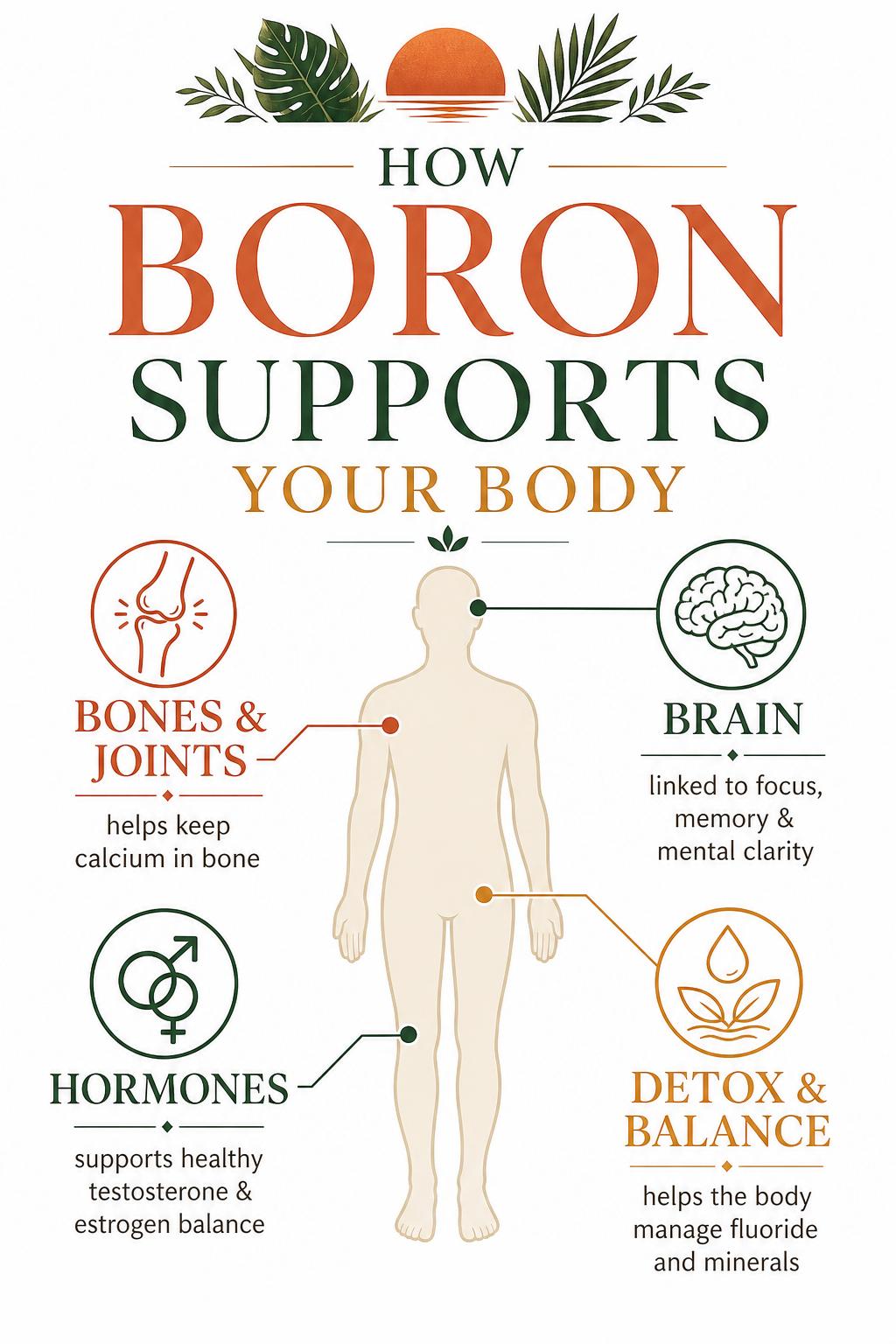
- Bones & joints: boron helps the body keep calcium locked in bone rather than drifting into soft tissue.
- Hormones: studies suggest modest boron supports healthy testosterone and estrogen balance and works alongside vitamin D and magnesium.
- Brain: controlled feeding studies link adequate boron with better attention, memory, and reaction time versus very low intake.
- Candida & fungus: boric acid (the form borax becomes) is studied for antifungal activity and disrupting fungal biofilms.
- Fluoride & minerals: boron can bind fluoride into complexes that are more easily excreted.
- This is educational context, not a diagnosis or treatment plan.
In Part 1 we looked at what borax and boron are and how modern diets slowly lost this mineral. Here we move system by system, in plain language, to understand why a single trace mineral shows up across so many different health stories.
How does boron support bones and joints?
Boron is best known for its connection to bones and joints.
One of its key roles is helping the parathyroid glands manage calcium correctly. When boron is low, the parathyroids tend to pull more calcium out of bones and teeth and leave more floating in the bloodstream. Over time, that pattern has been associated with:
- Thinner bones and slower fracture healing
- Stiff, uncomfortable joints
- Calcium deposits in soft tissues (such as joints, arteries, and kidneys)
When boron is adequate, more calcium tends to stay locked into bone where it belongs, and less ends up where it shouldn't.
Observational studies comparing different countries have found something striking: in regions with low soil and dietary boron, arthritis rates are high; in regions with higher boron, arthritis is far less common. This alone doesn't prove cause and effect, but combined with clinical trials it points toward boron mattering for joint health.
Can boron support healthy hormones?
Boron doesn't act like a hormone, but it appears to affect how your body handles the hormones you already produce.
Human studies have found that supplementing with modest amounts of boron may:
- Increase free (bioavailable) testosterone
- Decrease sex hormone-binding globulin (SHBG), a protein that "locks up" hormones
- Increase estradiol (a primary form of estrogen) in post-menopausal women
- Reduce inflammatory markers such as CRP and TNF-α
For men, this is traditionally associated with better energy, libido, and strength when combined with healthy lifestyle habits. For women, especially after menopause, boron is traditionally used to support bone density and general vitality by nudging estrogen and testosterone in a more youthful direction.
Boron also works together with vitamin D and magnesium. It helps activate vitamin D into its useful form, while magnesium helps both vitamin D and boron do their jobs. When people are low in all three, bone and hormone concerns often appear sooner.
Does boron affect the brain and mental clarity?
Boron's effect on the brain is one of the most under-reported areas of research.
Controlled feeding studies in humans have compared very low boron intake (around 0.25 mg per day) with more adequate intake (around 3 mg per day). The findings are consistent:
- Low boron intake is associated with slower reaction times and poorer manual dexterity.
- Attention, short-term memory, and long-term memory all performed worse on low boron.
- Brain-wave patterns on low boron resembled those seen in general malnutrition or heavy-metal exposure.
In practical terms, people who increase boron from very low to adequate often describe a mild but noticeable "lifting of brain fog": better focus, easier recall, and less mental fatigue.
Early work with boron-containing compounds is also exploring potential roles in protecting neurons and supporting healthy brain aging, though that research is still developing.
Does boron help with Candida and fungal balance?
Boron's antifungal activity comes mainly from boric acid — the form borax converts into in the body.
In the lab and in clinical use, boric acid has been shown to:
- Inhibit the growth of Candida species
- Interfere with Candida's ability to switch into its invasive "hyphal" form
- Disrupt fungal biofilms, the protective layers that make infections stubborn
- Help in cases where standard antifungal approaches no longer work
This is why boric acid vaginal suppositories are a well-established option in integrative and functional medicine for recurring, drug-resistant yeast concerns (used under professional guidance).
In broader wellness routines, low-dose boron is sometimes used as part of a whole-body antifungal strategy alongside diet changes, probiotics, gut support, and binders. It is not a stand-alone cure, but it is traditionally used as one piece of the puzzle.
How does boron relate to fluoride and mineral detox?
Fluoride accumulates in bones, teeth, and especially in the pineal gland — the small gland in the center of the brain that makes melatonin and helps regulate your sleep-wake cycle.
Boron has a unique chemistry here. It can bind fluoride to form boron-fluoride complexes that are more easily excreted in urine. In that sense it acts as a fluoride "antagonist," helping the body loosen and remove fluoride that has built up over time.
This is one reason boron shows up in many natural detox routines. It is usually combined with:
- Plenty of clean water
- Mineral support (especially magnesium)
- Gentle liver and kidney support
Fluoride detox is a long-term process, not a quick flush. Low-dose, steady support is the goal.
What about inflammation and the bigger picture?
Several human studies have found that boron can reduce key inflammatory markers in the blood. Lower inflammation is generally good news for joints and connective tissue, blood vessels, the brain and nervous system, and overall immune balance.
Step back and a pattern emerges. Boron is traditionally associated with helping the body:
- Place calcium where it belongs (in bones, not arteries or joints)
- Keep hormones in a more youthful, balanced range
- Support clear thinking and stable mood
- Keep fungi and other microbes from getting out of control
- Gently move out fluoride and support healthier mineral balance
It's not that boron "cures everything." It's that many modern concerns sit on top of a foundation of mineral imbalance — and boron is one of the minerals modern diets quietly forgot.
What can a "boron deficiency pattern" look like?
There is no official "boron deficiency disease," but based on research and clinical reports, people who benefit most from restoring boron often share several of these:
- Achy, stiff joints or diagnosed arthritis
- Low bone density or slow fracture healing
- Brain fog, poor short-term memory, or trouble focusing
- Low libido, low testosterone, or menopausal discomfort
- Recurring fungal or yeast concerns
- Sleep issues, especially trouble staying asleep
- Symptoms that don't respond well to vitamin D alone
If this cluster feels familiar, looking at your overall diet and mineral status — including boron — may be worthwhile, ideally with a practitioner.
What's next?
In Part 3, we move from "what boron does" to "how to work with it safely" — food sources, common low-dose borax methods, what the safety data really says, who should be cautious, and how to combine boron with other minerals for best effect.
Frequently asked questions
Frequently asked questions
How does boron support bone and joint health?
It helps the parathyroid glands manage calcium so more stays locked in bone rather than drifting into soft tissue, which is associated with stronger bones and more comfortable joints.
Does boron raise testosterone?
Human studies suggest modest boron can increase free testosterone and lower SHBG, supporting healthy hormone balance alongside good lifestyle habits.
Can boron help with brain fog?
Controlled studies link adequate boron with better attention, memory, and reaction time compared with very low intake; many people describe clearer thinking when restoring it.
Is boron antifungal?
Boric acid (the form borax becomes in the body) is studied for inhibiting Candida and disrupting fungal biofilms, and is used in integrative medicine for stubborn yeast concerns.
How does boron interact with fluoride?
Boron can bind fluoride into complexes that are more easily excreted, which is why it appears in many natural detox routines.
Does boron work better with other nutrients?
Yes — it works alongside vitamin D and magnesium, so addressing all three together tends to support bones and hormones more effectively.
Is this medical advice?
No. This article is educational only and does not diagnose, treat, or prescribe. Consult your own health professional first.