What's Really in Your Toothpaste? Heavy Metals, Hidden Toxins & Safer Alternatives
Independent lab testing found lead in 90% of toothpaste brands, plus arsenic, mercury, and cadmium. Here is what the research shows, why the mouth is a high-risk exposure route, which brands tested clean, and safer natural alternatives.
Maya Mountain Naturals Editorial · Published July 2026 · 11 min read
Quick answer
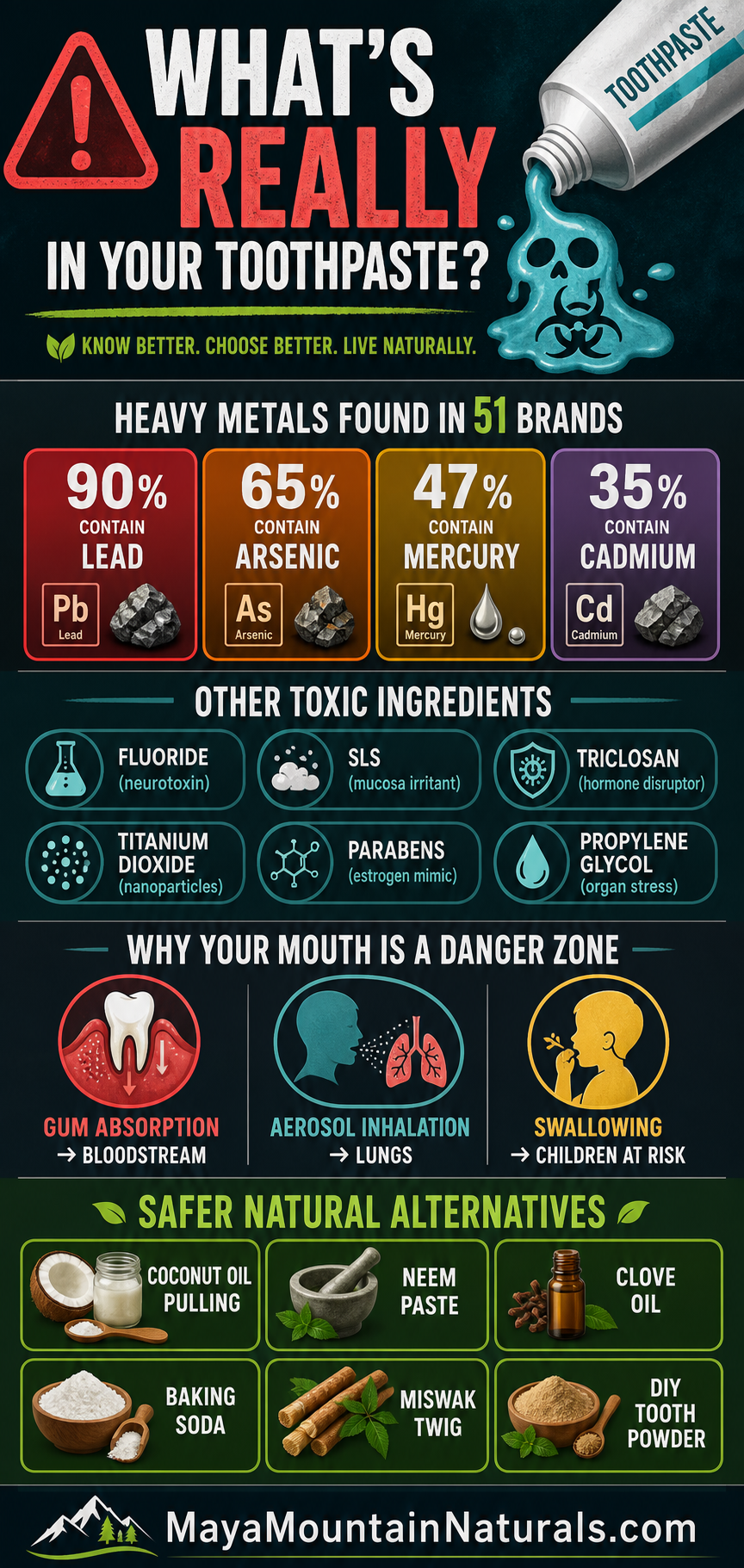
- Independent testing of 51 toothpaste brands in 2025 found lead in about 90%, arsenic in 65%, mercury in ~47%, and cadmium in ~35% — many brands carrying several metals at once.
- Contamination traces back to mineral raw materials like bentonite clay, hydroxyapatite, and calcium carbonate, so "natural" does not guarantee "clean."
- The mouth is a high-risk exposure route: the gums absorb substances directly into the bloodstream, brushing aerosolizes droplets into the lungs, and children routinely swallow toothpaste.
- Beyond metals, common additives — fluoride, SLS, triclosan, titanium dioxide, propylene glycol, and parabens — carry their own documented concerns.
- A few brands tested non-detect across all four metals, and simple natural options (neem, coconut oil pulling, clove oil, baking soda, miswak, DIY tooth powder) offer lower-exposure alternatives.
This article is educational only. It is not medical or dental advice. It summarizes published testing and peer-reviewed research so you can make informed product choices; it is not a diagnosis or treatment claim. Consult a dental or medical professional for personal guidance.
What Did the Toothpaste Testing Actually Find?
In early 2025, the independent consumer advocacy group Lead Safe Mama published results from testing 51 commercially available toothpaste brands, and the findings were alarming. Of the products tested, about 90% contained detectable lead, 65% contained arsenic, roughly 47% contained mercury, and about 35% contained cadmium. Many brands harbored multiple metals simultaneously.
Fifteen brands showed lead levels exceeding 300 parts per billion (ppb), with some surpassing 500 ppb. For context, the proposed Baby Food Safety Act set a 5 ppb limit for lead in children's food — yet the FDA currently permits up to 10,000 ppb in fluoride-free toothpaste and a staggering 20,000 ppb in fluoride-containing products.
These findings were not isolated. A peer-reviewed systematic review in Frontiers in Dental Medicine (Chengappa et al., 2025) synthesized 11 studies across multiple countries and confirmed that all included studies reported both essential and toxic heavy metals in toothpaste samples. Studies from Saudi Arabia found lead levels of 1,856–6,313 ppb and arsenic as high as 221.96 ppm — exceeding limits set by both the FDA and WHO. Well-known brands were among those flagged: Crest tested at 399 ppb lead and Tom's of Maine Kids at 240 ppb lead, with the highest contamination in powder-format products containing bentonite clay and hydroxyapatite.
Where Do the Heavy Metals Come From?
The contamination does not appear to be intentional — it traces back to the raw ingredient supply chain. Three commonly used toothpaste ingredients are consistently linked to the highest contamination levels:
- Bentonite clay — a natural cleaning and detoxifying mineral that carries trace heavy metals from its geological origin; products containing it showed the highest contamination across testing.
- Hydroxyapatite (HAp) — often derived from animal bone or synthetic sources and marketed as a fluoride alternative; independent testing of the raw material itself revealed significant lead contamination.
- Calcium carbonate — used as a mild abrasive and stain remover; also associated with elevated lead levels when tested as a standalone ingredient.
This means even products marketed as "natural" or "eco-friendly" are not exempt — in fact, their reliance on mineral-based ingredients may make some of them more contaminated than conventional brands. Natural does not guarantee clean.
Why Is Toothpaste Such a Dangerous Exposure Route?
Unlike food or supplements, toothpaste introduces heavy metals through multiple simultaneous pathways:
- Gum absorption — the oral mucosa is highly vascularized and permeable, so substances placed on the gums can be absorbed directly into the bloodstream, bypassing the digestive tract's detoxification filters.
- Aerosol inhalation — brushing creates micro-droplets that can be inhaled into the lungs.
- Ingestion — especially in children, who routinely swallow toothpaste while brushing.
The cumulative daily dosing across a lifetime compounds the risk. Unlike a one-time exposure, twice-daily brushing means continuous, low-level bioaccumulation — the same mechanism that makes heavy metals so dangerous in the first place.
What Are the Health Consequences of These Metals?
Each of the four major metals found in toothpaste carries distinct concerns:
- Lead — the CDC has stated there is no safe level of lead exposure. Childhood lead exposure disrupts brain development, and in adults it is linked to depression, anxiety, kidney damage, and cardiovascular disease. Children under 6 are most vulnerable.
- Mercury — a confirmed neurotoxin affecting the nervous system, kidneys, and respiratory function. Chronic low-level exposure — exactly what daily toothpaste use represents — is associated with cognitive decline, tremors, and immune suppression.
- Cadmium — eliminated extremely slowly, it accumulates in the kidneys, liver, and bones over years, contributing to bone demineralization, kidney dysfunction, and cardiovascular disease; it is also a known carcinogen.
- Arsenic — long-term exposure causes skin changes that can become cancerous, and the WHO lists bladder and lung cancer as outcomes of chronic arsenic exposure.
What Other Toxic Ingredients Should You Watch For?
Heavy metals are not the only concern. A range of synthetic additives present their own documented risks:
- Fluoride — a 2026 systematic review in Genetics and Molecular Biology confirmed excessive fluoride can induce oxidative stress, mitochondrial dysfunction, and neuronal damage, especially during brain development. A 2020 National Toxicology Program analysis of 149 human studies concluded fluoride was a "presumed developmental neurotoxin," and a 2025 EFSA assessment found dental fluoride can push 4–8-year-olds above tolerable upper intake levels.
- Sodium Lauryl Sulfate (SLS) — an industrial foaming detergent that causes shedding of the oral mucosa with regular use; SLS-free toothpaste significantly reduced canker sores in a meta-analysis.
- Triclosan — an antimicrobial linked to thyroid hormone disruption and antibiotic resistance; the FDA banned it in antibacterial soaps.
- Titanium dioxide (TiO₂) — a whitening agent whose nanoparticles have been linked to genetic and liver damage; the EU banned it from food in 2022, yet it remains in many oral care products.
- Propylene glycol — a surfactant and shelf-life extender that in larger quantities has been shown to stress the nervous system, liver, and kidneys.
- Parabens — preservatives that mimic estrogen and are absorbed through the oral mucosa into circulation.
Why Hasn't Regulation Caught Up?
The core problem is regulatory inadequacy. The FDA's current toothpaste lead limit of 20,000 ppb is 4,000 times higher than the proposed Baby Food Safety Act limit of 5 ppb. Unlike food — where heavy metal limits have been progressively tightened, with California imposing a 6 ppb limit for baby food lead — toothpaste falls into a regulatory grey zone.
Washington State enacted toothpaste-specific heavy metal limits in 2025, with several tested brands exceeding even those thresholds. Public health advocates have called FDA standards "woefully inadequate," and despite published, brand-level test results, no major manufacturer has taken voluntary action to reformulate.
Which Brands Tested Clean?
Not all toothpastes failed. Independent testing identified five products with non-detect results across all four metals (lead, arsenic, mercury, cadmium):
| Brand | Notes |
|---|---|
| Dr. Brown's Baby Toothpaste (Strawberry, fluoride-free) | Non-detect for all four metals |
| Miessence Mint Toothpaste (fluoride-free, Australian) | Non-detect for all four metals |
| Orajel Kids Training Toothpaste (fluoride-free, Natural Berry) | Non-detect for all four metals |
| Kid's Spry Tooth Gel with Xylitol (fluoride-free) | Non-detect for all four metals |
| Weleda | Non-detect for all four metals |
A key observation: all five clean-testing products are fluoride-free and contain no bentonite clay or hydroxyapatite. Xylitol, the natural sweetener used in some formulas, was identified as a non-contributing factor to metal contamination.
What Are the Safer Natural Alternatives?
For those seeking to step outside the commercial toothpaste system, several evidence-backed natural approaches exist:
- **Neem (Azadirachta indica)** — used in traditional Ayurvedic dentistry for millennia; research shows neem paste and mouthwash reduce plaque, help prevent caries, and calm gum inflammation through antibacterial and anti-inflammatory compounds.
- Coconut oil pulling — swish about 1 tablespoon of unrefined coconut oil for 10–20 minutes daily; its lauric acid has documented antimicrobial activity, and studies show oil pulling reduces plaque, gingivitis, and bleeding gums.
- Clove oil — the active compound eugenol is a well-documented analgesic, anti-inflammatory, and antimicrobial agent, historically used as a base for dental anesthetics.
- Baking soda (sodium bicarbonate) — mildly abrasive and antibacterial; neutralizes acidic pH. Use periodically rather than daily, as it can be too abrasive long-term.
- **Miswak (Salvadora persica)** — traditional cleaning twigs rich in phenolic compounds, flavonoids, and tannins; research confirms they reduce plaque and fight gingivitis.
- DIY remineralizing tooth powder — a simple home formula combining clean-tested calcium carbonate, baking soda, xylitol, clove or peppermint essential oil, and coconut oil.
If you use bentonite clay or hydroxyapatite in DIY formulas, source only from suppliers providing Certificates of Analysis (COAs) with heavy metal test results.
What Are the Practical Next Steps?
- Audit your current toothpaste against Lead Safe Mama's published testing chart and EWG's Skin Deep database.
- Switch to a clean-tested brand or a DIY powder for daily use.
- Prioritize children immediately — developing nervous systems and natural swallowing create disproportionate risk.
- Choose fluoride-free, SLS-free, clay-free formulas unless the brand provides third-party COAs confirming clean sourcing.
- Incorporate oil pulling as a complementary practice for oral microbiome health.
- Demand ingredient transparency — favor brands that publish batch-level heavy metal testing.
The daily ritual of brushing, done in complete trust of a product on every pharmacy shelf, may be delivering a compounding load of heavy metals — twice a day, every day. The research is no longer preliminary, and the regulatory framework is decades behind the science. Until that changes, the most protective action is informed product selection, natural alternatives, and demanding manufacturer transparency.
Frequently asked questions
Which toothpaste brands contain heavy metals?
Independent 2025 testing of 51 brands found lead in about 90%, arsenic in 65%, mercury in ~47%, and cadmium in ~35%, with many carrying several metals at once. Named examples included Crest (399 ppb lead) and Tom's of Maine Kids (240 ppb lead); powder formats with bentonite clay or hydroxyapatite were the most contaminated.
Are natural toothpastes safer than conventional ones?
Not automatically. Contamination traces to mineral raw materials like bentonite clay, hydroxyapatite, and calcium carbonate, so some "natural" products tested more contaminated than conventional ones. Look for brands that publish third-party heavy metal Certificates of Analysis rather than relying on marketing labels.
Why is toothpaste a risky way to be exposed to heavy metals?
The mouth exposes you through three pathways at once — gum tissue absorbs substances directly into the bloodstream, brushing aerosolizes droplets you can inhale, and toothpaste is often swallowed, especially by children. Twice-daily use means continuous, low-level bioaccumulation over a lifetime.
Is fluoride in toothpaste harmful?
Reviews raise real concerns. A 2020 National Toxicology Program analysis called fluoride a "presumed developmental neurotoxin," and a 2025 EFSA assessment found dental fluoride can push young children above tolerable intake levels. Many people choose fluoride-free options, particularly for children who swallow toothpaste.
Which toothpastes tested clean for heavy metals?
Five products tested non-detect across lead, arsenic, mercury, and cadmium: Dr. Brown's Baby Toothpaste (Strawberry), Miessence Mint, Orajel Kids Training (Natural Berry), Kid's Spry Tooth Gel with Xylitol, and Weleda. All are fluoride-free and free of bentonite clay and hydroxyapatite.
What natural alternatives can replace commercial toothpaste?
Evidence-backed options include neem, coconut oil pulling, clove oil, periodic baking soda, miswak twigs, and DIY remineralizing tooth powder made with clean-tested ingredients. These lower chemical exposure while supporting oral microbiome health.
Sources: Lead Safe Mama independent lab testing (2025); Chengappa et al., Frontiers in Dental Medicine (2025); The Guardian investigative reporting (April 2025); Fortune Health (2025); NTP Fluoride Systematic Review; EFSA Fluoride Risk Assessment (2025); and NIH/PubMed peer-reviewed studies on fluoride neurotoxicity, SLS oral effects, and titanium dioxide safety.