The "-itis" Illusion: It's Not a Disease, It's Inflammation
Arthritis, dermatitis, gastritis, colitis — the "-itis" suffix simply means inflammation. Understand inflammation as the body's adaptive response, not the problem itself.
Quick answer
- The suffix '-itis' simply means inflammation — arthritis, dermatitis, gastritis, colitis are all descriptions, not root causes.
- Inflammation is the body's repair signal, not the enemy; suppressing it without removing the trigger creates new problems.
- The most common upstream triggers: industrial seed oils, refined sugar, hidden food sensitivities, poor sleep, chronic infections, and unresolved stress.
- Removing triggers usually does more than any anti-inflammatory pill or supplement.
- Traditionally used anti-inflammatory allies include turmeric, ginger, boswellia, and omega-3-rich whole foods.
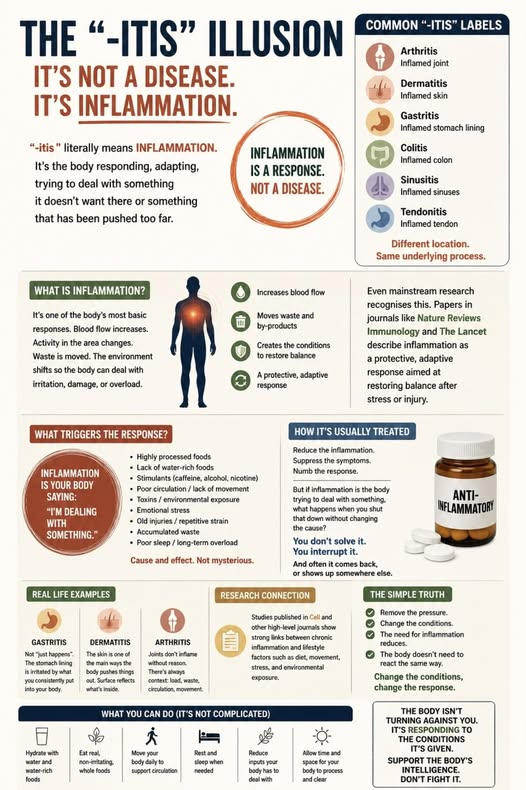
Shared with credit to Steve V. Graham and his Facebook page Natural Body Intelligence. All credit for the original writing belongs to the author.
Most people don''t realise this… but a huge number of so-called "diseases" are just labelled with one simple word ending: "-itis".
Arthritis, dermatitis, gastritis, colitis, sinusitis, tendonitis.
It sounds complex. It sounds medical. It sounds like something has gone wrong. But "-itis" literally just means inflammation. That''s it.
Inflammation Is a Process, Not a Disease
Inflammation is not a disease. It''s a process. It''s the body responding, adapting, trying to deal with something it doesn''t want there or something that''s been pushed too far.
- When you hear "gastritis", what you''re really hearing is an inflamed stomach lining.
- When you hear "dermatitis", it''s inflamed skin.
- When you hear "tendonitis", it''s an inflamed tendon.
The label makes it sound like a condition in itself. But it''s just describing what is happening, not why it''s happening. And that''s the part most people never get shown.
What Inflammation Actually Does
Inflammation is one of the most basic responses the body has. Blood flow increases. Activity in the area changes. Waste is moved. The environment shifts so the body can deal with irritation, damage, or overload.
Even mainstream research recognises this. Papers in journals like Nature Reviews Immunology and The Lancet describe inflammation as a protective, adaptive response aimed at restoring balance after stress or injury.
It''s not random. It''s not the body failing. It''s the body doing something very deliberate.
How Most "-itis" Conditions Get Treated
Reduce the inflammation. Suppress the symptoms. Numb the response.
But if inflammation is the body actively trying to deal with something, what happens when you shut that down without changing the cause?
You don''t solve it. You interrupt it.
And often it comes back, or shows up somewhere else.
Bring This Into Real Life
Someone eats highly processed food, low in water-rich foods, high in stimulants, day after day. The stomach lining becomes irritated. The body responds. That response gets labelled gastritis.
Nothing new has appeared. The body is reacting to what''s consistently been put into it.
Or take dermatitis. The skin becomes red, irritated, active. The body is using the surface to deal with internal load. The label changes nothing about what''s actually happening.
Or arthritis. Joints become inflamed. But joints don''t just decide to inflame for no reason. There''s always context — load, restriction, poor circulation, accumulated waste, lack of movement.
The body adapts. It responds. It tries to manage the situation.
Even broader research, including work published in Cell, links chronic inflammation to lifestyle patterns such as diet, movement, stress, and environmental exposure.
It''s not mysterious. It''s cause and effect.
The Question Shifts
Not "How do I get rid of inflammation?"
But "What is the body responding to?"
Because when that changes, the need for inflammation reduces.
Remove the pressure, and the body no longer needs to react in the same way.
What You Can Do (It''s Not Complicated)
- Hydrate with water and water-rich foods
- Eat real, non-irritating, whole foods
- Move your body daily to support circulation
- Rest and sleep when needed
- Reduce inputs your body has to constantly deal with
- Allow time and space for your body to process and clear
These are basic things. But they''re often ignored.
Instead, people get stuck managing labels. Arthritis. Sinusitis. Colitis. As if each one is a completely different problem.
They''re not.
Different location. Same underlying process.
The Simple Truth
The body isn''t turning against you. It''s responding to the conditions it''s given.
Change the conditions, and the response changes.
That''s the part most people never hear. Not because it''s complicated. Because it''s actually very simple.
---
Original article shared via Facebook. Reposted here for educational purposes — full credit to the original author.
Frequently Asked Questions
Frequently asked questions
Is inflammation always bad?
No. Acute inflammation is how the body heals injuries and fights infection. Chronic, low-grade inflammation that never shuts off is the harmful kind.
Why do anti-inflammatory drugs sometimes make things worse long-term?
They suppress the signal but leave the trigger in place. Over years this can damage the gut lining, kidneys, and cardiovascular system.
What triggers chronic inflammation most often?
In modern life: ultra-processed seed oils, refined sugar, alcohol, broken sleep, sedentary days, and unresolved psychological stress are the heavy hitters.
How do I know if I have systemic inflammation?
A high-sensitivity CRP (hsCRP) blood test, ferritin, and waist measurement give a useful starting picture.
Which herbs are traditionally used to calm inflammation?
Turmeric, ginger, boswellia, holy basil, and rosemary are well-studied. They work best alongside removing the upstream triggers.
Will diet alone fix it?
Often it's the single biggest lever, but sleep and stress recovery are usually needed for full resolution.