Balance: The Hidden Key to a Healthy Heart and a Sharp Mind
Your ability to stand steady is a powerful early signal of heart, brain, and nervous-system health. Here is the science linking balance to cardiovascular and dementia risk — plus at-home tests and 8 simple balance exercises that raise BDNF and help the brain rewire itself.
Maya Mountain Naturals Editorial · Published July 2026 · 12 min read
Quick answer
- The way your body stays upright is one of the clearest everyday windows into the health of your heart, brain, and nervous system — poor balance can predict cardiovascular events and cognitive decline years before other symptoms appear.
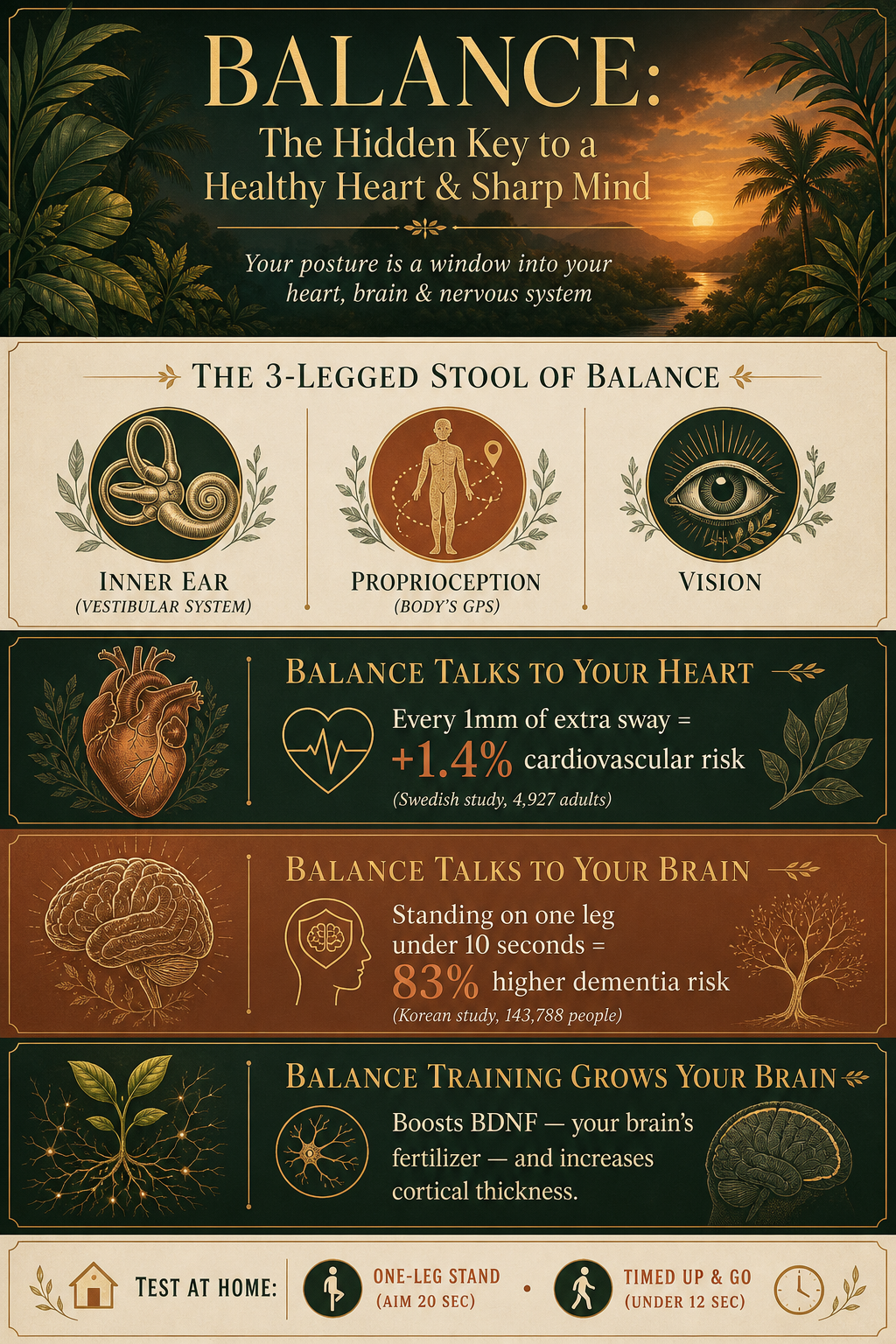
- Balance rests on a "three-legged stool": the inner ear (vestibular system), proprioception (your body's position sense), and vision — all integrated by the brainstem and cerebellum dozens of times per second.
- Research links greater standing sway to higher cardiovascular risk, and the inability to stand on one leg for 10+ seconds to a markedly higher risk of dementia.
- The encouraging part: balance is highly trainable at any age. Balance training raises BDNF (the brain's growth factor) and can increase cortical thickness — literally helping the brain rewire itself.
- Simple daily practices — one-leg stands, heel-to-toe walking, Tai Chi, ankle drills — done for just 10–15 minutes can make a measurable difference.
This article is educational only. It is not medical advice and does not diagnose, treat, cure, or prevent any disease. If you have frequent dizziness, unexplained falls, or significant balance changes, consult a qualified healthcare professional.
Why Balance Matters Way More Than You Think
Most of us only think about balance when we almost trip over the cat or wobble getting out of bed in the morning. But here's something that might genuinely surprise you: the way your body holds itself upright — right now, as you read this — is one of the most revealing windows into the overall health of your heart, your brain, and your nervous system.
Balance is not just a "fall prevention" issue. It is a full-body signal. Every fraction of a second, your brain is pulling information from your inner ear, your eyes, your joints, and your muscles — processing all of it in real time — just to keep you standing. When any part of that system starts to weaken, the ripple effects reach far beyond a wobbly step. New science is showing that poor balance predicts cardiovascular events, accelerated cognitive decline, and even future dementia — often years before any other symptoms appear.
This is genuinely good news, because balance is also one of the most trainable, most improvable aspects of your health — at any age.
How Your Balance System Actually Works
Think of balance as a three-legged stool. Remove one leg and the whole thing tips over.
Leg 1 — The Inner Ear (Vestibular System)
Deep inside each ear sits a tiny fluid-filled labyrinth made up of three semicircular canals and two otolith organs. When your head moves, the fluid inside these canals lags behind slightly due to inertia, bending microscopic hair cells. Those hair cells fire nerve signals to your brain, telling it exactly which direction you're moving and how fast. The otolith organs do the same for straight-line motion — like when an elevator drops or a car accelerates.
Leg 2 — Proprioception (Your Body's GPS)
Sensors in your muscles, tendons, and joints constantly report your body's position back to your brain. This system — called proprioception — is why you can touch your nose with your eyes closed. It tells your brain where every part of you is in space at all times.
Leg 3 — Vision
Your eyes cross-check what the inner ear and joints are reporting. When you close your eyes, your brain loses one of its three balance inputs — which is why standing on one leg is much harder with eyes closed than with eyes open. This is also precisely why researchers use the "eyes closed" balance test to expose hidden instability that you'd never notice in daily life.
All three signals converge in the brainstem and cerebellum, are cross-referenced, then sent to the muscles with correction commands — dozens of times per second. It is an extraordinarily complex, elegant system, and it begins to slow down with age, starting around the mid-40s, when the vestibular system's sensitivity starts to quietly decline.
Your Balance Is Talking to Your Heart
This is where it gets fascinating. The vestibular system doesn't just talk to your muscles — it's directly wired into your autonomic nervous system, the system that controls heart rate, blood pressure, and blood vessel tone. Called the vestibulo-sympathetic reflex (VSR), this connection means your inner ear actively helps regulate cardiovascular responses every time you change position — standing up, bending over, turning around.
When this connection weakens, cardiovascular regulation becomes less precise. This may be one reason that poor balance turns out to be a strong predictor of heart disease.
What the Research Found
A landmark September 2024 study published in the Journal of the American Heart Association, conducted by researchers in Umeå, Sweden, tracked 4,927 adults aged 70 — all healthy at the start, with no prior history of heart attack, angina, or stroke. They measured how much each person swayed during a simple balance test, both with eyes open and eyes closed.
The results were striking:
- For every 1 millimeter of extra lateral (side-to-side) sway with eyes open, cardiovascular disease risk increased by 1.4%
- With eyes closed, that figure rose to 1.5% per millimeter — and up to 1.8% after accounting for short follow-up periods
- People in the top quarter for lateral sway had significantly higher rates of hospitalization for heart attack, stroke, or angina than those in the lowest quarter
- Balance testing explained about 10% of cardiovascular risk across the entire study population — placing it among the four strongest predictors of CVD, alongside being male, and taking medications for high blood pressure or blood clots
- Even forward-backward (anterior-posterior) instability with eyes closed predicted CVD — a pattern reflecting instability invisible to routine medical exams
The message is clear: the way your body sways while standing still is not random noise. It reflects the health of the entire system that keeps both your posture and your cardiovascular function regulated.
Your Balance Is Talking to Your Brain
The brain connection may be even more important — and more urgent to understand.
Balance depends on the brain's ability to integrate signals from three different sensory systems simultaneously and respond with perfectly timed motor commands. It is, in many ways, a stress test for the brain itself. When those neural circuits are starting to deteriorate, balance goes first — often before memory problems, confusion, or any of the classic signs of cognitive decline that families and doctors watch for.
The Korean Study: 143,788 People, One Powerful Conclusion
A January 2024 analysis published in The Journal of Prevention of Alzheimer's Disease examined 143,788 Korean adults, all assessed at age 66. Researchers measured their ability to stand on one leg and then followed them forward to track who developed dementia.
Here's what they found:
- People who could stand on one leg for less than 10 seconds had a dementia rate more than twice as high as those who could hold it for 20 seconds or longer
- The "cautious" group — holding the position for 10 to 19 seconds — still had a 28% higher dementia risk compared to the strongest balancers
- Overall, those with balance impairment had an 83% higher risk of all-cause dementia
- Risk of Alzheimer's disease was 80% higher
- Risk of vascular dementia was nearly three times higher
The researchers point to two key mechanisms: white matter lesions and gray matter atrophy. White matter lesions — small patches of damage to the brain's signal-carrying fibers — are associated with small-vessel disease and appear in aging brains, particularly when vascular health is poor. They affect the frontal-subcortical circuits that control both movement and decision-making, which is why balance troubles and cognitive difficulties often arrive as a package deal.
Gait Speed Matters Too
A supporting August 2024 study in the Journal of Gerontology, drawing on over 9,000 older adults tracked for up to 15 years, confirmed and expanded these findings:
- People who struggled with a semi-tandem stance (one foot slightly ahead of the other) had a two to three times higher risk of developing dementia
- Slower walking speed was associated with a 52–73% greater likelihood of dementia onset
- Poor performance on the chair stand test (a measure of leg strength) was linked to a 56% higher risk of dementia
Gait speed is so reliable that research shows it slows up to 7 years before the clinical onset of dementia — making it one of the most actionable early warning signs available.
The BDNF Connection: Balance Training Literally Grows Your Brain
Here is perhaps the most encouraging piece of this entire picture. Balance training doesn't just prevent decline — it actively stimulates the brain to grow and rewire itself.
A 2019 study published in the Journal of Clinical Medicine found that 12 weeks of systematic balance training in older adults significantly increased serum levels of BDNF (Brain-Derived Neurotrophic Factor) — sometimes called the brain's "fertilizer." BDNF promotes the growth of new neurons, strengthens synaptic connections, and helps the brain repair itself from age-related wear.
A 2018 study published in NeuroImage found that balance training actually increased cortical thickness in regions associated with visual processing, vestibular self-motion perception, spatial orientation, and memory. These are the same brain regions that deteriorate earliest in cognitive decline. The group that did balance training also showed changes in the putamen — a deep brain region involved in motor learning and habit formation.
A broader 2025 meta-analysis of 35 randomized controlled trials confirmed that exercise training — particularly at 12 weeks duration, 3–4 sessions per week — significantly increases BDNF levels in older adults. Balance-style exercises, mind-body practices, and combined training all produced meaningful BDNF increases.
In short: every time you challenge your balance, you are sending a growth signal to your brain.
Test Your Balance at Home — Right Now
Dr. Greg W. Hartley, a physical therapy professor at the University of Miami, recommends these two simple self-assessments. You don't need any equipment — just a safe space and a wall nearby.
Test 1 — The One-Leg Stand (10-Second Rule)
Stand near a wall or chair for safety. Lift one foot and try to balance on the other leg for 10 seconds — without grabbing support. If you can do it, you're in a healthy range. If you wobble or grab within 10 seconds, that's a meaningful signal worth paying attention to. For reference, the large Korean study used 20 seconds as the benchmark for the lowest dementia risk.
Make it harder: Try it with your eyes closed. This removes the visual aid your brain normally uses and gives you a truer picture of your vestibular and proprioceptive health.
Test 2 — The Timed Up and Go (TUG)
Sit in a chair, stand up, walk 10 feet (about 3 meters), turn around, walk back, and sit down again. Time yourself.
- Under 12 seconds: You're in good functional balance territory
- 12–15 seconds: Moderate caution area — worth working on balance training
- Over 15 seconds: Impaired balance — see a healthcare professional and begin balance work immediately
8 Practical At-Home Balance Exercises for Older Adults
These exercises are specifically designed to be safe, doable, and effective for people over 50 — no gym required. Start with exercises 1 through 4, and add the rest as your confidence and strength grow. Always perform balance exercises near a wall, sturdy chair, or countertop until you feel secure.
🦶 Exercise 1 — Heel-to-Toe Walking (Tightrope Walk)
What it does: Trains your brain's spatial processing, sharpens coordination, and challenges your center of gravity.
How to do it:
- Find a clear stretch of floor — a hallway is perfect.
- Place the heel of your right foot directly in front of the toes of your left foot.
- Continue stepping, heel-to-toe, for 20 slow, deliberate steps.
- Keep your eyes fixed on a point straight ahead.
- Let your arms hang relaxed at your sides.
Frequency: Once or twice daily. You can progress by doing it along a line on the floor, or eventually with eyes closed for a few steps.
🪑 Exercise 2 — Chair-Supported Squats
What it does: Builds the leg strength and neuromuscular coordination that protect balance from below. Leg strength loss is directly linked to dementia risk.
How to do it:
- Stand behind a sturdy chair with both hands resting lightly on the back.
- Place feet hip-width apart, toes pointing slightly outward.
- Slowly lower yourself as if sitting down — stop before you fully sit.
- Pause briefly, then press through your heels to stand back up.
- Start with 5 repetitions and work up to 15 over several weeks.
Safety note: Never let your knees go past your toes. Keep your back tall. Lower only as far as is comfortable.
⚖️ Exercise 3 — Single-Leg Stand (Supported to Unsupported)
What it does: The same movement as your balance test, used therapeutically. Even brief daily practice produces measurable improvements in vestibular and proprioceptive function.
How to do it:
- Stand next to a wall or chair, fingertips touching lightly for safety.
- Slowly lift one foot, bending your knee to bring the foot off the floor.
- Hold for 10–30 seconds (whatever is safe and comfortable).
- Switch legs. Repeat 2–3 times per leg.
Progress: Gradually reduce the support — fingertips only, then one finger, then no contact. Eventually try it with eyes closed for 5–10 seconds.
✍️ Exercise 4 — Ankle Alphabet
What it does: Weak ankles are a primary cause of instability. This simple seated drill strengthens the small muscles around each ankle joint.
How to do it:
- Sit comfortably in a chair with feet flat on the floor.
- Lift one foot slightly off the floor.
- Using your foot as a "pen," trace the letters of the alphabet in the air — A through Z — making the movements as large as you comfortably can.
- Switch feet and repeat.
Frequency: Once daily with each foot. You can do this while watching TV or reading — zero excuse not to do it!
🌊 Exercise 5 — Seated Stability Ball Sitting
What it does: Activates deep core muscles, challenges your postural reflexes, and builds full-body stability without impact stress on joints.
How to do it:
- Sit on a stability ball (45–55 cm diameter for most people), feet flat on the floor.
- Sit tall with your hands resting on your thighs or lightly at your sides.
- Hold the position for 30 seconds at first, building up to 2–3 minutes.
- Progress by gently shifting your weight side to side, or lifting one foot slightly off the floor.
Don't have a ball? Sitting on the edge of a firm cushion placed on a chair creates a similar, gentler effect.
🥋 Exercise 6 — Gentle Tai Chi or Slow Flow Movements (5–10 Minutes)
What it does: Tai Chi is, by a significant margin, the most evidence-backed exercise for balance in older adults. A randomized trial published in JAMA Internal Medicine found that Tai Chi practitioners had 58% fewer falls than a stretching group and 31% fewer falls than a mixed-exercise group. It blends slow weight-shifting, breathing, and coordination in a way no other exercise matches.
How to do it at home:
- Search YouTube for "Tai Chi for beginners seniors" — dozens of free, seated and standing versions are available.
- Start with just 5–10 minutes, 3 times per week.
- Focus on slow, deliberate weight shifts from foot to foot, gentle arm movements, and steady breathing.
- No prior experience is needed — the movements are designed to be accessible.
Research shows yoga produces comparable balance benefits and is equally effective. Even a few minutes of slow, mindful movement done daily creates measurable improvements over time.
🚶 Exercise 7 — Side Steps and Lateral Walking
What it does: Most balance exercises work in a forward-backward direction. Side-to-side (lateral) stability is equally important — and, as the Swedish CVD study showed, lateral sway is the specific type most strongly linked to cardiovascular risk.
How to do it:
- Stand near a wall or counter for safety.
- Step to the right with your right foot, then bring your left foot to meet it.
- Take 10–15 steps to the right, then 10–15 steps back to the left.
- Keep knees slightly soft (never locked) and move at a slow, controlled pace.
Progress: Add a slight pause mid-step with one foot in the air before placing it down.
🦵 Exercise 8 — Tandem (Semi-Tandem) Standing
What it does: The semi-tandem stance — one foot slightly ahead of the other — is the specific balance test used in the Journal of Gerontology study that showed a two-to-three times higher dementia risk in those who struggled with it. Practicing it directly trains that pattern.
How to do it:
- Stand near a wall or chair.
- Place your right foot directly in front of your left, with your right heel touching the toes of your left foot (tandem) — or slightly offset (semi-tandem, which is easier and safer to start).
- Hold for 10–30 seconds.
- Switch foot positions and repeat.
- Progress toward eyes closed as you build confidence.
Quick Reference: At-a-Glance Exercise Guide
| Exercise | Primary Benefit | Equipment | Difficulty |
|---|---|---|---|
| Heel-to-Toe Walk | Brain coordination, spatial processing | None | Easy |
| Chair Squats | Leg strength, neuromuscular coordination | Sturdy chair | Easy–Moderate |
| Single-Leg Stand | Vestibular + proprioceptive training | Wall/chair | Moderate |
| Ankle Alphabet | Ankle strength, stability | Chair | Very Easy |
| Stability Ball Sitting | Core activation, postural reflexes | Stability ball | Easy–Moderate |
| Tai Chi / Slow Flow | Full-body balance, brain rewiring | None (YouTube) | Easy |
| Lateral Side Steps | Side-to-side cardiovascular balance | Wall/counter | Easy |
| Tandem Standing | Dementia-risk pattern training | Wall/chair | Moderate |
The Brain-Balance Feedback Loop: Putting It All Together
Here is the most empowering takeaway from all of this research. Balance and brain health are not a one-way street. Yes, declining brain health leads to declining balance. But the reverse is equally true: improving balance actively strengthens the brain.
When you practice balance exercises, you're stimulating the cerebellum, the vestibular cortex, the hippocampus (your memory center), and the prefrontal cortex — all at the same time. You're boosting BDNF, the molecule your brain uses to grow new neurons and repair old connections. You're strengthening the same frontal-subcortical circuits that, when damaged, give rise to both motor instability and cognitive decline.
The people in the research who maintained 20+ seconds on a one-leg stand had dramatically lower dementia rates — not because they happened to have healthier brains, but very likely because their ongoing physical habits were protecting and stimulating their brains all along.
This is what integrated health looks like. Not one system in isolation, but heart, brain, vestibular system, muscles, and nerves all speaking to each other in real time — and balance training is one of the simplest, most effective ways to keep that conversation healthy.
Signs It May Be Time to See a Professional
While the exercises above are designed for general wellness and are safe for most older adults, certain signs are worth discussing with a healthcare provider:
- You cannot stand on one leg for 5 seconds or more without grabbing support
- You completed the TUG test in over 15 seconds
- You experience frequent dizziness, vertigo, or sudden balance loss
- You've had one or more unexplained falls in the past year
- You've noticed significant changes in your walking pace or gait
A physical therapist or vestibular rehabilitation specialist can provide a full assessment and a customized program. Many conditions contributing to poor balance — including inner ear dysfunction, vitamin D deficiency, medication side effects, and vascular issues — are highly treatable when caught early.
Key Takeaways for Your Health
- Balance is a whole-body health signal, not just a fall-prevention concern
- Lateral sway during standing predicts cardiovascular disease risk in people with no prior heart conditions
- Poor one-leg balance at age 66 is associated with up to an 83% higher risk of dementia
- Slow walking speed predicts cognitive decline 7 years before symptoms appear
- Balance training increases BDNF — the brain's growth factor — and literally increases cortical thickness
- Tai Chi reduces falls by 58% compared to stretching alone, making it the gold standard for balance practice
- Simple daily exercises done consistently — even just 10–15 minutes — make a meaningful and measurable difference
Sources: J Am Heart Assoc. 2024 Oct;13(19):e035073 | J Prev Alzheimers Dis. 2024;11(1):130-137 | J Gerontol A Biol Sci Med Sci. 2024 Aug 1;79(8):glae165 | NeuroImage 2018 | J Clin Med 2019;8(11):1910 | JAMA Internal Medicine 2018 | J Gerontol 2017;72(5):655-661 | InformedHealth.org | OpenLearn — The Open University
This article is for educational purposes and is part of the Maya Mountain Naturals Vital Codex Knowledge Base. It is not intended as medical advice.
---
Frequently asked questions
Why does balance predict heart and brain health?
Balance depends on your inner ear, muscles, eyes, and the brain circuits that integrate them — and the vestibular system is directly wired into the autonomic nerves that regulate heart rate and blood pressure. When those systems weaken, both cardiovascular regulation and the brain networks behind movement and thinking are affected, so instability often shows up before other symptoms.
How long should I be able to stand on one leg?
In a large Korean study, holding a one-leg stand for 20 seconds or longer was linked to the lowest dementia risk, while under 10 seconds was associated with more than double the risk. As a quick home check, aim to hold it for at least 10 seconds without grabbing support, and work toward 20.
What is the Timed Up and Go (TUG) test?
Sit in a chair, stand, walk about 10 feet, turn, walk back, and sit down while timing yourself. Under 12 seconds reflects good functional balance, 12–15 seconds suggests it is worth training, and over 15 seconds is a signal to see a healthcare professional.
Can balance training really improve the brain?
Yes — this is the most hopeful part. Studies show balance training raises BDNF (a growth factor the brain uses to build and repair neurons) and can increase cortical thickness in regions tied to spatial awareness and memory. Improving balance actively sends a growth signal to the brain.
What is the single best exercise for balance?
Tai Chi has the strongest evidence — one trial found practitioners had 58% fewer falls than a stretching group. Yoga and simple daily drills (one-leg stands, heel-to-toe walking, ankle alphabet) also work well. Consistency of just 10–15 minutes a day matters more than any single method.
When should I see a professional?
See a healthcare provider if you can't stand on one leg for 5 seconds, complete the TUG in over 15 seconds, have frequent dizziness or vertigo, have had unexplained falls, or notice a meaningful change in your walking pace. Many causes — inner-ear issues, vitamin D deficiency, medication effects — are highly treatable when caught early.
Sources: J Am Heart Assoc. 2024;13(19):e035073 · J Prev Alzheimers Dis. 2024;11(1):130-137 · J Gerontol A Biol Sci Med Sci. 2024;79(8):glae165 · NeuroImage 2018 · J Clin Med 2019;8(11):1910 · JAMA Internal Medicine 2018 · research compiled from Dr. Joseph Mercola, June 2026, and supporting peer-reviewed studies. Presented for educational purposes only.