Vitamin E & Brain Health: The Full-Spectrum Neuroprotective Nutrient
How all 8 natural forms of vitamin E, from tocopherols to tocotrienols, are studied for antioxidant and neuroprotective support.
Quick answer
- Natural vitamin E is a family of 8 compounds: 4 tocopherols and 4 tocotrienols.
- Tocopherols are known for antioxidant action; tocotrienols are studied for neuroprotection.
- Full-spectrum vitamin E covers more of these forms than alpha-tocopherol alone.
- This is a research-backed educational overview.
Author: Maya Mountain Naturals Editorial · Published May 5, 2026 · 18 min read
Overview
Vitamin E is not a single compound — it is a family of eight distinct, fat-soluble molecules that collectively represent one of nature's most sophisticated neurological defense systems. While most people recognize "vitamin E" as the common antioxidant found in vegetable oils, decades of emerging research have revealed that the lesser-known members of this family — particularly the tocotrienols — are among the most potent neuroprotective agents ever identified in the natural world. The brain, with its extraordinarily high metabolic rate and large concentration of polyunsaturated fatty acids, is uniquely vulnerable to oxidative damage, and vitamin E in all its forms plays a front-line role in protecting it.
The Eight Natural Forms of Vitamin E
Vitamin E exists naturally in eight chemically distinct forms, divided into two main subfamilies:
Tocopherols:
- α-tocopherol (alpha)
- β-tocopherol (beta)
- γ-tocopherol (gamma)
- δ-tocopherol (delta)
Tocotrienols:
- α-tocotrienol (alpha)
- β-tocotrienol (beta)
- γ-tocotrienol (gamma)
- δ-tocotrienol (delta)
All eight share a common chromanol ring head structure but differ in their molecular tails. Tocopherols carry a saturated phytyl tail while tocotrienols carry an unsaturated isoprenoid tail with three double bonds. This structural difference produces dramatically different biological behaviors in the brain. The unsaturated tail of tocotrienols allows them to move more freely through cell membranes, penetrate lipid bilayers more efficiently, and distribute into specific brain tissues including white matter in ways tocopherols cannot match. On a concentration basis, tocotrienols' antioxidant activity is reported to be 40–60 times more potent, and their neuroprotective activity up to 1,000 times more potent, than alpha-tocopherol.
How the Brain Receives and Manages Vitamin E
The Tocopherol Transfer Protein (TTP)
The alpha-tocopherol transfer protein (αTTP), encoded by the TTPA gene, is the body's primary regulator of vitamin E distribution. Found in liver cells and brain astrocytes, TTP binds α-tocopherol with high affinity and governs how much vitamin E gets packaged into VLDL lipoproteins for circulation. In the brain, TTP is selectively expressed in GFAP-positive astrocytes where it facilitates active efflux of vitamin E to neighboring neurons via an ABC-type transporter. Neurons then take up vitamin E through the LRP1 receptor. Oxidative stress itself upregulates TTPA transcription in astrocytes — the more stress present, the more efficiently the brain mobilizes its vitamin E reserves.
Ataxia with Vitamin E Deficiency (AVED)
Mutations in the TTPA gene cause Ataxia with Vitamin E Deficiency (AVED) — a rare but devastating autosomal recessive disorder. Without functional TTP, free radicals accumulate in neurons causing progressive cell death. Clinical progression:
- Early: Hyporeflexia, decreased proprioception, vibratory sense loss, distal weakness, night blindness
- Middle: Truncal and limb ataxia, eye movement abnormalities
- Late: Areflexia, dysphagia, dysarthria, cardiac arrhythmias, dementia
AVED symptoms are reversible or halted with vitamin E supplementation, powerfully demonstrating the vitamin's non-negotiable neurological role.
Mechanisms of Action: How Vitamin E Protects the Brain
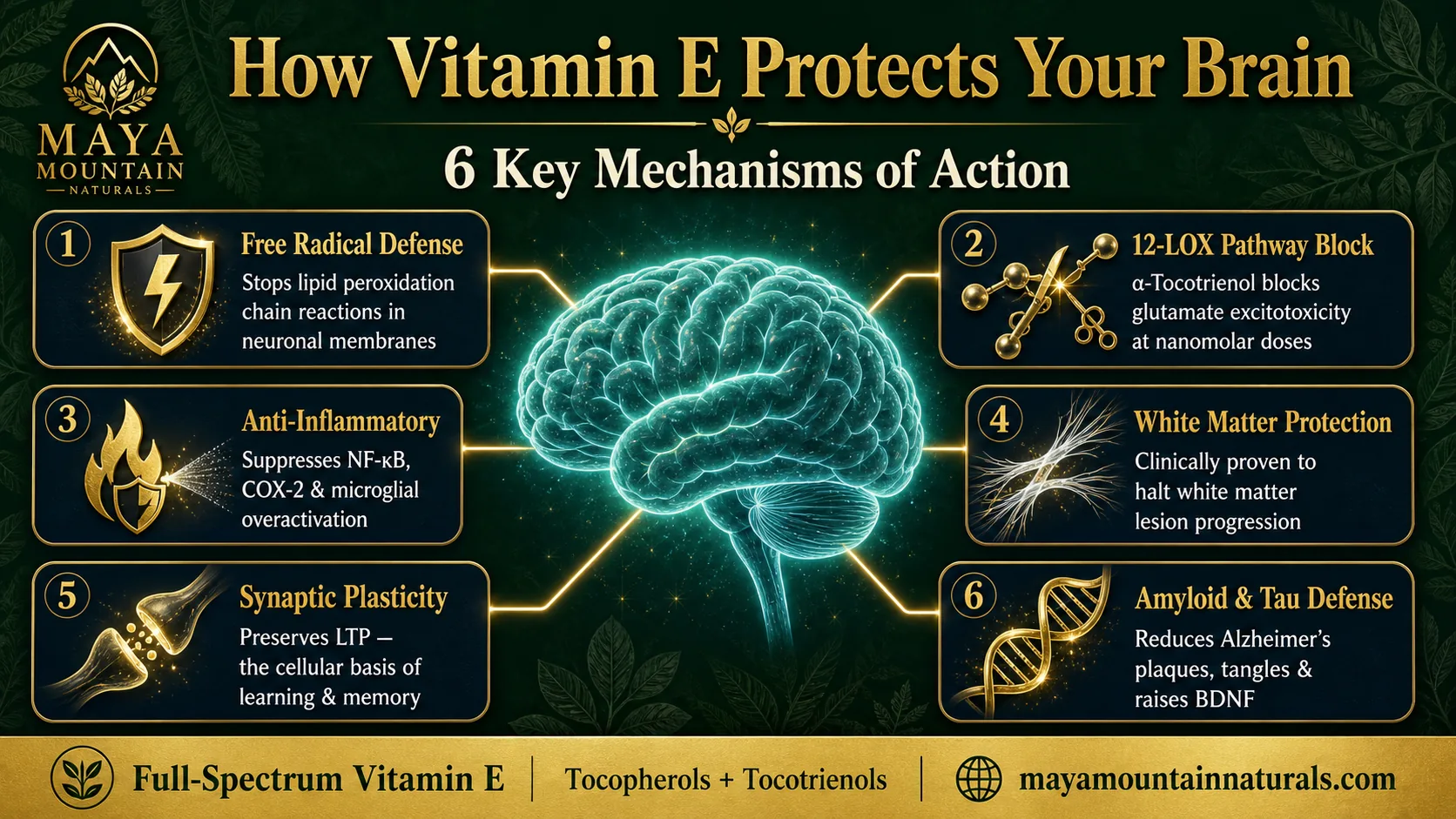
1. Lipid Peroxidation Scavenging
The brain is approximately 60% fat, including high concentrations of polyunsaturated fatty acids like DHA and arachidonic acid — extremely susceptible to chain-reaction lipid peroxidation. Vitamin E inserts itself into neuronal cell membranes and donates a hydrogen atom from its chromanol hydroxyl group to neutralize peroxyl radicals, breaking the chain before it propagates. Alpha-tocopherol reduces markers of lipid peroxidation including MDA and TBARS in the brain.
2. The 12-LOX / c-Src Kinase Pathway (Tocotrienols Unique)
In a landmark series of studies by Dr. Chandan Sen at Ohio State University, nanomolar concentrations of alpha-tocotrienol — but not alpha-tocopherol — completely blocked glutamate-induced neuronal death. The mechanism:
- Glutamate excitotoxicity depletes intracellular glutathione (GSH), activating the enzyme 12-lipoxygenase (12-LOX) — the most abundant lipoxygenase in the human brain
- 12-LOX is activated by tyrosine phosphorylation via c-Src kinase, generating toxic arachidonic acid metabolites, causing calcium influx and executing neuronal death
- Alpha-tocotrienol directly inhibits c-Src kinase activation and blocks arachidonic acid from 12-LOX's active site at sub-nanomolar concentration — 1,000× more effective than alpha-tocopherol
3. Anti-Inflammatory Mechanisms: NF-κB, COX-2, Microglial Modulation
- NF-κB inhibition: Tocotrienols suppress the master inflammation transcription factor, reducing pro-inflammatory mediators
- COX-2 suppression: Tocotrienols inhibit cyclooxygenase-2, reducing prostaglandin synthesis
- Microglial modulation: Tocotrienols reduce microglial activation and suppress NO, IL-1β, and PGE2. Delta-tocotrienol showed the highest reduction in NO production among all isomers.
4. Beta-Amyloid and Tau Protection (Alzheimer's)
- Reduces beta-amyloid (Aβ) plaque deposition and toxicity
- Decreases tau-protein hyperphosphorylation (neurofibrillary tangles)
- Upregulates BDNF (brain-derived neurotrophic factor)
- Increases SOD (superoxide dismutase) activity
5. Synaptic Plasticity and Hippocampal Neurogenesis
- Preserves and enhances Long-Term Potentiation (LTP) — the cellular substrate of learning and memory
- Protects SNARE proteins critical for neurotransmitter vesicle fusion
- Supports adult hippocampal neurogenesis
- Activates pro-survival NF-κB signaling in neurons at protective concentrations
6. White Matter Protection and Cerebrovascular Defense
A landmark 2-year randomized, double-blind, placebo-controlled trial published in Stroke (American Heart Association) found:
- Placebo group: white matter lesion volume INCREASED over 2 years
- Tocotrienol group: white matter lesion volume remained STABLE
- Difference was statistically significant (p=0.019)
This was the first clinical trial to demonstrate direct human brain protective effects of a natural vitamin E compound.
Individual Form Profiles
| Form | Type | Primary Brain Actions | Key Sources |
|---|---|---|---|
| α-Tocopherol | Tocopherol | Lipid scavenging, LTP, BDNF, TTP delivery | Wheat germ oil, almonds, avocados |
| γ-Tocopherol | Tocopherol | Neuroinflammation, synaptic proteins | Walnuts, soybean oil |
| α-Tocotrienol | Tocotrienol | 12-LOX/c-Src, stroke, WML protection | Palm oil, rice bran |
| γ-Tocotrienol | Tocotrienol | Anti-neuroinflammation, Parkinson's | Palm oil, rice bran, annatto |
| δ-Tocotrienol | Tocotrienol | Highest anti-inflammatory potency | Annatto seeds, palm oil |
| β-Tocopherol | Tocopherol | Antioxidant support | Various vegetable oils |
| β-Tocotrienol | Tocotrienol | Antioxidant support | Barley, rice |
| δ-Tocopherol | Tocopherol | Antioxidant support | Soybean, canola oil |
The Tocopherol vs. Tocotrienol Debate
A 2025 scoping review in the International Journal of Molecular Sciences found that tocopherols and tocotrienols have complementary, non-redundant brain-protective roles. High-dose alpha-tocopherol alone was long thought to block tocotrienol absorption, but a 2025 study found the opposite: co-supplementation with d-alpha-tocopherol actually increased plasma delta-tocotrienol levels. Full-spectrum vitamin E complexes outperform single-form supplements for brain health.
"Together, both forms of vitamin E may provide complementary benefits for cognitive performance, neuroinflammation and structural brain protection." — International Journal of Molecular Sciences, 2025
Clinical Evidence Summary
Alzheimer's Disease
A randomized trial across 14 VA Medical Centers (n=613, mild-to-moderate AD) found 2,000 IU/day alpha-tocopherol produced a 19% per year slower rate of functional decline — approximately 6.2 months of preserved function — with significantly fewer deaths in the vitamin E group. Cochrane review confirmed moderate-quality evidence for slowing functional decline in AD.
Parkinson's Disease
Both α-tocotrienol and γ-tocotrienol alleviate 6-OHDA-induced dopaminergic neuron damage in Parkinson's models. Alpha-tocotrienol shows better potential for reducing neuroinflammation.
Stroke & White Matter
Mixed palm tocotrienols attenuated white matter lesion progression in a 2-year human clinical trial. Animal studies show reduced infarct volume, improved collateral cerebral circulation, and preserved white matter connectivity.
Memory & Cognition
A 2025 randomized, double-blind, placebo-controlled trial with rice bran-derived tocotrienols (TheraPrimE® rice) showed significantly greater improvements in general memory (p=0.045) and non-verbal memory (p=0.039) vs. placebo over 12 weeks.
Natural Food Sources
| Source | Dominant Form | Notes |
|---|---|---|
| Palm oil (crude/red) | α + γ Tocotrienol | 70% tocotrienols, richest source |
| Annatto seeds | δ + γ Tocotrienol | Only tocopherol-free vitamin E food |
| Rice bran oil | Mixed tocotrienols | Full-spectrum complex |
| Wheat germ oil | α-Tocopherol | Highest single-food tocopherol |
| Sunflower seeds | α-Tocopherol | 49% DV per ounce |
| Almonds | α-Tocopherol | 45% DV per ounce |
| Avocados | α-Tocopherol | Excellent bioavailability |
| Barley | β + γ Tocotrienol | Moderate amounts |
Supplementation Guidance
- RDA for adults: 15 mg/day (22 IU) minimum
- Alzheimer's functional decline: 2,000 IU/day alpha-tocopherol
- White matter protection: ~200 mg/day mixed palm tocotrienols
- Memory support: 50 mg tocotrienols + 9 mg astaxanthin daily
- Upper safe limit: 1,000 mg/day total from supplements
- Always take with a fat-containing meal (fat-soluble nutrient)
- Choose natural (d-alpha) over synthetic (dl-alpha) forms
- Full-spectrum complexes outperform isolates
Frequently asked questions
How many forms of vitamin E are there?
Eight natural forms: four tocopherols and four tocotrienols (alpha, beta, gamma, delta of each).
What is the difference between tocopherols and tocotrienols?
Both are antioxidants; tocotrienols have a different structure and are particularly studied for neuroprotective effects.
Why choose full-spectrum vitamin E?
Full-spectrum products include more of the eight natural forms than isolated alpha-tocopherol.
How does vitamin E support the brain?
Its antioxidant and membrane-protective actions are studied for neuroprotection and brain health.
Is this medical advice?
No. It is an educational, research-backed overview, not treatment guidance.