Therapeutic Niacin: Using Vitamin B3 for Flush, Detox, and NAD+ Support
How niacin (vitamin B3) is used as a therapeutic tool, from the flush and microcirculation to detox and NAD+ support.
Quick answer
- Niacin is vitamin B3, used both as a nutrient and a therapeutic tool.
- The niacin 'flush' reflects a temporary boost in microcirculation.
- It is discussed for detox routines and NAD+ support.
- This is educational; start low and go slow with the flush.
Why Think of Niacin as a Therapy, Not Just a Nutrient
Vitamin B3 (niacin) is classically treated as "just another B-vitamin," something you get from food and basic multivitamins. But at the right dose — and in the right form — niacin becomes a powerful therapeutic tool for circulation, detox support, lipids, skin, and healthy aging through its role in NAD+.
This article focuses on niacin as a targeted intervention, not on meeting minimum dietary requirements. Food is still the foundation, but food alone will not produce the characteristic flush or the deeper circulation and NAD+ effects most people are seeking.
How Niacin Turns Into NAD+ Inside Your Cells
Niacin's real magic happens after your body converts it into NAD+ (nicotinamide adenine dinucleotide), a coenzyme that sits at the center of energy production, DNA repair, and cellular stress responses.
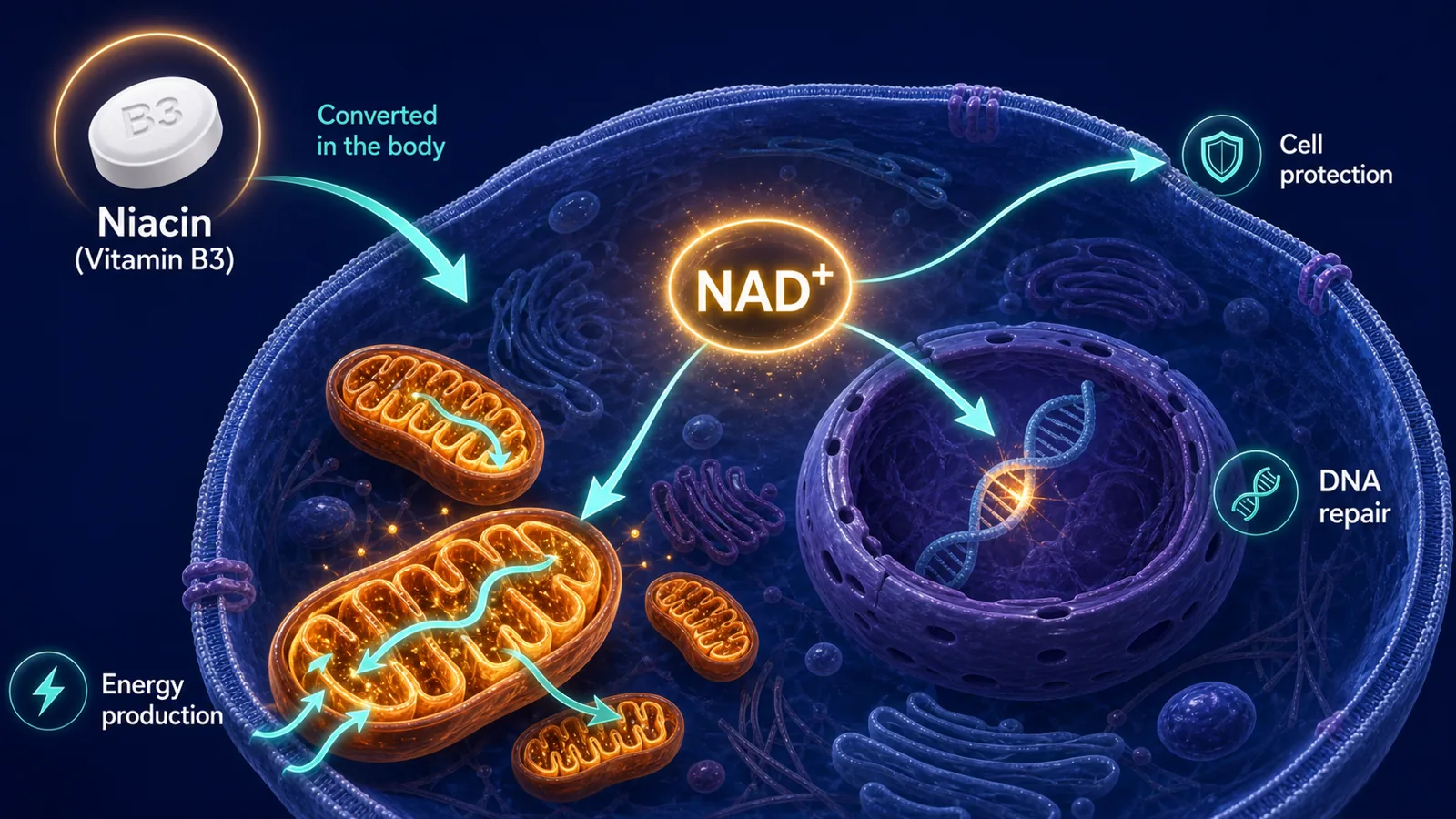
Inside your cells, NAD+ is used to:
- Fuel mitochondria — it shuttles electrons through the energy-generating pathways that make ATP, the cell's usable energy currency.
- Repair DNA — NAD+ powers PARP enzymes that find and fix DNA damage from aging, toxins, and everyday wear.
- Activate "longevity" pathways — NAD+ is required for sirtuins, a family of proteins that help maintain metabolic health and stress resistance.
The pathway in plain terms:
Niacin (Vitamin B3) → converted in the body → NAD+ inside the cell → energy production (mitochondria), DNA repair (nucleus), and cell protection (membrane).
As we age, NAD+ levels decline significantly, and this drop is now considered a key driver of age-related metabolic slowdown and cellular damage.
The Forms of Niacin — And Which One You Actually Want
Niacin shows up under different names on labels, but they are not interchangeable for therapeutic use.
| Label Name | Chemical Form | Flush? | Key Uses |
|---|---|---|---|
| Niacin / Nicotinic Acid | Nicotinic acid | Yes | Flush protocols, lipids, circulation, NAD+ support |
| Niacinamide / Nicotinamide | Nicotinamide | No | Skin, DNA repair, gentle NAD+ support, no lipids effect |
| NR | Nicotinamide riboside | Minimal | Premium NAD+ booster, anti-aging focus |
| NMN | Nicotinamide mononucleotide | Minimal | Direct NAD+ precursor, longevity focus |
For flush, circulation, and classic niacin effects, you specifically want immediate-release nicotinic acid — not niacinamide, not "no-flush niacin," and not extended-release forms.
The Niacin Flush: What It Really Is
The "niacin flush" is a whole-body vasodilation event — a temporary opening of capillaries in the skin and peripheral tissues.
Mechanism in Plain Language
- Nicotinic acid binds to a receptor (GPR109A) on certain skin and immune cells.
- This triggers a burst of prostaglandins (mainly PGD₂ and PGE₂).
- Those prostaglandins tell small blood vessels in the skin to dilate (open wider).
- Blood rushes to the surface → warmth, redness, tingling, sometimes mild itching.
Onset is usually 15–30 minutes after a dose and resolves within about an hour. It is not an allergy, not damage, and not dangerous in otherwise stable individuals — it's a controlled, reversible shift in microcirculation.
Why Purposefully Use the Flush?
From a therapeutic perspective, the flush is part of the benefit, not just a side effect to be tolerated.
1. Opening Capillaries and Microcirculation
Capillaries are where oxygen and nutrients actually exchange with cells. Many people — especially older adults or those with metabolic issues — have stagnant microcirculation in the skin and peripheral tissues.
The flush:
- Forces more blood into under-perfused capillary beds.
- Enhances delivery of oxygen and nutrients to skin and superficial tissues.
- Improves removal of metabolic waste products.
Over time, repeated vasodilation can support healthier vascular responsiveness and may contribute to better blood pressure control when used appropriately.
2. Supporting Detoxification Protocols
Because many toxins are fat-stored and poorly perfused (pesticides, solvents, some drug residues), mobilizing blood flow into these tissues is a key strategy in detox programs.
Clinically used niacin + heat/sweat protocols take advantage of this:
- Niacin opens capillaries and mobilizes stored compounds from fat into the bloodstream.
- Follow-up sweating (sauna, hot bath, or intense movement) encourages elimination through skin and excretory routes.
Several detox programs (including those used with firefighters and chemical-exposure populations) have used niacin-based protocols and reported reductions in measured body burdens of certain contaminants.
3. Skin and Barrier Health
Because the flush drives blood to the skin, it:
- Enhances nutrient and immune cell delivery to the epidermis.
- May reduce low-grade inflammation in chronic skin issues.
- Pairs well with niacinamide (oral or topical) for skin barrier and pigmentation benefits.
Using Niacin Therapeutically: Dosing Logic
What follows is orientation, not medical advice. High-dose niacin is a serious tool and should be done in partnership with a practitioner if you have cardiovascular, liver, or metabolic disease.
General Principles
- Use immediate-release nicotinic acid for flush and circulation effects.
- Start low and slow; your ideal dose is the lowest dose that gives you a meaningful, comfortable flush.
- Niacinamide does not flush and is better suited to gentle daily NAD+ and skin support.
Typical Ranges by Intent (Adults)
These are ballpark ranges based on clinical and nutritional references, not prescriptions:
| Goal | Typical Range (Immediate-Release Niacin) | Notes |
|---|---|---|
| Basic NAD+ & metabolic support | 50–200 mg/day | Mild or no flush in many people |
| Meaningful flush & microcirculation | 200–500 mg per dose (1–3×/week) | Strong but manageable flush for most adults |
| Aggressive detox/sauna protocols | 250–1000 mg per session, ramped gradually | Must be supervised; watch liver, BP, symptoms |
| Prescription lipid lowering | 1000–2000+ mg/day | Prescription territory; high monitoring burden |
Safety note: Long-term high-dose niacin (especially sustained-release) can stress the liver and worsen insulin resistance in some individuals. This is not a casual daily supplement at gram doses.
Finding Your Flush Dose
Because everyone's circulation and sensitivity differ, the most useful information is often your own body's response.
A simple self-titration framework (for generally healthy adults):
1. Baseline Checks
No active liver disease? No uncontrolled gout or severe diabetes? Not pregnant? If unsure, stop here and talk to a practitioner.
2. Choose Form
Immediate-release nicotinic acid tablets (e.g., 50 mg or 100 mg scoring) — not timed-release, not "no flush."
3. Start Low
Day 1–3: 50 mg once, taken with a light snack. Note: intensity, duration, and distribution of flush (face only, chest, whole body).
4. Stepwise Increase
If flush is very mild or absent, increase by 50–100 mg every 3–5 days until:
- You experience a strong but tolerable flush, and
- It resolves within about an hour without concerning symptoms.
5. Stay at the Sweet Spot
Your working "flush dose" is the lowest dose that reliably gives you a good, full-body warmth and color shift without distress. For many people this ends up between 200–500 mg.
6. Cycle Rather Than Chronically Hammer
- For circulation/detox: 2–4 flush sessions per week is often more than enough.
- For longevity NAD+ support, some people separate a small daily niacinamide or NR dose from occasional higher-dose niacin flush sessions.
Special Considerations in Older Adults and Impaired Circulation
With age and metabolic disease, microcirculation and vessel flexibility change. That affects both the experience and the risks of flush protocols:
- Start even lower — 25–50 mg, regardless of body weight.
- Flush may be uneven — strong in the face, weak in feet or hands; that unevenness often maps to circulation deficits.
- Blood pressure meds — niacin's vasodilation can temporarily amplify the effects of antihypertensives; dizziness or lightheadedness are signs the dose or context is wrong.
- Sit or lie down during the first few flushes so you're not standing if your pressure dips.
- Liver and glucose monitoring become more important above 500 mg, especially with daily use.
For this group, a practitioner-guided protocol is strongly recommended.
NAD+ and Longevity: Where Niacin Fits Among the Newer Molecules
NR and NMN get the headlines, but old-fashioned niacin is still a potent and cost-effective NAD+ amplifier.
- NR and NMN may raise NAD+ more efficiently per mg and with less flush, but are significantly more expensive and still under active regulatory and clinical debate.
- Niacin and niacinamide are time-tested, widely available, and very well-characterized in terms of safety, contraindications, and long-term effects.
A common long-term strategy:
- Daily base: modest niacinamide or NR for steady NAD+ support.
- Periodic spikes: niacin flush sessions (e.g., 2–4×/week) for microcirculation, detox pairing, and "wake up the capillaries" effects.
Why Food Sources Still Matter (Even If They Won't Make You Flush)
Food niacin will not produce a therapeutic flush. Typical daily intakes from diet (15–20 mg) are 10–50× lower than the doses used to trigger significant vasodilation. But they still matter as your baseline substrate:
- High-niacin and high-tryptophan diets (fish, poultry, eggs, peanuts, mushrooms) ensure that all NAD+-dependent systems have at least their minimum building blocks.
- That baseline lets you use therapeutic niacin more sparingly, because you're not trying to correct a deficiency and do advanced work at the same time.
Think of food niacin as maintenance and therapeutic niacin as intervention. They are complementary, not interchangeable.
Practical Summary for Therapeutic Use
- Use immediate-release nicotinic acid when your goal is flush, circulation, and detox pairing.
- Respect the dose — this is a pharmacologic tool at higher levels, not just a "vitamin."
- Aim for the lowest dose that gives you a comfortable, reliable flush and cycle your use.
- Combine with movement or heat (shower, bath, or sauna if available) when you want detox-supporting effects.
- Use niacinamide or NR/NMN for non-flush NAD+ support, skin, and gentle daily maintenance.
- Work with a practitioner if you have heart disease, diabetes, gout, liver issues, or are taking multiple medications.
For educational purposes only. Always consult a qualified health practitioner before beginning any high-dose niacin or detox protocol.
Frequently asked questions
What is the niacin flush?
The flush is a temporary warmth and redness from niacin widening small blood vessels, reflecting boosted microcirculation.
How does niacin relate to NAD+?
Niacin is a precursor the body uses to make NAD+, a coenzyme central to cellular energy and repair.
Is niacin the same as niacinamide?
No. Niacin (nicotinic acid) causes the flush; niacinamide generally does not and has different uses.
How do people start with therapeutic niacin?
Most start low and increase gradually to manage the flush; follow professional guidance.
Is this medical advice?
No. It is educational; consult a professional before using high-dose niacin.