UV Blood Irradiation: An Overlooked Light-Based Therapy With Renewed Interest
How ultraviolet blood irradiation (UVBI/UBI) may influence immunity, inflammation, circulation, and microbial burden — its history, proposed mechanisms, and the state of the evidence. Educational overview.
Maya Mountain Naturals Editorial · Published July 2026 · 12 min read
Quick answer
- Ultraviolet Blood Irradiation (UVBI or UBI) is a light-based therapy in which a small portion of blood is drawn, exposed to ultraviolet light outside the body, and then returned to circulation.
- Its proposed value comes from how light alters immune signaling, oxidative balance, and blood-cell behavior — not from simply "cleaning" or sterilizing the blood.
- It is dose-sensitive and often described as hormetic: a modest dose may stimulate adaptive healing responses, while too much may reduce benefit or cause harm.
- Widely used in hospitals from the 1930s–1950s for serious infections, it was displaced by antibiotics and is now revisited in integrative and biological medicine.
- The strongest modern evidence is in the specialized procedure called extracorporeal photopheresis; classic UVBI for general conditions remains investigational.
This article is educational only. It is not medical advice, and nothing here is a recommendation to seek, perform, or avoid any treatment. UVBI is not a Maya Mountain Naturals product or service.
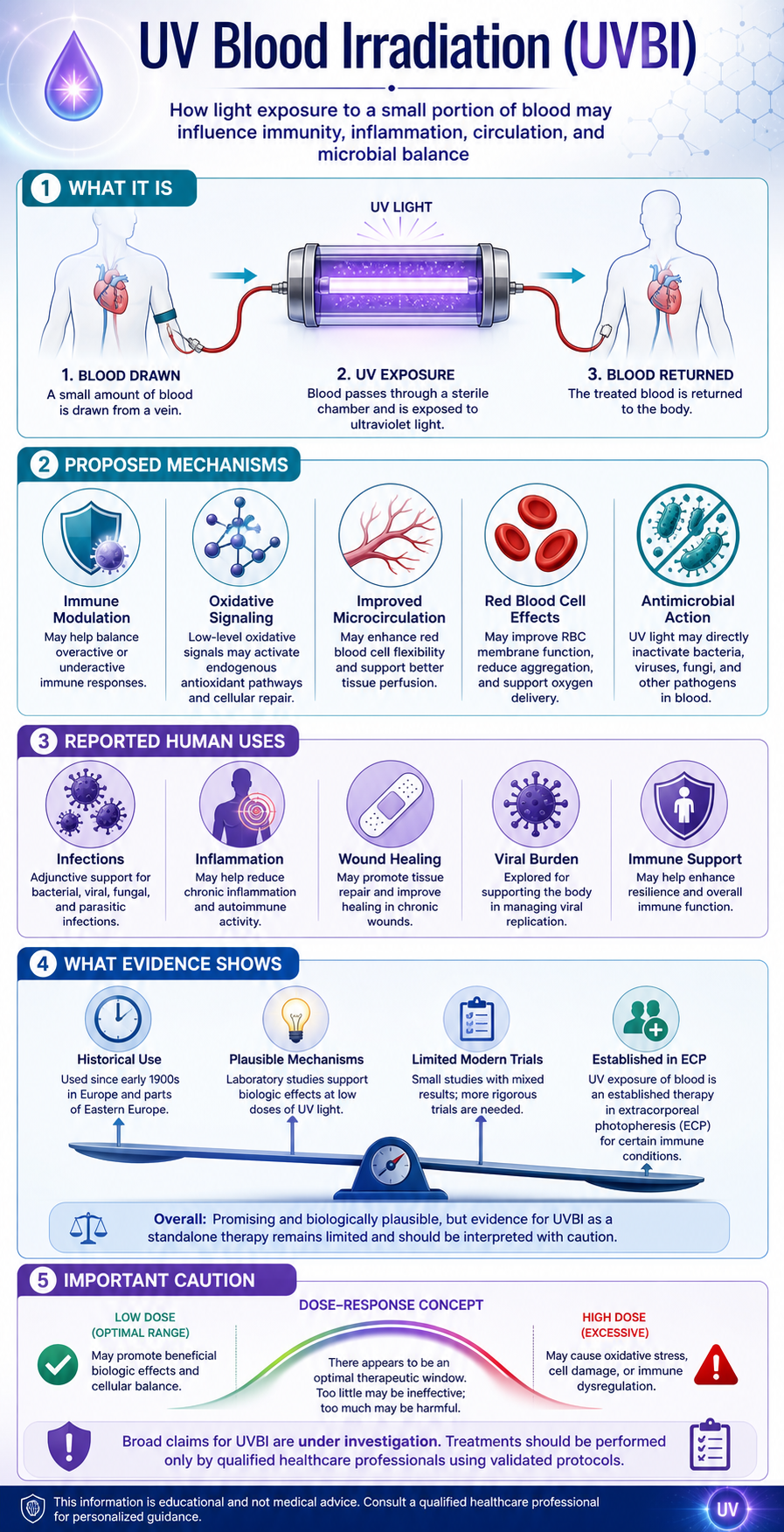
What Is UV Blood Irradiation?
Ultraviolet Blood Irradiation, often called UVBI or UBI, is a little-known therapy with surprisingly deep roots in medical history. It involves removing a small portion of blood, exposing it to ultraviolet light outside the body, and then returning it to circulation — with the goal of triggering beneficial systemic effects rather than simply "cleaning" the blood directly.
Although largely displaced by antibiotics and modern pharmaceuticals, UVBI was once used in hospitals for serious infections and inflammatory conditions, and it is now attracting renewed interest in integrative and biological medicine. What makes the therapy noteworthy is that its proposed value appears to come from how light alters immune signaling, oxidative balance, and blood-cell behavior — not from a simplistic one-step antimicrobial effect.
In a standard UVBI procedure, a small amount of venous blood is withdrawn, mixed with an anticoagulant, passed through a chamber where it is exposed to ultraviolet light, and then reinfused. Traditional protocols were designed to treat only a small fraction of total blood volume — often around 5 to 7 percent — because early investigators found that low-dose exposure appeared more beneficial than larger exposures.
Why Does Dose Matter So Much?
This dose-sensitive effect is one of the most important things to understand about UVBI. The therapy has long been described as hormetic, meaning a modest dose may stimulate adaptation and healing responses, while too much exposure may reduce benefit or increase harm.
That concept helps explain why advocates do not view UVBI as a bulk sterilization method, but as a controlled biological signal. As the infographic above illustrates, there appears to be an optimal therapeutic window: too little may be ineffective, and too much may cause oxidative stress, cell damage, or immune dysregulation.
A Brief History of Blood Phototherapy
The medical use of ultraviolet light grew out of early discoveries that UV radiation could affect living tissue and inactivate microbes. In the early 20th century, this line of work eventually led to the development of blood irradiation systems by Emmett Knott, whose device brought blood into contact with UV light outside the body before reinfusion.
From the 1930s through the 1950s, UVBI was reported in the medical literature for septicemia, pneumonia, tuberculosis, arthritis, asthma, poliomyelitis, wound infections, and other conditions. Interest faded as antibiotics, vaccines, and newer drug-based interventions became dominant — but the therapy never fully disappeared, continuing to be explored in other parts of the world and later in integrative medicine circles.
How Might UV Light Affect Blood?
The most important point is that UVBI is thought to act indirectly. Since only a small amount of blood is typically irradiated, its effects are believed to come from downstream signaling changes throughout the body rather than from killing every pathogen in circulation.
Researchers have proposed several overlapping mechanisms:
- Immune modulation — UV exposure may alter white blood cell activity and cytokine signaling, potentially helping balance overactive or underactive responses.
- Oxidative signaling — low-level oxidative signals may activate endogenous antioxidant pathways and cellular repair.
- Improved microcirculation — effects on red blood cell membranes and flexibility may support better tissue perfusion.
- Red blood cell effects — changes in membrane function, aggregation, and oxygen delivery may help explain older accounts of improved circulation and reduced cyanosis.
- Antimicrobial action — UV light may directly inactivate some bacteria, viruses, and fungi in the treated fraction of blood.
Neutrophils appear especially relevant. Low-dose UV exposure has been associated with increased oxidative-burst activity and improved pathogen-handling capacity, while other immune cells may be modulated depending on dose and context. This may explain why UVBI has been described as both immune-supportive and inflammation-regulating, rather than simply "stimulating" the immune system across the board.
What Have People Used UVBI For?
Historical reports described some of the most dramatic outcomes in severe infections — especially septic states and pneumonia — where physicians noted rapid clinical improvement in certain patients. Other reports and reviews have discussed possible roles in inflammatory disorders, wound healing, thrombophlebitis, viral illness, hepatitis, asthma, and chronic infectious burden.
Modern interest has extended to viral conditions because UVBI may combine modest direct antiviral effects with broader immune modulation. A small clinical trial in hepatitis C, for example, suggested potential improvement in viral load and liver-related markers — but the study was too limited to establish UVBI as a validated standard treatment.
From a natural-health perspective, UVBI is often viewed as a therapy that may help the body regulate itself more effectively under infectious or inflammatory stress. The most responsible interpretation, however, is that there is biological plausibility and historical support, but not enough modern evidence to make sweeping claims for every condition sometimes listed by clinics.
Where Is the Evidence Strongest?
It is important to separate classic UVBI from extracorporeal photopheresis (ECP). Photopheresis is a related but more specialized medical procedure that uses separated white blood cells, UVA light, and a photosensitizing compound. It has recognized medical use in cutaneous T-cell lymphoma and certain transplant-related complications.
That distinction matters, because some broad promotional claims about "UV blood treatment" go far beyond what current evidence supports. At present, the clearest evidence-backed blood-phototherapy applications are in these specialized photopheresis settings, while conventional UVBI for general infection, chronic inflammation, fatigue, or immune dysregulation remains investigational.
Why Is Interest in UVBI Returning?
One reason UVBI is being revisited is that modern medicine is once again paying close attention to immune balance, mitochondrial stress signaling, redox biology, and non-pharmaceutical ways of influencing systemic resilience. In that framework, UVBI fits naturally into a broader conversation about therapies that use measured stressors to stimulate adaptation rather than only suppressing symptoms.
Another reason is practical frustration. Chronic inflammatory illness, persistent viral burden, and complex multisystem conditions often leave people searching for options beyond standard protocols. This does not prove UVBI works broadly — but it helps explain why it continues to attract attention among both practitioners and patients.
Is UVBI Safe?
Low-dose UVBI has generally been described as well tolerated in the older literature, but its safety depends heavily on proper dosing, appropriate equipment, sterile handling, and clinical judgment. Because UV effects are dose-dependent, more is not better — excessive exposure could shift the therapy from adaptive to harmful.
There is also a larger caution. Much of the positive literature is older, not always rigorously controlled, and not sufficient by current standards to establish broad medical consensus. For that reason, UVBI is best understood as a promising historical and integrative therapy with genuine mechanistic interest — but one that still needs stronger modern clinical validation. Any procedure involving blood should be performed only by qualified healthcare professionals using validated protocols.
A Balanced Final Perspective
UV Blood Irradiation sits at the intersection of old medical wisdom and modern biological curiosity. It appears to influence immunity, oxidative signaling, blood-cell behavior, and inflammatory balance in ways that may help explain its longstanding reputation — yet most of its broader clinical claims remain ahead of the strongest evidence.
For a natural-health knowledge base, the most balanced view is this: UVBI is neither mere pseudoscience nor a proven cure-all. It is a historically significant light-based therapy with plausible mechanisms, documented human use, and enough promise to merit serious attention — but also enough uncertainty to require discernment.
Frequently asked questions
What is UV Blood Irradiation (UVBI)?
UVBI, also called UBI, is a light-based therapy in which a small portion of blood is drawn, exposed to ultraviolet light outside the body, and then returned to circulation. It is intended to trigger beneficial systemic effects through changes in immune and oxidative signaling rather than by directly sterilizing the blood.
How does UVBI work?
Because only a small fraction of blood is treated, UVBI is thought to work indirectly — by altering white blood cell activity, cytokine signaling, oxidative balance, and red blood cell behavior, which then influence the wider body. It is described as hormetic, meaning a modest dose may stimulate adaptive responses.
Is UVBI scientifically proven?
The strongest evidence for blood phototherapy is in the specialized procedure called extracorporeal photopheresis. Classic UVBI for general infections, inflammation, or immune concerns remains investigational, supported mostly by older studies and historical reports that do not meet current standards for broad medical consensus.
What is the difference between UVBI and photopheresis?
Extracorporeal photopheresis is a more specialized medical procedure that separates white blood cells, adds a photosensitizing compound, and uses UVA light. It has recognized use in conditions like cutaneous T-cell lymphoma. Classic UVBI is simpler and broader in its historical claims, but far less validated by modern trials.
Is UVBI safe?
Low-dose UVBI has generally been described as well tolerated in the literature, but safety depends on correct dosing, sterile handling, and proper equipment. Because effects are dose-dependent, excessive exposure could be harmful. Any blood procedure should only be performed by qualified healthcare professionals.
Educational content only. This article does not diagnose, treat, cure, or prevent any disease, and is not a substitute for professional medical advice. Consult a qualified healthcare professional for personalized guidance.