Tissue Salts: The Forgotten Minerals Your Cells Can't Live Without
The 12 Schüssler tissue salts (cell salts) are micro-dose mineral compounds traditionally used to support cellular health. Learn their history, what each salt does, the zodiac connection, and how to use them safely.
Maya Mountain Naturals Editorial · Published June 24, 2026 · 11 min read
Quick answer
- Tissue salts (also called cell salts or Schüssler salts) are twelve inorganic mineral compounds the body needs for healthy cell function, prepared as fine micro-doses for direct cellular uptake.
- They were identified in 1873 by German physician Dr. Wilhelm Heinrich Schüssler, who saw them as the "material basis" of every tissue and organ.
- Each salt maps to particular functions — for example Ferr Phos for first-stage inflammation, Kali Phos for nerves and stress, Mag Phos for cramps and spasms, and Silica for connective tissue.
- A classic system links each of the twelve salts to a zodiac sign, offering a constitutional starting point for which mineral a person may run short of.
- They are gentle, taken under the tongue, considered safe for all ages, and traditionally used to support cellular balance rather than to treat disease.
Tissue salts are one of the oldest cellular nutrition systems still in quiet use today — twelve simple mineral compounds that the body relies on to build, repair and run every cell it contains. Used as fine micro-doses, they are traditionally taken to support the cell's own ability to rebalance itself, making them a gentle ally alongside good food, rest and your botanical allies.
A Quiet System with a Long History
Ask most people what a tissue salt is today and you'll get a blank stare. Yet a hundred years ago, these twelve simple mineral compounds were a cornerstone of natural medicine — used by practitioners and families alike, found in health books, and trusted across generations. The fact that they've quietly vanished from mainstream conversation isn't because they were disproven. They were simply nudged out of the spotlight as pharmaceutical medicine took center stage. The interesting question isn't whether tissue salts work. It's why something so foundational to cellular life stopped being talked about at all.
Who Discovered Them — and Why
The story begins in 1873 in Oldenburg, Germany, with a physician named Dr. Wilhelm Heinrich Schüssler (1821–1898). Schüssler was a man of unusual intellectual range — trained in medicine at the Universities of Berlin, Paris, Giessen and Prague, fluent in multiple languages, and deeply influenced by two giants of 19th-century science.
The first was Rudolf Virchow, the founder of cellular pathology, who proposed that disease originates within the cell itself — not in the body as a vague whole, but at the level of individual living units. The second was Jacob Moleschott, a Dutch physiologist who published research in 1852 pointing out that the structure and vitality of organs depended directly on the presence of inorganic (mineral) constituents inside them.
Schüssler took these two ideas and built a system around them. During his research, which included the analysis of cremated human tissue, he identified twelve inorganic mineral salts that accounted for the bulk of what the body left behind. He concluded that these twelve compounds were not merely present in the body — they were essential workers that drove the construction and repair of every cell. His first published paper appeared in the General Homoeopathic Journal in 1873, and his first book followed in 1874. By 1888, physicians in San Francisco had published an English-language reference guide to all twelve tissue remedies, and the system spread rapidly through the Western world.
Schüssler was careful to distinguish his approach from conventional homeopathy. While he used the homeopathic method of preparing very small, finely diluted doses, his reasoning was nutritional and biochemical — not purely energetic. He was asking a simple question: what does the cell actually need to function, and how do we get it there?
The Core Principle: Cellular Mineral Balance
The theory behind tissue salts is straightforward enough to write on a napkin.
The human body is composed of trillions of cells. Every one of those cells requires a precise balance of inorganic mineral salts to carry out its function — whether that's building bone, conducting nerve signals, regulating fluid, oxygenating the blood, or healing damaged tissue. These twelve salts are not optional accessories. According to Schüssler, they are "the material basis of the organs and tissues of the body and are absolutely essential to their integrity of structure and functional activity."
When the balance is disturbed — through stress, poor nutrition, illness, environmental toxins, or simply the demands of modern life — the cell cannot rebuild itself properly. Function degrades. Symptoms emerge. Disease follows. The body then signals its need through specific symptoms, which Schüssler and later practitioners mapped carefully to particular mineral deficiencies.
The solution, in Schüssler's model, is not to flood the system with bulk minerals in crude form. Most minerals in their raw state are insoluble and cannot pass through the delicate walls of cells. The key insight was delivery. By tritrating (grinding) the salts with lactose into an extremely fine, micro-dose form, Schüssler believed they could pass rapidly into the bloodstream and reach the cells directly — acting not so much as replacements but as prompts, stimulating the cell to correct its own mineral balance.
This concept — that a micro-dose of a mineral prompts cellular self-correction rather than simply supplementing bulk levels — distinguishes tissue salts from ordinary mineral supplements and is still the basis of how practitioners use them today.
The Twelve Salts: What They Are and What They Do
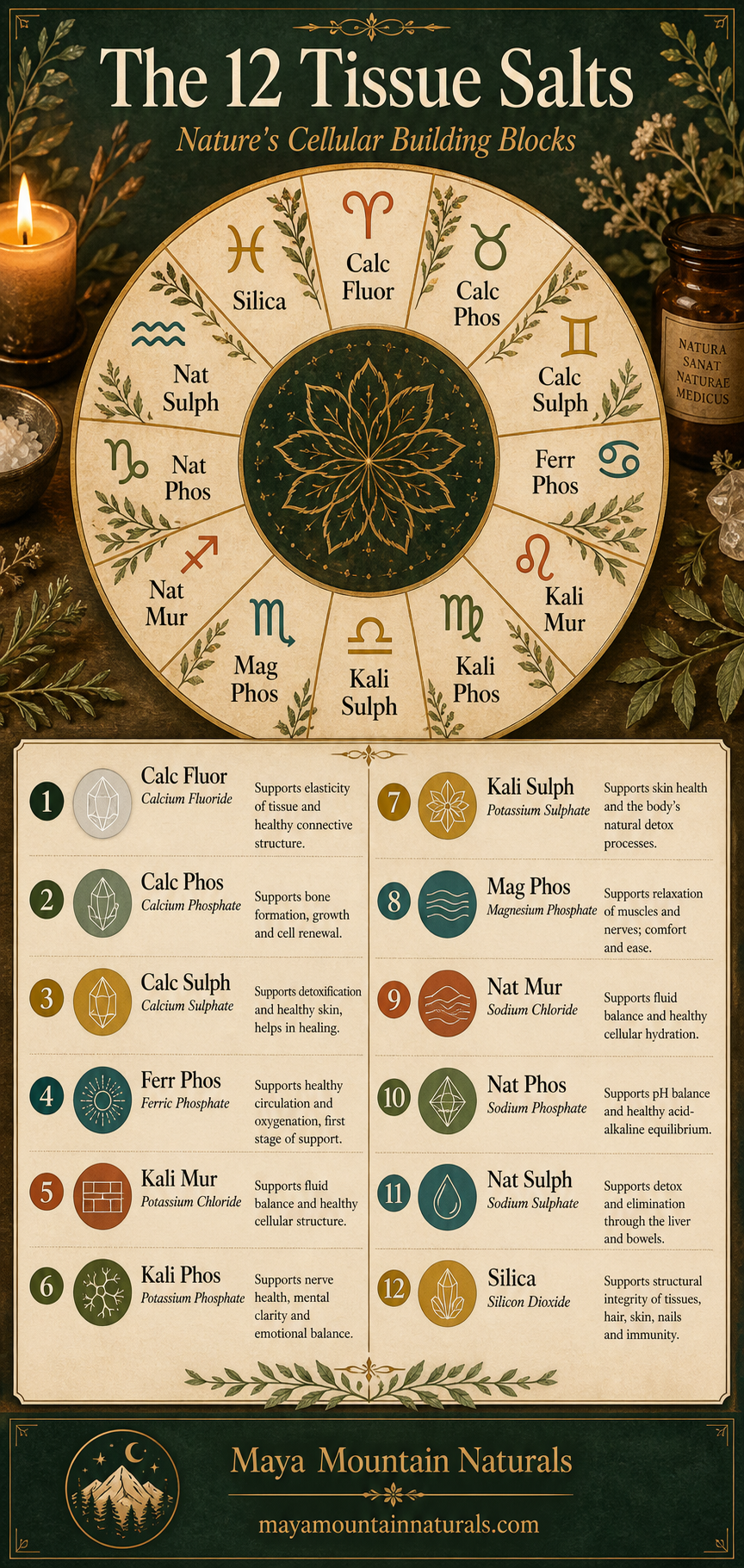
Here is a practical overview of all twelve tissue salts, their mineral source, and their primary areas of action in the body.
| # | Tissue Salt | Mineral | Key Function | Often Used For |
|---|---|---|---|---|
| 1 | Calc Fluor | Calcium Fluoride | Tissue elasticity; structural integrity of bones, teeth, vessel walls | Varicose veins, hemorrhoids, lax tissues, bone spurs, tooth enamel |
| 2 | Calc Phos | Calcium Phosphate | Bone and cell nutrition; digestive function | Bone repair, poor growth in children, anemia, teething, recovery from illness |
| 3 | Calc Sulph | Calcium Sulphate | Blood purification; healing of infected tissues | Acne, slow-healing wounds, thick yellow discharges, boils, abscesses |
| 4 | Ferr Phos | Iron Phosphate | Oxygen transport; inflammation control | First-stage fevers and inflammation, anemia, early colds, minor injuries |
| 5 | Kali Mur | Potassium Chloride | Fibrin formation; mucous membrane health | Congestion, coughs, colds, swollen glands, white/gray discharges |
| 6 | Kali Phos | Potassium Phosphate | Nerve and brain function; cellular energy | Anxiety, fatigue, depression, insomnia, headache, burnout |
| 7 | Kali Sulph | Potassium Sulphate | Skin oxygenation; oil production and distribution | Skin disorders, yellow discharges, scaling, dandruff, alopecia |
| 8 | Mag Phos | Magnesium Phosphate | Motor nerves; muscle relaxation | Cramps, spasms, shooting pains, migraines, colic, nerve pain |
| 9 | Nat Mur | Sodium Chloride | Fluid balance; cellular hydration | Edema, dry skin, eczema, constipation, fluid retention, cold sores |
| 10 | Nat Phos | Sodium Phosphate | Acid-alkali balance | Acidity, gout, arthritis, heartburn, sour-smelling discharges |
| 11 | Nat Sulph | Sodium Sulphate | Liver support; elimination of excess fluid | Liver conditions, jaundice, constipation, gallstones, fluid retention |
| 12 | Silica | Silicic Acid | Connective tissue; cellular cleansing | Weak nails, poor hair, scar tissue, slow-to-heal wounds, brittle bones |
A few of these deserve special attention. Ferr Phos (Iron Phosphate) is considered the universal "first aid" salt — the go-to at the very first sign of any inflammation or fever. Kali Phos (Potassium Phosphate) is the nerve and brain salt, arguably the most important in modern life given the epidemic levels of stress, anxiety and nervous exhaustion that characterize daily living. Mag Phos is sometimes called the "anti-spasm" salt — it acts quickly on cramping, shooting pain and nervous tension. And Silica, which exists in quartz, is described by some practitioners as "nature's surgeon" — it moves through congested tissue, breaking up and clearing what doesn't belong.
All twelve combined into a single formula is known as Bioplasma — a whole-body mineral support used when the precise deficiency isn't obvious or when general cellular nourishment is the goal.
How They're Prepared
The preparation method matters, and it's where tissue salts part company with ordinary mineral supplements. Schüssler adopted the homeopathic method of trituration — grinding the mineral salt with lactose powder in a 1:9 ratio, then grinding that mixture with fresh lactose again, and repeating the process six times. The result is a preparation diluted to roughly one part mineral per million parts lactose.
This level of dilution is precisely why orthodox medicine dismisses them as pharmacologically inert — at this concentration, the direct mineral content is below what standard blood tests would detect. But proponents point out that this misses the mechanism entirely. The argument is not that you're supplementing mineral levels in bulk. The argument is that the ultra-fine particle size allows direct cellular uptake through the mucous membranes — bypassing sluggish digestive absorption that often prevents ordinary mineral supplements from reaching the cell in the first place.
Recent work published in 2025 in a peer-reviewed journal notes that tissue salts may exert their effects through nanopharmacologic behavior — acting at a scale that influences cellular signaling pathways rather than simply adding mineral mass. Research in the same year acknowledged that while robust clinical trials remain limited, growing interest in biochemic therapy's mechanistic basis represents a legitimate area of investigation.
The tablets themselves are typically taken under the tongue rather than swallowed whole, allowing absorption directly through the oral mucosa into the bloodstream. They are considered safe for all ages, including infants, pregnant women, and the elderly — with no known side effects and no risk of overdose, since the body simply excretes any excess it doesn't need.
The Astrochemical Layer: Tissue Salts and the Zodiac
Here is where the subject becomes genuinely fascinating for those who sense that ancient systems understood something modern science is only beginning to rediscover.
Traditional astrology has long associated each of the twelve zodiac signs with specific regions and systems of the body. Aries governs the head and brain. Taurus the throat and neck. Gemini the lungs, shoulders and arms. Cancer the chest and stomach. And so on around the wheel. The body, in this cosmology, was not separate from the larger patterns of nature — it reflected them, with each part corresponding to a planetary force and a seasonal cycle.
The connection to tissue salts was formalized most clearly by George W. Carey in his 1932 book Relation of the Mineral Salts of the Body to the Signs of the Zodiac — a work that is still cited by practitioners today. Carey's argument was that different constitutional types — shaped in part by the astrological influences present at birth — have characteristic mineral strengths and weaknesses. Knowing your zodiac sign, in this view, gives you a starting point for understanding which cellular salts your body is most likely to be chronically short of.
The correspondences, as they are most commonly cited, are as follows:
| Zodiac Sign | Tissue Salt | Body Association |
|---|---|---|
| Aries | Kali Phos | Head, brain, nervous system |
| Taurus | Nat Sulph | Throat, liver, fluid elimination |
| Gemini | Kali Mur | Lungs, bronchi, mucous membranes |
| Cancer | Calc Fluor | Chest, stomach, elastic tissues |
| Leo | Mag Phos | Heart, spine, motor nerves |
| Virgo | Kali Sulph | Solar plexus, skin, digestive enzymes |
| Libra | Nat Phos | Kidneys, acid-alkali balance |
| Scorpio | Calc Sulph | Reproductive organs, connective tissue |
| Sagittarius | Silica | Hips, bones, hair, connective tissue |
| Capricorn | Calc Phos | Skeleton, joints, bone density |
| Aquarius | Nat Mur | Circulation, ankles, fluid distribution |
| Pisces | Ferr Phos | Feet, lymph, blood, oxygenation |
The interpretation is not that your star sign causes disease or predetermines illness. The idea is constitutional: that each sign, representing a particular energetic and physiological tendency, draws more heavily on certain mineral reserves throughout life. A person born under Aries may naturally run through Kali Phos faster than average, making nervous exhaustion a recurring theme. A Capricorn constitution might lean hard on Calc Phos throughout life, with bone and joint issues being the first place imbalance shows up.
Whether approached as literal biochemistry or as a poetic map of human constitution, the twelve-sign, twelve-salt correspondence is an elegant and surprisingly durable system — one that many holistic practitioners continue to use as a first filter when exploring a client's mineral needs.
Why They Disappeared — and Why They're Coming Back
The decline of tissue salts from public awareness has less to do with evidence and more to do with economics and classification. When pharmaceutical medicine organized itself around patentable synthetic compounds in the 20th century, simple inorganic minerals — which cannot be patented — had no commercial champions willing to fund the research needed to keep them in the conversation. They weren't attacked or disproven. They were simply crowded out.
They were also caught in an awkward regulatory position — classified alongside homeopathic remedies in most jurisdictions, which meant they inherited homeopathy's reputation for controversy without receiving the same scrutiny or defense that more established systems attract. That classification remains contested. Schüssler himself was careful to note that his system was not conventional homeopathy — the mechanism he proposed was nutritional, not energetic.
What is notable is where tissue salts remain active today. They never really disappeared from Germany, their country of origin, where they are still sold widely in pharmacies. Australia, India and the UK also have active tissue salt markets. Among practitioners of nutritional medicine, naturopathy, and integrative health, they have remained a working tool across more than 150 years.
Interest is now visibly growing again. A 2025 review in a peer-reviewed journal described tissue salts as "an important complementary medicine system" while calling for more rigorous clinical trials. Research published the same year explored their potential to modulate cellular stress responses at the nanopharmacologic level. These are small but meaningful steps toward the kind of formal scientific attention that this system deserves.
Practical Notes for the Curious
Tissue salts are widely available as small lactose tablets (or lactose-free sprays for those with dairy sensitivity) and are taken either dissolved under the tongue or held in the mouth briefly before swallowing. Standard adult dosing is typically 4 tablets three to four times daily, though this varies by product and condition. They are gentle enough to take alongside other supplements or medications without concern about interactions.
For those exploring tissue salts for the first time, a practical starting point is Ferr Phos at the first sign of any inflammation, fever or infection — taken early and often, it acts as a natural first-line immune response. For chronic stress and nervous exhaustion — arguably the defining condition of modern life — Kali Phos is widely regarded as the most relevant daily support. For anyone dealing with digestive acidity, joint pain or metabolic imbalance, Nat Phos quietly does work that most people have never thought to ask a mineral salt to do.
The astrological system offers another doorway for those who prefer a constitutional lens: identify your sun sign, locate the corresponding tissue salt, and start there — not as a final answer but as a thoughtful starting hypothesis about where your body's mineral demands may be highest.
These are not miracle cures. They are building materials — the inorganic raw materials the body uses to maintain, repair, and run every living cell it contains. The simplicity of that idea is precisely what makes it powerful, and precisely why it deserves a place back in the conversation.
---
References
- The Twelve Tissue Salts - alive magazine - We've heard of the 12 days of Christmas—but what about the 12 tissue salts? Worth much more than a d...
- 6. The Founders. - 1. Dr Schuessler – The 12 Cell Salts Founder. Dr. Wilhelm Heinrich Schüssler . (1821-1898) . Founder...
- What Are Tissue Salts? The 12 Mineral Compounds Explained - Understand the 12 tissue salts, their foundational theory of cellular mineral deficiency, preparatio...
- Biochemic cell salts - Biochemic cell salts Bioplasma redirects here. For bioplasma in photography, please see Kirlian phot...
- SCHUESSLER TISSUE SALTS - Tissue salts have existed as an independent therapeutic method since the 19th century. Dr. Wilhelm S...
- Tissue Salt Therapy - Integrative Homeopathy New Jersey - When you take a cell salt you are supplying your body with the essential micro-nutrients that enable...
- A Focus On: Tissue Salts - The Nutritional Institute - Wholesome Nutrition for you by Ian Craig and Rachel Jesson
- Unveiling the Wonders of Tissue Salts: Your Path to Cellular Balance i - Tissue salts work address imbalances and deficiencies due to factors such as stress, diet, or enviro...
- Twelve Tissue Salts for Good Health - Lotus Homeopathy - Uncover the benefits of the 12 tissue salts, from bone health to nerve function, and learn how they ...
- Physical Wellbeing - The link between Astrobiology, Tissue Salts and Wellbeing — The Oily Witch - More natural and interesting ways to self medicate yourself to wellness…
- An Overview on the Recent Studies of Biochemic Remedies ... - Conclusion: While Schüssler tissue salts remain an important complementary medicine system, there is...
- Therapeutic modulation of unfolded protein response by biochemic ... - Homeopathic and biochemic tissue salts have, in recent years, attracted interest based on their nano...
- Cell Salt Reference Chart to Use with George W. Carey's “Relation of t - If you are using your astrological sign to determine what cell salt to take, here is a handy chart t...
- The 12 Cell Salts of the Zodiac in Astrology - “You can trace every sickness, every disease, every ailment to a mineral deficiency” – Dr. Linus Pau...
- The 12 Biochemical Cell Salts and Their Astrology Signs - Aries - Potassium Phosphate, · Taurus - Sodium Sulphate, · Gemini - Potassium Chloride, · Cancer - C...
- Cell Salts and the Zodiac | Homeopathic Store - The 12 zodiac signs offer a method adopted by many to identify which one or which group of the prais...
- Unlocking the Power of Tissue Salts: Exploring Holistic Living ... - Tissue salts, also known as cell salts, play a vital role in alternative medicine. They are viewed a...
- IJIRT | An UGC Compliant Peer reviewed Journal | International Open Access Journal - International Journal for Innovative Research in Technology is UGC Compliant Peer reviewed Journal. ...
Frequently asked questions
What are tissue salts?
Tissue salts — also called cell salts or Schüssler salts — are twelve inorganic mineral compounds the body needs for healthy cell function. They are prepared as ultra-fine micro-doses so they can be absorbed directly through the lining of the mouth and reach the cells.
Who discovered tissue salts?
German physician Dr. Wilhelm Heinrich Schüssler introduced the system in 1873. Drawing on cellular pathology and physiology, he identified twelve mineral salts he considered essential to the structure and function of every tissue in the body.
How are tissue salts different from regular mineral supplements?
Ordinary minerals are often poorly absorbed because they are taken in bulk, insoluble form. Tissue salts use a finely triturated micro-dose meant to pass directly into cells and prompt the body to correct its own mineral balance, rather than simply flooding the system with bulk minerals.
Which tissue salt should a beginner start with?
Ferr Phos is the classic first-aid salt for the earliest sign of inflammation or fever, Kali Phos is the go-to for stress and nervous exhaustion, and Nat Phos is often used for acidity, joint discomfort and metabolic balance.
How do you take tissue salts?
They are usually small lactose tablets (or lactose-free sprays) taken under the tongue to dissolve. A common adult routine is around four tablets three to four times daily, adjusted to the product and need.
Are tissue salts safe?
They are considered gentle and safe for all ages, including infants, pregnant women and the elderly, with no known interactions and no risk of overdose since the body excretes any excess. They are supportive rather than a treatment for any disease — check with your provider for specific health concerns.
What is the connection between tissue salts and the zodiac?
A traditional system, formalized by George W. Carey in 1932, links each of the twelve salts to a zodiac sign and the body region that sign governs. It is used as a constitutional starting point for which mineral a person may chronically run short of — not as a diagnosis.