The Fat That Was Forgotten: C15:0 and the Science of Quality Dairy
C15:0 (pentadecanoic acid) is being called the first essential fatty acid discovered in over 90 years. Found in grass-fed, full-fat dairy, it supports brain health, metabolism, the liver, and longevity. Here is what the emerging science says — and how to get enough from real food.
Maya Mountain Naturals Editorial · Published June 2026 · 11 min read
Quick answer
- C15:0 (pentadecanoic acid) is an odd-chain saturated fatty acid that researchers are calling the first essential fatty acid discovered in over 90 years.
- Your body cannot make meaningful amounts on its own, so it must come from food — and the richest source is full-fat dairy from grass-fed, pasture-raised animals.
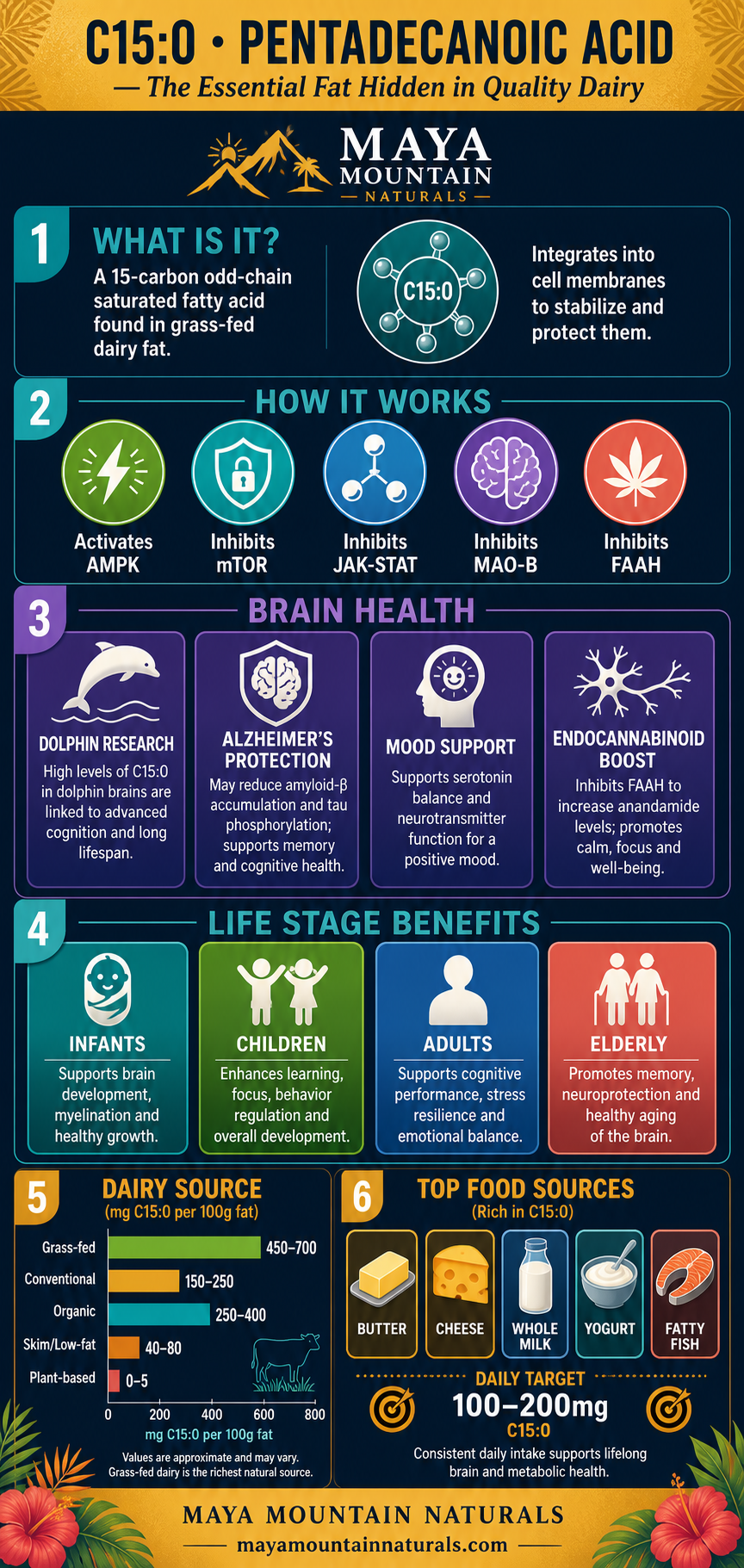
- It works across many pathways at once: activating AMPK and PPARα/δ, calming inflammatory and aging pathways (JAK-STAT, mTOR), strengthening cell membranes, and supporting mitochondria.
- Emerging studies link adequate C15:0 to brain health, healthy metabolism and liver fat, balanced mood, and longevity across every stage of life.
- A practical daily target is about 100–200 mg, achievable with grass-fed butter, hard cheese, whole milk, and yogurt.
Overview
For nearly fifty years, we were told saturated fat was the enemy. So we swapped full-fat dairy for skim milk, replaced butter with margarine, and watched chronic disease rates climb anyway. Now, a quiet revolution is underway in nutritional science — and it begins with a single molecule hiding in the cream.
Meet C15:0 (pentadecanoic acid), an odd-chain saturated fatty acid found in whole-fat dairy, grass-fed butter, and certain fatty fish. Researchers are calling it the first essential fatty acid to be discovered in over 90 years — since the omegas. Backed by more than 100 peer-reviewed studies, it is turning decades of dietary advice on its head. And if you have been eating quality, full-fat dairy from pastured animals, you may have been ahead of the curve all along.
What Exactly Is C15:0?
Think of C15:0 as a 15-carbon saturated fat — but with an important twist. Unlike the even-chain saturated fats (like palmitic acid C16:0) that have been blamed for raising cardiovascular risk, odd-chain saturated fatty acids behave differently in the body. Your body cannot make meaningful amounts of C15:0 on its own, which is the exact definition of an essential nutrient — something you must obtain from food.
C15:0 is produced primarily in the rumen (digestive system) of grass-fed animals, then deposited into their milk fat. This is why full-fat dairy from pasture-raised cows is the richest dietary source available to most people. The more diverse the pasture, the more C15:0 in the milk — and that is one powerful argument for quality dairy over commodity dairy.
How C15:0 Works: The Big Picture
What makes C15:0 genuinely remarkable is that it does not just do one thing. It operates across multiple biological pathways at the same time:
- Activates AMPK and PPARα/δ — the master switches for energy balance and anti-inflammatory response
- Inhibits JAK-STAT — a pathway closely linked to chronic inflammation and accelerated aging
- Inhibits mTOR — a key component of the longevity pathway also targeted by the drug rapamycin
- Physically integrates into cell membranes — making them more stable, more resilient, and less vulnerable to oxidative damage
- Enhances mitochondrial function — improving the energy output of every cell it touches
This physical integration into cell membranes is critical. When cells have fragile, unstable membranes, they become vulnerable to a newly described form of cell death called ferroptosis — where iron combines with fragile oxidized fats to destroy cells from the inside. Researchers now believe that low C15:0 levels may contribute to a condition called Cellular Fragility Syndrome, which appears to accelerate aging and chronic disease onset. The encouraging part: replenishing C15:0 has been shown to halt ferroptosis and reverse this syndrome in clinical models.
Brain Health: The Newest (and Most Exciting) Frontier
One of the most striking developments confirmed in 2025–2026 is that C15:0 is now linked to direct brain health benefits.
Researchers studying aging dolphins — one of the few animal species besides humans that naturally develop Alzheimer's-like amyloid-β plaques — made a startling discovery. Dolphins with higher circulating C15:0 levels showed significantly less amyloid accumulation and neuroinflammation in the hippocampus, the brain's memory center.
Digging deeper into the mechanism, scientists found two previously unknown actions of C15:0:
- Inhibits FAAH (fatty acid amide hydrolase) — helping preserve the body's natural endocannabinoid tone and protecting neurons from inflammatory damage
- Inhibits MAO-B (monoamine oxidase B) — the same enzyme targeted by certain Parkinson's and depression medications — supporting healthy dopamine levels and mood
The molecule C15:0 produces in the body — pentadecanoylcarnitine — turns out to be a newly discovered endocannabinoid with wide-ranging effects on mood, sleep, pain, and neurological resilience. In short, adequate C15:0 from quality dairy may help keep the brain's natural calming and protective chemistry intact.
In human studies, people with type 2 diabetes who had higher C15:0 levels performed significantly better on memory and overall cognitive assessments. Given that diabetes, fatty liver disease, and cardiovascular disease are all known accelerators of cognitive decline, addressing C15:0 deficiency may be one of the more accessible neuroprotective strategies available.
Benefits Across Every Stage of Life
🍼 Infants and Young Children
The earliest months of life may be the most critical window for C15:0. It passes through breast milk — and studies show that babies who received more C15:0 from their mothers during their first year showed healthier body growth and better cognitive development at ages 3 and 6. In animal models, C15:0 supplementation directly improved body growth in neonates, attributed to its role as a PPARα agonist and mitochondrial supporter.
One finding stands out for parents: children on reduced-fat dairy diets had circulating C15:0 levels roughly half those of children drinking whole-fat milk — directly relevant to decades of advice to give children low-fat milk during peak development years.
🧒 School-Age Children and Adolescents
In school-age children (ages 6–9), higher C15:0 levels were associated with greater skeletal muscle mass — relevant for physical development and metabolic health. A cross-sectional study of 421 children showed that higher odd-chain fatty acid levels (including C15:0) were associated with a 55–59% greater likelihood of having healthy blood pressure. A separate study of 237 children ages 8–17 found that higher C15:0 independently predicted lower liver fat — a finding that matters as childhood fatty liver disease rises globally.
🧑 Young Adults and Adults in Their Prime
For adults, the metabolic benefits of C15:0 are where the most clinical trial data currently lives. A randomized controlled trial in young adults with overweight and obesity showed that C15:0 improved liver function in participants who achieved healthy C15:0 thresholds. A landmark TANGO trial demonstrated that combining a Mediterranean-style diet with C15:0 significantly reduced fatty liver disease.
On cardiovascular and metabolic health, every 50% increase in circulating C15:0 was associated with an 8% reduction in type 2 diabetes risk across global prospective cohort meta-analyses. Higher C15:0 levels have been associated with lower systolic and diastolic blood pressure in studies involving nearly 7,000 participants. For mental health, a randomized controlled trial found C15:0 produced notable reductions in anxiety and depression markers within 12 weeks — connected to its role in supporting dopamine and endocannabinoid levels.
🧓 Older Adults and Longevity
In September 2024, at the 11th Aging Research and Drug Discovery Meeting in Copenhagen, Dr. Nicholas J. Schork of the NIH-funded Longevity Consortium presented data showing that C15:0 outranked both rapamycin and metformin — two of medicine's most studied longevity compounds — in breadth of clinically relevant geroprotective activities.
The supporting evidence includes:
- Targeting multiple hallmarks of aging simultaneously (cellular senescence, mitochondrial dysfunction, chronic inflammation, loss of proteostasis)
- A prospective cohort study of 4,000+ adults showing higher C15:0 levels were associated with lower cardiovascular disease risk and all-cause mortality over 16 years
- C15:0 levels measured significantly higher in adults living in longevity zones compared with low-longevity zones
The natural decline of C15:0 with age — coupled with the decades-long dietary shift away from full-fat dairy — may be one underappreciated contributor to the chronic disease burden in aging populations.
The Grass-Fed Difference
Not all dairy delivers equal amounts of C15:0. The key variable is what the cow eats. C15:0 is primarily produced by specific bacteria in the rumen during fermentation of high-forage diets. When cows eat grass and diverse pasture plants, these bacteria thrive and produce more C15:0. When cows eat corn and grain, these bacteria are suppressed and C15:0 output drops significantly.
| Dairy Type | C15:0 Content | Notes |
|---|---|---|
| Grass-fed, full-fat dairy | Highest | Pasture diversity boosts rumen C15:0 synthesis |
| Conventional full-fat dairy | Moderate | Varies based on grain vs. forage ratio |
| Organic (but grain-fed) dairy | Moderate | Organic label ≠ grass-fed |
| Low-fat / skim dairy | Negligible | C15:0 is bound to fat — remove the fat, lose the C15:0 |
| Plant-based dairy alternatives | Zero | No ruminant fat = no C15:0 |
Cheese is an especially concentrated source because the cheese-making process removes water and concentrates milk fat — and with it, C15:0. Traditional raw, grass-fed cheeses are about as nutrient-dense as dairy gets.
C15:0 vs. Omega-3s: How Do They Compare?
This comparison surprises a lot of people. A head-to-head cell study pitting C15:0 against EPA (the primary omega-3 in fish oil) across 12 human cell systems found:
- C15:0 outperformed EPA in reducing inflammation, supporting metabolism, boosting mood, and demonstrating antimicrobial and anti-cancer activities
- C15:0 was non-toxic at every dose tested; EPA showed cell toxicity in 4 of the 12 systems at high doses
The reason? Omega-3s are polyunsaturated fats with unstable double bonds that can oxidize and become pro-inflammatory in excess. C15:0 is a stable saturated fat that resists oxidation and reinforces rather than destabilizes cell membranes.
This does not mean to throw away your fish oil — omega-3s still have important roles. But it does suggest that C15:0 from quality dairy may provide a category of cellular protection that fish oil simply cannot replicate.
Practical Takeaways for Your Daily Life
Getting enough C15:0 through food is very achievable if you make the right choices. Research suggests a daily target of 100–200 mg of C15:0 to maintain healthy blood levels.
Richest food sources:
- 🧈 Grass-fed butter (1 tablespoon provides approximately 75–100 mg C15:0)
- 🧀 Grass-fed hard cheese (1 oz provides approximately 50–75 mg C15:0)
- 🥛 Full-fat grass-fed milk (1 cup provides approximately 50–70 mg C15:0)
- 🐄 Whole-fat grass-fed yogurt or kefir
- 🐟 Certain fatty fish (lower amounts, but still a contributor)
Practical daily approach:
- Use grass-fed butter generously in cooking rather than seed oils
- Include a serving or two of full-fat grass-fed dairy daily (whole milk, cheese, yogurt)
- Source from farms that prioritize pasture — look for "100% grass-fed" certification
- If using raw dairy where available and legal, it offers the same fat-soluble nutrient profile in its most unprocessed form
For those with dairy intolerance or who want to guarantee therapeutic-level intake, a pure C15:0 supplement called Fatty15 (by Seraphina Therapeutics) is the only commercially available option with published clinical trial data.
A Note on the Science
The bulk of C15:0 research has been pioneered by Dr. Stephanie Venn-Watson — a Navy scientist who first noticed that aging dolphins with higher C15:0 levels stayed dramatically healthier longer. Her work has generated over 100 peer-reviewed publications, clinical trials at institutions including Rady Children's Hospital, and presentations at major aging research conferences.
It is worth noting that not every study has found a causal cardiovascular benefit — a 2026 Frontiers in Nutrition study using Mendelian randomization found observational associations between C15:0 and blood pressure but could not confirm causality through genetic analysis. The metabolic and cellular mechanisms are well-established; the direct cardiovascular causality question is still being refined by larger trials. This is normal for an emerging essential nutrient — the preponderance of evidence is strongly positive, and the risk profile is excellent.
The Bottom Line
C15:0 is the best argument yet that the war on saturated fat was oversimplified and, in key ways, counterproductive. By swapping full-fat dairy for reduced-fat alternatives — and by shifting away from quality, pasture-based animal products toward processed plant-based substitutes — modern diets may have inadvertently created a widespread nutritional gap with real consequences for brain health, metabolic health, liver health, and longevity.
Quality dairy — especially from grass-fed, pasture-raised animals — is not just "acceptable." It may be one of the most strategically important foods in a long-term wellness approach. From infants building brains to seniors protecting cognitive function, C15:0 is a nutrient that belongs back on the table.
Frequently Asked Questions
Frequently asked questions
What is C15:0?
C15:0, or pentadecanoic acid, is a 15-carbon odd-chain saturated fatty acid found mainly in full-fat dairy from grass-fed animals. Researchers describe it as the first essential fatty acid discovered in over 90 years because the body cannot make meaningful amounts on its own.
Why is it called "essential"?
A nutrient is "essential" when the body needs it but cannot produce enough on its own, so it must come from food. C15:0 fits that definition, which is why dietary sources like grass-fed dairy matter.
What is the best food source of C15:0?
Full-fat dairy from grass-fed, pasture-raised animals is the richest source — especially grass-fed butter and hard cheese, followed by whole milk and full-fat yogurt. Certain fatty fish contribute smaller amounts.
How much C15:0 should I aim for?
Research suggests a daily target of roughly 100–200 mg to maintain healthy blood levels, which is achievable through grass-fed butter, cheese, and whole-fat dairy.
Is low-fat or skim milk a good source?
No. C15:0 is bound to the fat in dairy, so removing the fat removes the C15:0. Reduced-fat dairy provides negligible amounts.
Do I need a supplement?
Most people can reach a healthy intake through quality full-fat dairy. For those with dairy intolerance or who want a guaranteed daily dose, a pure C15:0 supplement (Fatty15) is the only option with published clinical-trial data.
Is C15:0 safe?
In studies to date, C15:0 has shown an excellent safety profile and was non-toxic at every dose tested. As always, this information is educational — talk with a qualified health professional before starting any new supplement, especially if you are pregnant, breastfeeding, or managing a health condition.
This article is for educational purposes and does not constitute medical advice. Consult a qualified health practitioner for personalized guidance.