Better Fats, Slower Wear-and-Tear: C15:0, Linoleic Acid, and Grass-Fed Dairy
Most people worry about how much fat they eat. The more useful question is what kind of fat is being built into their cells. Cut seed-oil linoleic acid, favor grass-fed full-fat dairy and beef, and steadily shift cell membranes toward stable, resilient fats like C15:0.
Maya Mountain Naturals Editorial · Vital Codex · 12 min read
Quick answer
- The problem for most modern eaters is not too little essential fat — it is far too much fragile linoleic acid (LA) from seed oils.
- LA has multiple double bonds and oxidizes easily; C15:0 has none and is structurally stable, making it a more resilient building block for cell membranes.
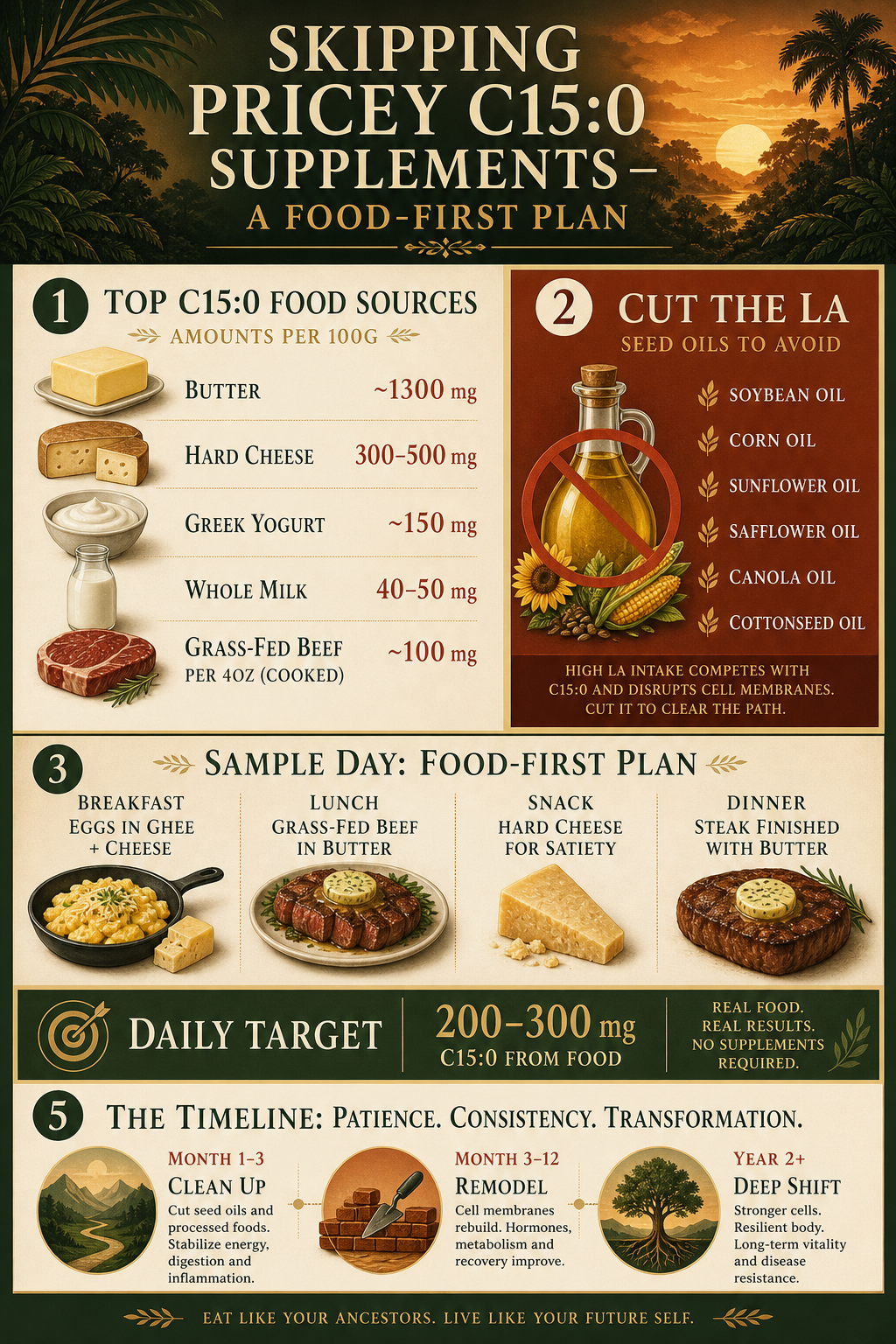
- Cut seed oils (soybean, corn, sunflower, safflower, cottonseed, canola, grapeseed) and processed foods; add grass-fed butter, ghee, hard cheese, cream, full-fat yogurt and cottage cheese, and grass-fed beef or lamb.
- Full-fat, grass-fed matters — low-fat dairy strips out the milk-fat fraction that carries C15:0, CLA, and fat-soluble nutrients.
- Think 12–24 months. Membranes remodel slowly, and consistency beats perfection.
Vital Basics
Most people spend a lot of time worrying about how much fat they eat. The more useful question is what kind of fat is being built into their cells. In this article, that comes down to two very different fats: C15:0, a stable odd-chain saturated fat found mainly in ruminant foods, and linoleic acid (LA), a fragile omega-6 fat that now dominates much of the modern processed food supply.
For most people in the modern West, the problem is not getting enough LA. It is getting far too much of it. Reviews of the modern Western diet describe LA exposure as commonly landing around 6% to 9% of total calories, and popular food sources include seed oils, packaged foods, restaurant fryers, and grain-fed animal fats. That is why the practical Vital Codex message is not "find more essential fatty acids." It is "stop overloading your body with the most fragile one."
Fragile fats vs resilient fats
LA contains multiple double bonds, which makes it easier to oxidize under metabolic stress, inflammation, heat, and ultraviolet exposure. C15:0 has no double bonds, which makes it structurally more stable and less vulnerable to oxidative breakdown. Over time, this difference matters because cell membranes are built from the fats a person eats regularly. A diet that constantly feeds tissues fragile fats is more likely to leave those tissues vulnerable to oxidative wear, while a pattern richer in stable ruminant fats may support stronger, calmer membranes.
Where these fats come from
High-LA foods are not hard to find. They include soybean, corn, sunflower, safflower, cottonseed, canola, and grapeseed oils, along with fast food, commercial dressings, packaged snacks, and much of the fat from grain-fed poultry and pork. Foods that provide more C15:0 and other more resilient fats include butter, ghee, hard cheeses, cream, full-fat yogurt, full-fat cottage cheese, and grass-fed beef or lamb. Low-fat dairy still offers protein and calcium, but it removes much of the milk-fat fraction that carries odd-chain saturated fats and other bioactive compounds.
Why full-fat, grass-fed matters
Full-fat dairy keeps the portion of milk that contains C15:0, C17:0, CLA, and fat-soluble nutrients, while low-fat dairy strips much of that away. Recent reviews no longer support the old blanket idea that full-fat dairy is inherently harmful. In fact, newer syntheses report that full-fat dairy is often neutral or favorable for cardiometabolic health, especially when dairy foods are evaluated as foods rather than as isolated saturated fat. Grass-fed dairy and beef add another advantage because they typically provide more omega-3s and CLA and a better omega-6 to omega-3 balance than grain-heavy industrial systems.
Better fats and skin stress
This story is not only about the heart, liver, or waistline. It may matter for the skin too. UV exposure drives oxidative stress in skin lipids, and photoaging research shows that ultraviolet radiation alters lipid composition and contributes to peroxidation damage in skin tissues. Because LA is one of the more oxidizable fats in that environment, a body already loaded with fragile fats may be carrying more material that can be damaged under sun stress. The skin literature is not perfectly one-sided, and some context-specific studies report protective effects of LA in certain cell or topical settings, so this should not be oversimplified. But from a whole-diet perspective, there is no practical need to chase more LA for skin health when modern diets already provide plenty of it.
A realistic food pattern
A practical food-first approach does not require eating absurd amounts of dairy fat or turning every meal into a spreadsheet. A simple pattern might include:
- 2 to 3 tablespoons of grass-fed butter or ghee across the day
- 2 to 3 ounces of hard cheese
- 1/2 to 1 cup of full-fat cottage cheese or plain full-fat yogurt
- 6 to 8 ounces of grass-fed beef or lamb
The point is not precision. The point is steadily replacing fragile industrial fats with more stable, nutrient-dense animal fats from better sources.
What this means in plain English
This is not about chasing a miracle food. It is about changing the raw materials the body uses to build and maintain tissues. Lower LA intake means fewer peroxidation-prone fats in membranes, while more C15:0 and other stable ruminant fats may help tissues handle stress with less damage over time. In plain English, choosing grass-fed full-fat dairy and beef over seed-oil-heavy processed foods should help cells, skin, and metabolism age more gracefully.
Codex Insights
The deeper question is whether shifting away from industrial seed-oil-heavy eating toward grass-fed full-fat dairy and beef can meaningfully influence the pace of biological wear-and-tear. The current literature does not justify claiming that a dietary pattern can stop aging. It does, however, support a more careful conclusion: reducing excess LA while increasing exposure to resilient ruminant fats, especially C15:0, likely shifts membrane composition, mitochondrial function, inflammatory tone, and nutrient signaling in ways that are compatible with slower cellular damage accumulation.
C15:0 as a longevity-relevant fat
C15:0 has attracted attention because it behaves differently from the generic "saturated fat" category that shaped older nutrition advice. In mechanistic and translational work, pentadecanoic acid has been associated with broad activities relevant to cardiometabolic, immune, liver, and cellular health. One reason is that C15:0 appears to interact with AMPK and mTOR, two pathways central to energy sensing, autophagy, repair, and longevity biology. AMPK activation generally supports energy efficiency and cellular repair, while lower mTOR signaling is commonly associated with improved housekeeping, reduced growth pressure, and greater stress resistance. That does not mean a pat of butter is a longevity drug. It does mean C15:0 sits inside real biological pathways that aging researchers already care about.
Another important distinction is that C15:0 is an odd-chain saturated fat. During beta-oxidation, odd-chain fats yield propionyl-CoA, which can replenish succinyl-CoA and support tricarboxylic acid cycle flux. In practical terms, that means C15:0 is not only a membrane fat. It may also contribute to mitochondrial energy handling in a way that differs from even-chain saturated fats such as palmitic acid. Meta-analyses of fatty-acid biomarkers continue to report a different risk profile for odd-chain versus even-chain saturated fats, with odd-chain markers tracking inversely with cardiometabolic disease risk.
Membranes, peroxidation, and ferroptosis
The Vital Codex idea that "food quality shapes tissue quality" is especially relevant to membranes. Cell membranes are active structures whose fatty-acid composition influences fluidity, signaling, receptor behavior, oxidative vulnerability, and mitochondrial performance. LA, because of its double bonds, is substantially more vulnerable to lipid peroxidation than saturated fats, and excess membrane PUFA content can increase the susceptibility of tissues to oxidative chain reactions. This matters because peroxidized lipids are not passive debris. They generate reactive breakdown products and can contribute to ferroptosis, an iron-dependent form of cell death driven by PUFA peroxidation.
C15:0 is notable in this context because it is structurally stable and has been discussed as supporting membrane resilience under stress. A membrane pattern with relatively less LA and relatively more stable fats should, in theory, generate less oxidative cracking under heat, UV exposure, inflammatory signaling, and mitochondrial stress.
Why LA is still controversial
LA remains controversial because it is essential in small amounts, and mainstream dietary models still emphasize replacing saturated fats with polyunsaturated fats to improve certain cardiovascular risk markers. That position should be acknowledged honestly. At the same time, essential does not mean scarce. The modern Western diet already provides LA in abundance, and current intake estimates make deficiency an unlikely real-world concern for most adults. The practical argument is not that LA must be eliminated. It is that chronically excessive LA exposure may be a poor match for long-term membrane stability in an environment already burdened by processed food, repeated frying, hypercaloric eating, and oxidative stress.
Narrative reviews critical of excess LA emphasize its incorporation into adipose tissue and cell membranes, where it can be converted into oxidized linoleic acid metabolites and related oxylipins involved in inflammatory signaling, hepatic steatosis, adipocyte dysfunction, and oxidative stress.
Full-fat dairy vs low-fat dairy
If the goal is improving membrane inputs, low-fat dairy is not a true substitute for full-fat dairy. Low-fat milk, yogurt, and cottage cheese still provide protein, calcium, and some vitamins, but they lose much of the milk-fat fraction that carries odd-chain saturated fats, CLA, and fat-soluble compounds. Multiple reviews and pooled analyses now find little evidence that full-fat dairy is detrimental to cardiometabolic health, and some evidence suggests it may be neutral or favorable depending on the food matrix and outcome examined.
This is often framed as a "dairy fat paradox," but the paradox softens once the dairy matrix is taken seriously. Dairy is not just a lump of saturated fat. It is a structured package of odd-chain fats, phospholipids, proteins, minerals, fermentation products, and fat-soluble compounds. Remove the fat, and some of the most interesting metabolic features go with it.
Cottage cheese as a support food
Cottage cheese deserves a short separate note because it is practical, protein-rich, and easy to use. It can support satiety, calcium intake, and blood-sugar stability, especially when used as a breakfast or snack anchor. But for a C15:0-oriented strategy, its value depends heavily on fat content. Food-composition data indicate that low-fat cottage cheese delivers far less C15:0 than hard cheeses, cream cheese, sour cream, or butter. That makes cottage cheese a support food rather than a primary driver of odd-chain fat status.
Grass-fed vs industrial dairy and beef
The grass-fed distinction matters because pasture-based systems repeatedly show more favorable fatty-acid patterns than grain-heavy confinement systems. In beef, grass-fed patterns tend to improve the omega-6 to omega-3 ratio and increase omega-3s and CLA. In dairy, grass-fed feeding is associated with richer fat-soluble nutrient content and better lipid quality, including more omega-3s and CLA and, in some settings, more odd-chain saturated fats. Exact C15:0 differences vary by season, herd, and analytical method, so this is not a place for false precision. But as a broad pattern, grass-fed full-fat dairy and beef move in the right direction: less industrial omega-6 burden, more beneficial ruminant lipids, and a food matrix closer to what humans consumed before large-scale industrial feeding systems.
Industrial or "big ag" dairy also dominates the market for low-fat, flavored, stabilized, and sweetened products. The more damaging pattern is reduced-fat dairy plus added sugars plus gums plus the broader seed-oil-heavy food environment.
Sun damage, skin aging, and lipid quality
The skin angle deserves deeper treatment because it is both intuitive and mechanistically plausible. Photoaging research shows that ultraviolet exposure alters epidermal lipid composition, increases oxidative stress, and contributes to structural skin damage over time. UV-driven lipid peroxidation is one of the major biochemical routes through which light exposure accelerates visible and invisible skin aging. Since LA is among the more oxidation-prone fats in skin-relevant lipid environments, a person with chronically high tissue LA may be carrying a larger pool of peroxidizable material into sun exposure.
This area needs nuance. Some cell and topical studies report context-specific protective effects of LA against certain UVB-related injuries. But other in vivo studies suggest linoleic acid can aggravate UV-induced damage markers in some settings. Taken together, the cleanest conclusion is that modern diets already provide ample LA, while the skin-aging case for intentionally increasing dietary LA remains weak compared with the broader concern that excess oxidizable fats may worsen photo-oxidative burden under real-world sun stress.
The most defensible aging claim
The aging claim should stay measured. No human trial shows that switching from canola oil to grass-fed butter instantly makes a person biologically younger. But several strands of evidence converge in the same direction. Higher circulating C15:0 is associated with healthier aging-related phenotypes and lower chronic disease burden. C15:0 engages AMPK and mTOR pathways relevant to longevity science. Lower tissue loading with LA should reduce the substrate available for lipid peroxidation. Grass-fed dairy and beef also provide additional compounds, including CLA and fat-soluble nutrients, that may support antioxidant capacity, mitochondrial function, and lower inflammatory tone.
Taken together, the most defensible statement is this: a diet centered on grass-fed full-fat dairy and beef, while sharply reducing seed oils and other industrial LA sources, should support slower cellular aging by improving membrane stability, reducing oxidative damage potential, and favorably influencing core metabolic signaling pathways.
Practical use and tracking
For real-world use, a tiered approach keeps the concept grounded:
- Baseline food-only tier: remove seed oils and heavily processed foods while reintroducing moderate amounts of full-fat dairy and ruminant fat.
- Optimized food tier: deliberately emphasize grass-fed butter or ghee, hard cheeses, cream, full-fat cultured dairy, and 6 to 8 ounces of grass-fed beef or lamb daily.
- Hybrid tier: add modest purified C15:0 supplementation for people who want more measurable movement in blood biomarkers or who cannot get enough from food alone.
Where possible, objective tracking beats guesswork. Red-blood-cell fatty-acid testing over 3- to 6-month intervals can help monitor whether LA is falling and whether odd-chain fatty-acid status is improving.
Closing perspective
The strongest version of this argument is not that grass-fed dairy and beef are magical foods. It is that they are useful tools for replacing fragile industrial fats with more stable, nutrient-dense ruminant fats that better support membranes, mitochondria, and long-term metabolic resilience. Vital Basics carries the plain-language message: cut seed oils, choose full-fat grass-fed dairy and beef, and stay consistent. Codex Insights carries the deeper claim: this pattern plausibly slows cellular wear by changing membrane composition, oxidative vulnerability, and nutrient signaling over time.
Frequently Asked Questions
Frequently asked questions
What is C15:0 and why does it matter?
C15:0 (pentadecanoic acid) is an odd-chain saturated fat found mainly in ruminant foods like butter, cheese, and grass-fed beef. It has no double bonds, making it structurally stable, and it engages AMPK and mTOR pathways central to longevity biology.
Why is linoleic acid (LA) a problem if it's essential?
LA is essential only in small amounts, and modern diets already provide 6-9% of calories from it — far more than needed. Excess LA loads cell membranes and adipose tissue with peroxidation-prone fats that can drive inflammation and oxidative wear.
Which foods should I cut first?
Seed oils — soybean, corn, sunflower, safflower, cottonseed, canola, grapeseed — plus fast food, commercial dressings, packaged snacks, and grain-fed poultry and pork fat.
Which foods should I add?
Grass-fed butter and ghee, hard cheeses, cream, full-fat yogurt and cottage cheese, and grass-fed beef or lamb. Full-fat and grass-fed matter — low-fat dairy strips out the C15:0 fraction.
Is full-fat dairy safe long term?
Recent reviews and pooled analyses find full-fat dairy is neutral or favorable for cardiometabolic health when the rest of the diet is clean of ultra-processed foods and seed oils.
Do I need a C15:0 supplement?
Most people don't. A food-first pattern of grass-fed butter, hard cheese, and grass-fed beef delivers a meaningful daily dose. Supplements make more sense for people who can't eat dairy or beef.
How long before I see results?
Cell membranes and fat stores remodel slowly. Expect 1-3 months to settle into the pattern, 3-12 months for membrane and inflammation shifts, and 2+ years for deeper changes in stored fat composition.
Is this medical advice?
No. This article is educational. Talk with a qualified health practitioner before making major dietary changes.
This article is for educational purposes only and does not constitute medical advice.