Microplastics in the Body: Latest Research, Natural Detox Support, and Herbal Allies
Microplastics are turning up in human organs, but there's no proven way to extract them once embedded. The evidence-based natural strategy: lower exposure, support gut elimination with fiber and fermented foods, and use liver and antioxidant herbal allies for resilience.
Maya Mountain Naturals Editorial · Published June 16, 2026 · 9 min read
Quick answer
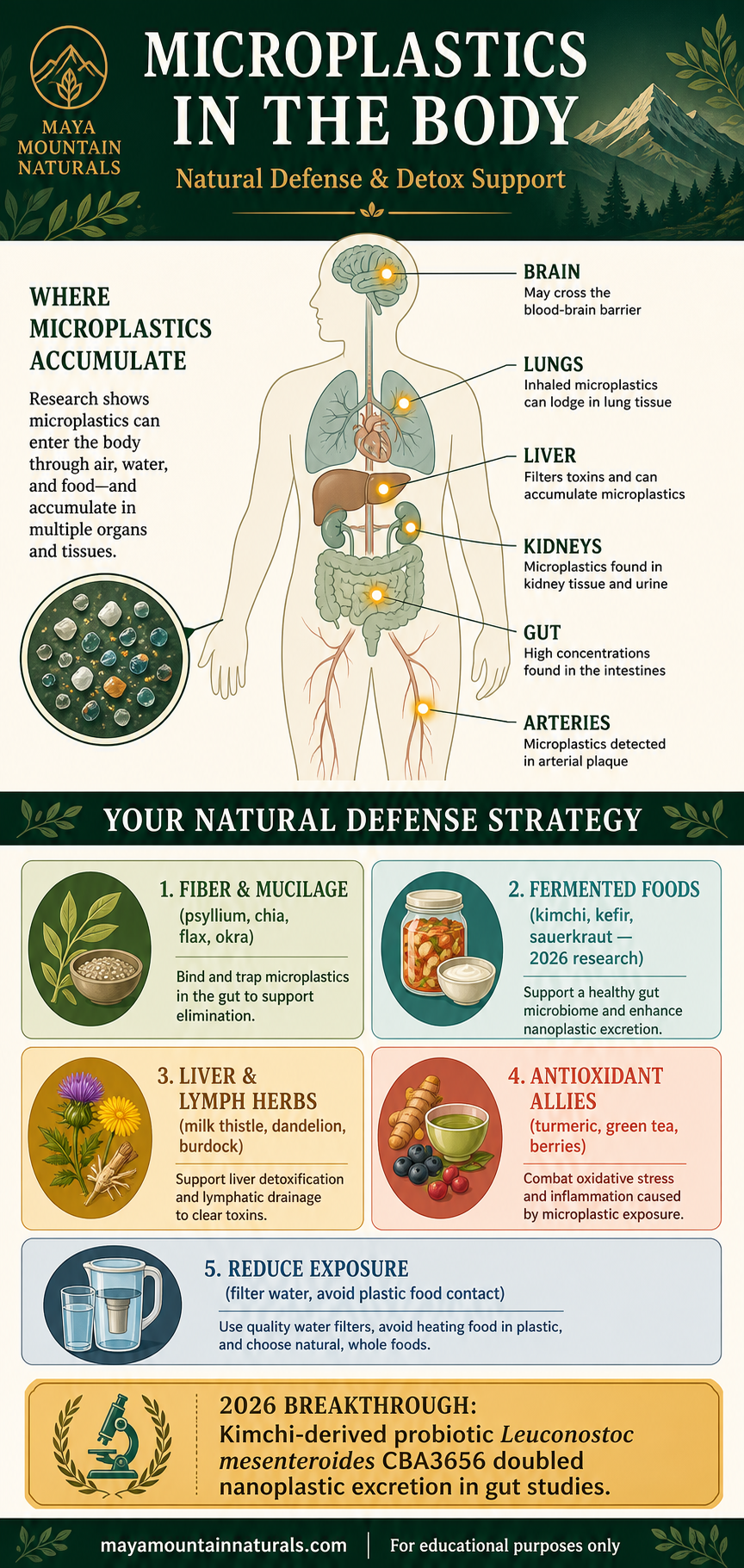
- Microplastics are now being detected in multiple human organs — including the liver, kidneys, intestines, lungs, and even brain tissue.
- There is no proven way to pull embedded microplastics back out of organs, so the evidence-aligned strategy is to lower exposure, reduce absorption, and support the body's natural elimination routes.
- The most promising new research targets the gut: fiber and probiotics (notably a 2026 kimchi-derived strain) that bind particles and increase fecal excretion.
- Herbs like milk thistle, dandelion root, burdock, and turmeric are best understood as detox-pathway and resilience supporters — not microplastic removers.
- The biggest, most dependable wins are preventive: filter your water, avoid heating food in plastic, and eat a fiber-rich, fermented-food, whole-food diet.
Microplastics are now being detected in multiple human organs, and the newest research suggests the real issue is not a simple “detox” question but a broader strategy of lowering exposure, reducing absorption, supporting elimination, and limiting inflammatory damage. The evidence for fully clearing established microplastics from human tissues is still early, but several natural approaches now have at least mechanistic or animal-level support, especially gut-focused fiber, probiotic, and bile-supported elimination strategies.
What are microplastics, and why do they matter?
Microplastics are plastic particles smaller than 5 millimeters, while nanoplastics are much smaller fragments that can more easily cross biological barriers and enter tissues. Current reviews report that these particles can trigger oxidative stress, inflammation, endocrine disruption, gut dysfunction, and possibly genotoxic effects once they accumulate in the body. The concern is not just the plastic particle itself, but also the additives and hitchhiking pollutants that may travel with it.
Where are microplastics found in the body?
Recent tissue-mapping work found microplastics across all seven major organs examined, with especially high burdens reported in the liver, small intestine, and kidneys. Other research has also identified substantial burdens in lung tissue and intestinal tissue, while separate studies have reported particles in placenta, brain, liver, and kidney samples. Brain findings are receiving special attention because one 2025 report found increasing concentrations over time in human liver and brain samples, with even greater accumulation in decedent brains from people with documented dementia.
Can the body remove microplastics naturally?
Yes, at least in part, because the gastrointestinal tract can eliminate particles that remain in the gut lumen and do not cross into deeper tissues. However, there is still no strong human clinical evidence showing that a supplement, herb, or protocol can reliably pull embedded microplastics back out of organs once they have accumulated there. That means the most evidence-aligned strategy is to reduce incoming exposure while improving the body's normal elimination routes: stool, bile-supported excretion, and possibly sweat for certain plastic-associated chemicals rather than the particles themselves.
What is the latest research on actually clearing them?
The most promising new line of research is gut binding and fecal excretion rather than “deep tissue cleansing.” In 2026, researchers reported that Leuconostoc mesenteroides CBA3656, a lactic acid bacterium isolated from kimchi, bound nanoplastics under simulated intestinal conditions and more than doubled nanoplastic excretion in germ-free mice. This does not prove the same outcome in humans yet, but it strongly supports the idea that the gut is the most practical therapeutic target right now.
Do herbs directly dissolve or extract microplastics from tissues?
No herb has been clinically proven to dissolve or extract microplastics from human tissues. Most herbal and natural strategies are more accurately described as supportive: they may reduce absorption in the gut, improve bile flow and bowel transit, support liver resilience, protect mucosal barriers, and reduce oxidative stress triggered by plastic exposure. This distinction matters because exaggerated detox claims are moving faster than the science.
Which natural solutions make the most sense right now?
1. Fiber and mucilage
Fiber is one of the most practical first-line tools because it can bind waste, support regular bowel movements, and increase bile-mediated elimination in the gut. Psyllium, chia, flax, oats, legumes, and vegetable-rich diets fit this model well, and mucilaginous plants such as okra are being discussed because their polysaccharides can help trap contaminants in aqueous environments. The strongest practical conclusion is that a high-fiber, high-plant diet is more defensible than a single “miracle” herb.
2. Fermented foods and probiotic support
Fermented foods now deserve serious attention because of the 2026 kimchi-derived probiotic findings. Although the exact study strain is not available as a standard supplement in most markets, regularly using kimchi, sauerkraut, kefir, yogurt, and other live fermented foods is a reasonable food-first strategy for supporting gut ecology while the human research develops. This is one of the most interesting new areas for future natural microplastic protocols.
3. Liver and bile support herbs
Milk thistle, dandelion root, and burdock are better framed as detox pathway supporters than microplastic removers. Milk thistle may help protect liver cells from oxidative stress, dandelion may support bile flow, and burdock is traditionally used for lymphatic and eliminative support. These herbs are most rational when used to help the body manage the inflammatory and chemical burden associated with plastic exposure, not as stand-alone proof of plastic clearance.
4. Antioxidant and barrier-support allies
Turmeric, green tea, berries, sulfur-rich foods, and other antioxidant-rich plants may help counter the oxidative stress and inflammation associated with microplastic exposure. This category does not remove the particles directly, but it may reduce collateral damage to tissues, gut lining, and metabolic signaling. In practical terms, antioxidant support is a resilience strategy rather than a direct extraction strategy.
5. Algae such as chlorella and spirulina
Chlorella and spirulina are frequently recommended in natural health circles, but the strongest evidence so far comes from environmental and aquatic-system research rather than human detox trials. A 2025 analysis described Chlorella and Spirulina as candidate microalgae for microplastic removal in aquatic systems, which makes them biologically interesting but not yet clinically proven for removing plastics from human tissues. They may still have value as nutrient-dense adjuncts or as gut-level binders in practice, but that remains a cautious, extrapolated position.
What should be avoided?
The weakest claims are those promising that one herb, smoothie, or short cleanse can “flush microplastics out of every organ.” Daily overuse of aggressive binders such as activated charcoal or clays can also interfere with nutrient absorption and medications, so they are not ideal as casual long-term defaults. Heating food in plastic, drinking from low-quality plastic bottles, and storing hot or fatty foods in plastic remain among the most avoidable ongoing exposure sources.
A practical natural microplastic-defense strategy
| Area | Practical approach | Rationale |
|---|---|---|
| Water | Use reverse osmosis or a high-quality filtration system where possible. | Reduces incoming exposure at a primary daily source. |
| Food contact | Prefer glass, stainless steel, and ceramic for hot food and storage. | Helps lower repeat ingestion from packaging and heating. |
| Diet | Emphasize fiber-rich whole foods, especially legumes, seeds, vegetables, and oats. | Supports bowel transit and bile-linked waste elimination. |
| Fermented foods | Include kimchi, sauerkraut, kefir, yogurt, or similar live foods regularly. | Aligns with emerging probiotic research on gut binding and excretion. |
| Herbal support | Consider milk thistle, dandelion root, burdock, and turmeric in appropriate formulations. | Supports liver, bile, lymphatic, and inflammatory balance rather than direct tissue extraction. |
| Lifestyle | Avoid overheating plastics, reduce ultraprocessed packaged foods, and support regular sweating and sleep. | Lowers exposure and may improve overall waste-processing physiology. |
Frequently asked questions
Can sweating or sauna remove microplastics?
Sweat may help eliminate some plastic-associated chemicals such as BPA, but current evidence does not show that sauna reliably removes significant amounts of intact microplastic particles from tissues. Sauna is better understood as a general metabolic-support practice than a proven microplastic-clearing therapy.
Can fasting clear microplastics?
There is no solid human evidence showing that fasting specifically clears microplastics from tissues. In some people, fasting may temporarily reduce exposure from packaged foods, but the strongest evidence still favors consistent high-fiber eating patterns, better food storage, and gut-supportive elimination rather than fasting alone.
Are children, pregnant women, or people with chronic illness at higher risk?
They may be more vulnerable because developing tissues, placental exposure, endocrine signaling, and inflammatory load all raise concern, even when hard outcome data are still developing. That makes low-exposure household practices especially important in pregnancy, infancy, and chronic inflammatory conditions.
Are bottled water and ultraprocessed foods major sources?
Yes, they are consistently treated as important exposure routes in current discussions of prevention. The simplest natural-medicine advice is often the most powerful here: filter water, store food in non-plastic containers, and shift toward minimally packaged whole foods.
MMN takeaways
The newest research does not support hype-heavy claims that herbs can pull microplastics out of every organ, but it does support a thoughtful natural strategy centered on prevention, gut binding, elimination, and tissue protection. The most promising emerging intervention is probiotic-assisted fecal excretion, especially the kimchi-derived Leuconostoc mesenteroides findings from 2026, while the most dependable current tools remain fiber-rich foods, fermented foods, lower-plastic food handling, and well-chosen liver and antioxidant herbs. For an MMN audience, the most accurate message is this: natural medicine can likely help reduce burden and improve resilience, but claims of complete herbal clearance are ahead of the evidence.