The Drum Inside the Body: Your Living Resonant Architecture and How to Tune It
Your body is a living drum of bone, fascia, and fluid. Learn how heartbeat, breath, and rhythm heal you — plus 7 simple practices to tune your nervous system.
Author: Maya Mountain Naturals Editorial · Published June 8, 2026 · 14 min read
Your Body Is Already Playing Music
Here is something most people never learn in a biology class: your body is not just a chemical factory. It is a living, vibrating, pulsing instrument — more like a drum than a machine.
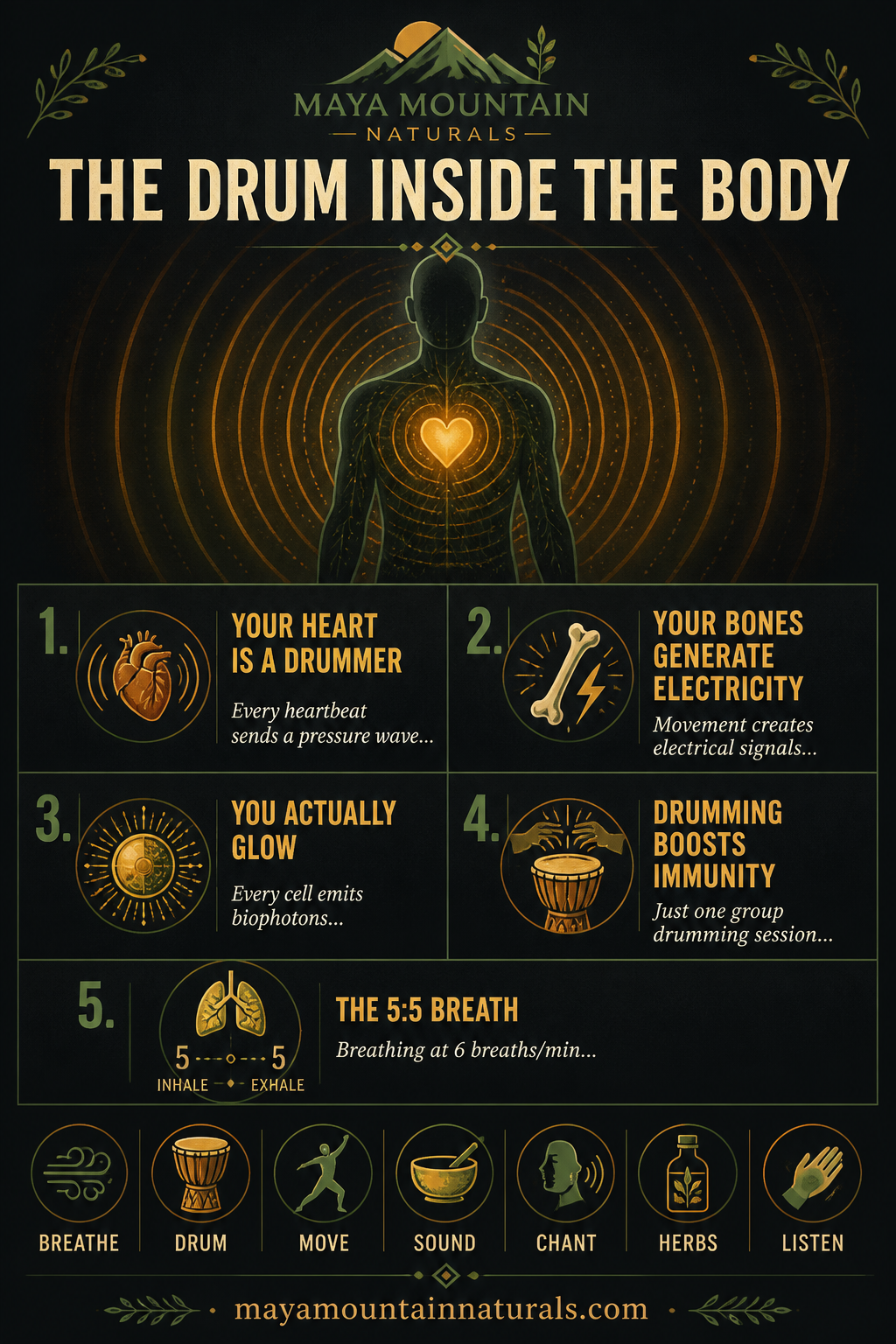
Every heartbeat sends a pressure wave rippling through your blood, your bones, your brain, and every cell in your body. Your breath creates its own rhythmic tide. Your bones generate tiny electrical charges when you move. Even your cells glow — emitting faint pulses of light as part of how they communicate.
Science is now confirming what ancient healers in every culture seemed to already know: rhythm heals. Not as a metaphor. Literally, measurably, at the cellular level.
This article breaks down what is happening inside you — and gives you simple, practical tools to work with your body's natural rhythms instead of against them.
Quick answer
- Your body behaves like a living drum: a resonant chamber of bone, fascia, and fluid that runs on rhythm, pressure waves, and tiny electrical signals.
- A 2024 Science study showed the brain directly "feels" each heartbeat through fast mechanosensitive (Piezo) ion channels — the heartbeat is a timing signal, not just a pump.
- Bone and fascia are piezoelectric: movement, vibration, and touch generate the bioelectrical signals that guide repair and self-organization.
- Simple practices retune the system — resonance breathing at ~6 breaths per minute (0.1 Hz), drumming, sound baths, chanting, and weight-bearing movement.
- Certain botanicals (ashwagandha, lion's mane, reishi, bacopa, magnesium) are traditionally used to support the autonomic balance and nerve signaling this architecture relies on.
The Heartbeat: Way More Than a Pump
Most of us think of the heart as a pump that moves blood around. That is true — but it is only part of the story.
A landmark 2024 study published in the journal Science discovered something remarkable: your brain actually feels every heartbeat. Researchers at the University of Regensburg found specialized brain cells that detect the pressure wave from each heartbeat within just 20 milliseconds — faster than you can consciously perceive anything — through fast mechanosensitive ion channels (most likely Piezo2). That wave directly shapes how your neurons fire, how you think, how you feel, and how you regulate stress.
Think about that for a moment. Your heart is not just delivering oxygen. It is sending a rhythmic signal to your entire nervous system with every single beat. The heart is the body's primary drummer, setting the tempo for everything else.
This is why heart health is inseparable from mental health, mood, and cognitive clarity. A healthy, rhythmically coherent heart does not just keep you physically alive — it keeps your brain organized and your nervous system calm.
Your Bones and Connective Tissue Are Electric
Here is another fact that sounds like science fiction but is well established: your bones generate electricity when you move.
This is called piezoelectricity — the ability of certain crystalline materials to produce an electrical charge when compressed or stretched. Quartz crystals do it. So does bone. And so does fascia — the thin, web-like tissue that wraps every muscle, organ, nerve, and bone in your body in a continuous sheet.
Every time you walk, stretch, jump, or even take a deep breath, your body generates tiny electrical currents through these tissues. Those currents are not wasted — they are signals that tell your cells where to build new bone, how to repair damaged tissue, and how to regulate fluid and inflammation throughout the body.
This is why movement is not just good for your heart and lungs. Movement is electrical medicine. It activates signals that are essential for healing, repair, and biological coordination that no pill can replicate.
You Even Glow (Seriously)
Every cell in your body continuously emits tiny pulses of light — so dim that you need specialized equipment to detect them, but absolutely real and measurable. Scientists call these biophotons.
These are not random sparks. They appear to be part of how cells coordinate with each other — a kind of light-based language running alongside the chemical signals we learn about in school. When cells are healthy and organized, biophoton emission is orderly. When there is stress, damage, or disease, the light patterns become erratic.
The practical implication? Anything that supports cellular health — deep sleep, clean nutrition, stress reduction, sunlight, and yes, rhythmic practices like breathwork and movement — also supports the coherence of your body's inner light system.
What Drumming Actually Does to Your Body
This is where it gets exciting for everyday wellness.
In a controlled clinical trial led by Dr. Barry Bittman, groups of people who participated in a single session of group drumming showed measurable improvements in their immune markers right afterward — specifically, increased activity of natural killer (NK) cells, the white blood cells that hunt down and clear virally infected cells. Their stress hormone ratios (DHEA-to-cortisol) also improved.
You do not need to be a drummer. You do not need any musical skill. The research was done with ordinary people playing hand drums in a circle together.
Further research has linked drumming to:
- Reduced stress, anxiety, and low mood
- Lower blood pressure and cortisol
- Improved motor function in people with Parkinson's disease
- Support for recovery from addiction, trauma, and emotional dysregulation
- A sense of connection and belonging that itself has documented health benefits
The mechanism behind all of this connects directly to what we discussed above: rhythmic entrainment. When your body synchronizes with an external rhythm — a drum, a breath cycle, a chant — your nervous system shifts. Your heartbeat, breathing, and brainwaves begin to align. Stress hormones drop. Immune function rises. You feel better, and measurably are better.
The Single Most Powerful Breathing Technique You Can Do Today
If there is one practice that shows up consistently across every layer of this research — neuroscience, cardiology, immunology, stress physiology — it is this: slow, rhythmic breathing at about six breaths per minute.
That works out to a 5-second inhale and a 5-second exhale, repeated continuously.
At this exact tempo, your body's blood pressure feedback system, heart rate, and nervous system come into a state researchers call resonance or coherence. Heart rate variability — a key marker of long-term health and resilience — is maximized. The fight-or-flight system and the rest-and-repair system balance each other out. Brain connectivity improves.
A 2025 global study found that people who regularly practiced this kind of breathing showed better emotional stability, sharper thinking, and more consistent recovery from stress — and the effects were strongest when people made it a daily habit.
The practice is simple:
- Sit comfortably or lie down
- Inhale slowly through your nose for 5 seconds
- Exhale slowly through your nose or mouth for 5 seconds
- Continue for 5–10 minutes
- Do this once a day — morning and evening is ideal
That is it. No app required. No special equipment. Just your breath, your rhythm, and about ten minutes.
Bonus: Slow, repetitive chanting or singing works just as well. Research shows that chanting long vowel sounds at a slow, steady pace produces heart-coherence benefits similar to the breathing practice — and adds the resonance of your own voice vibrating through your chest cavity.
Practical Takeaways: A Personal Implementation Guide
Here are seven ways to put this all together into your daily life. You do not need to do all of them. Start with one or two that feel most accessible and build from there.
1. Practice the 5:5 Coherence Breath Every Morning
Time: 5–10 minutes | Equipment: None
Before you reach for your phone in the morning, lie or sit still and breathe at 5 seconds in / 5 seconds out. This is the single highest-leverage practice in this entire article. It directly tunes your nervous system for the day ahead, starts HRV coherence building, and helps soften the cortisol spike that naturally occurs in the first 30 minutes after waking.
2. Drum, Clap, or Tap — Even Alone
Time: 20–30 minutes | Equipment: Any percussion instrument, or just your hands
You do not need a drum circle to get benefits. Put on a rhythm track you enjoy, grab a hand drum, djembe, or even a pair of spoons, and play along for 20–30 minutes. Focus less on getting it "right" and more on losing yourself in the rhythm. Notice what happens to your body — tension dropping, breathing slowing, mental chatter quieting. Better yet, find or start a local drum circle. The group effect amplifies everything.
3. Move Your Body Every Day — Especially Weight-Bearing Movement
Time: 20–30 minutes | Equipment: None required
Walking, dancing, bodyweight exercises, yoga, rebounding on a mini-trampoline — any weight-bearing movement activates your piezoelectric network, generates the bioelectrical signals your bones and fascia need for repair, and keeps fascia hydrated and electrically responsive. Think of daily movement as your body's recharging ritual, not just a workout.
Bonus: Rebounding (gentle bouncing on a mini-trampoline) is particularly effective because it delivers rhythmic, full-body mechanical stimulation to every tissue simultaneously, while also supporting lymphatic drainage.
4. Receive a Sound Bath or Try Singing Bowl Self-Care
Time: 30–60 minutes | Equipment: Singing bowl or local sound bath session
Sound baths — where you lie down while someone plays gongs, crystal bowls, or Tibetan singing bowls around you — deliver low-frequency vibration directly into body tissue through the same mechanotransduction pathway as your heartbeat. If you cannot access a practitioner, a single quality singing bowl placed gently on your sternum or belly and struck softly while you breathe slowly is a legitimate self-care practice. Focus on feeling the vibration as much as hearing it.
5. Chant, Tone, or Hum Daily
Time: 5–15 minutes | Equipment: Your voice
This is the most underused tool most people already have. Slow, sustained humming or toning (holding a single vowel sound like "AHH," "OMM," or "MMM") at a comfortable low pitch stimulates your vagus nerve, shifts your heart toward coherence, vibrates your sinuses and chest cavity, and helps lower stress hormones. Do it in the shower. Do it during a walk. Do it before bed. Five minutes of slow, conscious humming can shift your nervous system state noticeably.
6. Support Your Body's Electrical and Resonance Systems with Herbs
Time: Daily | Equipment: Tinctures or supplements
Several botanicals are traditionally used to support the pathways we have been discussing:
| Herbal Ally / Nutrient | Traditionally Used To Support |
|---|---|
| Ashwagandha | A balanced stress response, healthy cortisol levels, and resilience |
| Lion's Mane | Nerve health and the body-sensing (interoceptive) circuits that register heartbeat and internal signals |
| Reishi | Balanced immune function — a natural complement to drumming's immune benefits |
| Bacopa | Neural plasticity and a steady stress response |
| Magnesium | Ion-channel function in bone, nerve, and heart; an essential mineral cofactor for electrical responsiveness |
Tincture forms of Ashwagandha, Lion's Mane, and Reishi are particularly bioavailable and can be combined into a daily "resonance support" ritual.
7. Tune Into Your Heartbeat Intentionally
Time: 5 minutes | Equipment: None
Once a day — ideally during your breathing practice — place one hand on your heart and simply feel it beat. Do not try to change anything. Just notice the rhythm, the pressure, the regularity. This practice is called interoceptive awareness, and research consistently links it to better emotional regulation, lower anxiety, and a deeper connection between your conscious mind and your body's own rhythmic intelligence. You are not just listening to your heart. According to the 2024 Science research, your brain is already listening — you are simply joining the conversation.
The Big Picture
Your body has been a resonant, rhythmic, electrically alive instrument your entire life. It does not need to be fixed so much as it needs to be tuned — brought back into the kind of rhythmic coherence that is its natural state.
The practices in this article are not exotic or difficult. Drumming, breathing, chanting, moving, and connecting with other people through shared rhythm are among the oldest human activities in existence. Every culture on earth evolved them independently, because on some level, people always understood that these things worked.
Now we have the science to explain why.
Start with the breath. Add the movement. Find the drum. Let the body remember its own rhythm.
Frequently asked questions
What does it mean that the body is a "drum"?
It means the body is a closed resonant system — chambers of bone, membrane, fascia, and conductive fluid that carry pressure waves and vibration. Each heartbeat and breath excites this system, and you can deliberately tune it with rhythm, breath, sound, and movement.
Is heartbeat-brain coupling actually proven?
Yes. A 2024 study in Science found neurons that fire within about 20 milliseconds of each heartbeat, detecting blood-pressure pulsations through fast mechanosensitive ion channels (likely Piezo2). The brain directly senses the pulse.
What is resonance breathing and how do I do it?
Breathe slowly at roughly six breaths per minute (0.1 Hz): inhale for 5 seconds, exhale for 5 seconds, for 5–10 minutes daily. This frequency maximizes heart rate variability and helps the autonomic nervous system synchronize.
Does drumming really affect the immune system?
A landmark 2001 controlled study found that one hour of group drumming increased natural killer (NK) cell activity and improved DHEA-to-cortisol ratios. Later research links rhythm practices to lower stress hormones and motor benefits.
What is piezoelectricity in the body?
Bone and fascia generate tiny electrical currents when stressed, stretched, or vibrated. These bioelectrical signals help guide bone remodeling, fascial hydration, and tissue repair — which is why movement, vibration, and bodywork are also electrical tools.
Which herbs are traditionally used to support this system?
Ashwagandha and bacopa are traditionally used to support the stress response and autonomic balance; lion's mane is used to support nerve health; reishi is used to support immune balance; and magnesium is an essential cofactor for ion-channel function.
Is any of this a treatment or cure?
No. This article is educational and does not diagnose, treat, cure, or prevent any disease. These are wellness practices traditionally used to support the body's own balance. Always consult a qualified health practitioner for individual concerns.
This article is part of the Maya Mountain Naturals Knowledge Base and is intended for educational purposes only. It does not constitute medical advice. For individual health concerns, consult a qualified health practitioner.