Activated Charcoal: The Ancient Black Powder That Still Amazes Modern Science
Activated charcoal has been trusted for 3,500+ years and sits on the WHO Essential Medicines List. Here's how adsorption works, what it binds, its clinical and natural wellness uses, safety rules, and why coconut-shell quality matters.
Maya Mountain Naturals Editorial · Published June 20, 2026 · 11 min read
Quick answer
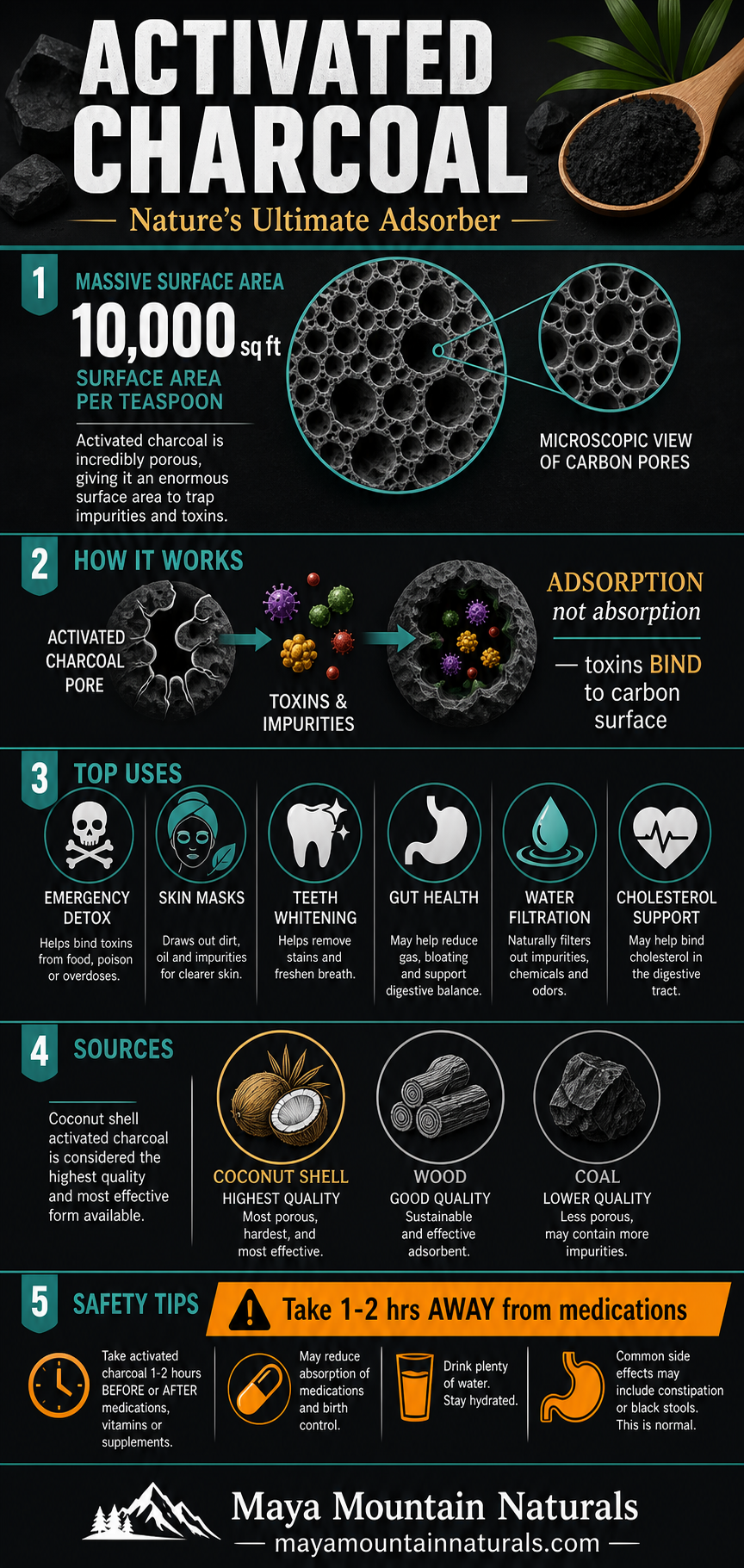
- Activated charcoal is a pharmaceutical-grade form of carbon with an enormous internal surface area — a single teaspoon can have roughly 10,000 square feet of surface, about the size of a football field.
- It works by adsorption (toxins stick to its surface), not absorption, which lets it bind many drugs, chemicals, heavy metals, and intestinal gases and carry them out through the stool.
- Its most evidence-backed use is emergency poisoning and overdose care, where it sits on the World Health Organization's List of Essential Medicines.
- For everyday wellness it is traditionally used to support gas and bloating relief, gentle detox protocols, skin care, and oral care — best understood as supportive rather than a cure-all.
- Coconut-shell activated charcoal is the gold standard for internal use: highest surface area, no detectable heavy metals, and renewable — a natural fit for our Caribbean home at Maya Mountain Naturals.
Activated charcoal is one of the oldest natural remedies still validated by modern science. Its extraordinary surface area and unique adsorptive chemistry let it bind toxins thousands of times its own weight, which is why it remains a trusted tool in both emergency medicine and everyday natural wellness. Used intelligently — timed away from food and medications, and chosen in coconut-shell quality — it earns a place alongside your tinctures, clays, and botanical allies.\n\n## What is activated charcoal?
Picture a sponge so incredibly tiny and porous that a single teaspoon of it has a surface area roughly equivalent to 10,000 square feet — bigger than a football field, packed into something that fits in your hand. That is activated charcoal (AC). It is not your backyard barbecue briquette, not campfire ash, and nothing to be afraid of. It is a highly refined, pharmaceutical-grade substance with one of the most extraordinary physical properties known to science.
Activated charcoal (also called activated carbon) is a form of carbon processed at extreme temperatures to create a massive internal network of pores and cavities. This structure gives it an almost magnetic ability to attract and hold toxins, chemicals, gases, and impurities — a process called adsorption (not absorption — more on that distinction below). It is odorless, tasteless, jet black, and completely non-toxic.
A history older than civilization
Activated charcoal has been used medicinally for over 3,500 years. The first documented use traces to ancient Egypt around 1500 B.C., where it treated intestinal ailments, absorbed wound odors, and served as an antiseptic. As far back as 3750 B.C., Egyptians used charcoal for smelting metals, and noticed that charred wooden posts placed in the Nile didn't rot — an early recognition of its antibacterial powers.
By 400 B.C., ancient Indians and Phoenicians discovered its water-purifying properties. Sailors charred the inside of wooden water barrels to keep drinking water fresh on long sea voyages — arguably the world's first water filtration system. In Ayurvedic medicine, charcoal was known as Vaitarana and used for detoxification, skin care, oral hygiene, and as a poison antidote.
Hippocrates and later Pliny used charcoal for epilepsy, chlorosis, and vertigo around 50 A.D. By the mid-18th century it had re-entered mainstream Western medicine; in 1776 Russian chemist Johann Lowitz discovered its decolorizing properties, and in the early 1800s the activation process was refined into the modern medical-grade product. During World War I, activated carbon protected soldiers in gas masks, and today it holds a place on the World Health Organization's List of Essential Medicines.
How is activated charcoal made?
Activated charcoal starts as an ordinary carbon-rich raw material — coconut shells, wood, coal, bamboo, olive pits, or peat. The transformation happens in two stages.
Stage 1: Carbonization
The raw material is heated in the absence of oxygen to 600–900°C. This drives off moisture, volatile compounds, and organic matter, leaving a dense, carbon-rich char. Before activation, regular charcoal has a surface area of only about 2–5 m²/g.
Stage 2: Activation
This is where the magic happens, through one of two methods:
- Physical (steam) activation: the char is exposed to steam or CO₂ at 900–1100°C. The steam reacts with the carbon (C + H₂O → CO + H₂), etching millions of new pores and exploding the surface area to over 1,000–3,500 m²/g.
- Chemical activation: the char is impregnated with agents like phosphoric acid or zinc chloride, then heated at 400–600°C, creating a more developed microporous structure with even higher surface area.
After activation, the material is washed, dried, crushed, and sized into powders, granules, or pellets.
Coconut shell vs. wood vs. coal: which is best?
Not all activated charcoal is created equal — the source material matters enormously, especially for internal use.
| Property | Coconut Shell | Coal | Wood |
|---|---|---|---|
| Surface area | Highest (1,150–1,350 m²/g) | Medium (below 600 m²/g) | 720–940 m²/g |
| Pore type | Predominantly micropores | Micropores + mesopores | Mesopores + macropores |
| Hardness | Very high (98%+) | High (90–95%) | Lower (85%) |
| Heavy metals | None detectable | May be present | Low |
| Eco source | Renewable agricultural byproduct | Fossil-based | Renewable but depleting |
| Best for | Human consumption, fine molecules | Industrial, larger molecules | Industrial, largest molecules |
For natural health and internal use, coconut-shell activated charcoal is the clear winner: highest surface area, no detectable heavy metals, renewable, and it meets the USP minimum of 900 m²/g for medicinal use. In the tropics — and especially in the Caribbean, like us at Maya Mountain Naturals — coconut-shell AC is the gold standard.
How does adsorption actually work?
Activated charcoal does not absorb toxins the way a sponge soaks up water. It adsorbs them — toxins stick to the carbon surface like flies to flypaper.
Adsorption is driven by Van der Waals forces — weak but incredibly additive electromagnetic attractions between molecules. Because AC has such a staggeringly large internal surface area, these weak forces combine into extraordinarily powerful binding capacity. When a toxin molecule drifts close to a carbon platelet inside those microscopic pores, it is pulled in and held in a lower-energy state — essentially locked in.
This is why activated charcoal can adsorb substances thousands of times its own weight. The body doesn't digest the charcoal itself — it simply passes through the gastrointestinal tract, carrying its bound cargo of toxins out in the stool.
What it binds (and what it doesn't)
Binds well: most pharmaceutical drugs, morphine and opioids, pesticides including DDT, phenobarbital/carbamazepine/theophylline, heavy metals like mercury and lead (in water filtration), chlorine and VOCs, intestinal gases, bile acids and cholesterol, and many bacterial toxins.
Does NOT bind well: strong acids or alkaline corrosives (lye, bleach), cyanide, iron, lithium, arsenic, ethanol/methanol/ethylene glycol, petroleum hydrocarbons (gasoline, kerosene), and acetone.
What are the medical and clinical uses?
Emergency poisoning and overdose
This is activated charcoal's most established, evidence-based use — so proven it sits on the WHO Essential Medicines List. Given within one hour of ingestion, a single large dose can dramatically reduce how much toxin reaches the bloodstream. Standard adult emergency dosing is 25–100 grams as a water slurry, sometimes repeated every 2–4 hours (multiple-dose AC) to intercept toxins that recirculate through the body. This is strictly a medical-supervision scenario, not a home remedy.
Interrupting enterohepatic circulation
Some drugs and toxins cycle between gut, liver, and bile in a loop. By continuously binding these in the gut, multiple-dose AC can accelerate elimination even after a toxin has entered the bloodstream. A meta-analysis of amatoxin (death cap mushroom) poisoning found 83% survival in AC-treated patients versus 75% in untreated controls.
Chronic kidney disease support
In kidney disease, uremic toxins like indoxyl sulfate build up in the blood. Oral AC (notably AST-120) has been shown to adsorb their precursors in the gut before absorption, lowering blood levels and potentially slowing CKD progression — an emerging, promising research frontier best pursued under medical supervision.
Cholesterol support
Several studies report meaningful drops in cholesterol and triglycerides with AC. One older study using 35 g/day in patients with renal insufficiency observed cholesterol reductions of 23–43% and triglyceride reductions of 60–76%. The mechanism: AC adsorbs bile acids in the gut, forcing the liver to draw cholesterol from the blood to make more bile.
Intestinal gas and bloating
The European Food Safety Authority recognizes AC for reducing intestinal gas. A practical protocol is at least 1 gram taken 30 minutes before and after meals, adsorbing gas-producing compounds before they ferment.
What are the natural wellness uses?
Skin care and topical use
Applied topically, AC acts like a deep magnet for pores, drawing out bacteria, excess sebum, pollutants, and chemical residues. Mix the powder with water (or aloe gel, apple cider vinegar, or bentonite clay) into a paste for a 10–15 minute face mask, then rinse well. A poultice of AC and coconut oil is traditionally used to support relief from insect bites and stings, and AC-impregnated dressings are used clinically on wounds.
Oral health and teeth whitening
AC has been used in oral hygiene since the early 1900s. It adsorbs surface stains and binds oral bacteria. Because it is mildly abrasive, apply it gently — dabbing rather than scrubbing — to protect enamel, and use sparingly if you have sensitive teeth or veneers.
Gentle detox and cleansing
A commonly used protocol takes 20–35 grams per day in divided doses on two consecutive days per week, on an empty stomach. Critical timing rule: always take AC at least 30 minutes to 1 hour before, or 2+ hours after, food, supplements, and medications — otherwise it binds your nutrients and medicines along with the toxins.
Where else is activated charcoal used?
- Water filtration: granular activated carbon (GAC) filters remove chlorine and chloramines, VOCs and pesticide residues, heavy metals like lead and mercury, and taste/odor compounds — the core medium in many premium water filters.
- Air purification: the active material in air filters, HVAC systems, scrubbers, and the charcoal bags people use in fridges and cars.
- Medical devices: hemoperfusion systems, dialysis cartridges, and charcoal-impregnated wound dressings.
- Industry: recovering precious metals, decolorizing sugar and beverages, fuel systems, and pharmaceutical purification.
Is activated charcoal safe?
Activated charcoal has an excellent safety profile for short-term use and is considered non-toxic — it is not absorbed and passes through the digestive system. Still, important cautions apply.
Common side effects: black stools (normal and harmless), constipation (drink plenty of water), and occasional nausea if taken too fast or in high doses.
Drug and supplement interactions: because AC binds almost anything organic, it can reduce the effectiveness of birth control pills, digoxin, theophylline, carbamazepine, antidepressants, and virtually any oral medication. The golden rule: separate AC by at least 1–2 hours from any medication (3+ hours for critical ones like birth control).
Do NOT use activated charcoal if an intestinal obstruction is suspected, there is a diminished gag reflex or aspiration risk (AC in the lungs can cause serious pneumonia), or if corrosive substances, petroleum products, or cyanide have been ingested — AC doesn't bind these, and delay can be fatal. During pregnancy and breastfeeding, short-term use may be acceptable, but consult a healthcare provider first.
How do you choose quality activated charcoal?
- Source material: choose coconut shell for internal use — highest surface area, cleanest, no heavy metals, sustainably sourced.
- USP-grade certification: look for at least 900 m²/g surface area for medicinal grade.
- Purity: free of additives, fillers, binders, or flavorings.
- Particle size: finely powdered AC exposes more surface area for internal use.
- Packaging: store airtight and moisture-protected — AC will adsorb impurities from the air over time.
Quick reference: uses at a glance
| Application | Method | Notes |
|---|---|---|
| Emergency poisoning | 25–100g oral slurry | Medical supervision required; within 1 hour of ingestion |
| Intestinal gas / bloating | 1g before & after meals | EFSA-recognized use |
| Detox protocol | 20–35g/day, 2 days/week | Take away from food and supplements |
| Cholesterol support | 24–35g/day | Clinical evidence supports this |
| CKD / uremic toxins | Under medical supervision | Emerging but promising research |
| Skin / face mask | AC + water paste, 10–15 min | Rinse well; avoid eyes |
| Teeth whitening | Gentle dab, not scrubbing | Use sparingly to protect enamel |
| Water filtration | GAC filter systems | Highly effective, proven technology |
| Odor neutralization | Charcoal bags or powder | Refrigerators, cars, gym bags |
Frequently asked questions
What is the difference between adsorption and absorption?
Absorption means a substance soaks into the bulk of a material, like water into a sponge. Adsorption means molecules stick to the surface. Activated charcoal works by adsorption — toxins bind to its vast internal surface area and are carried out of the body, rather than being soaked up and held inside the carbon.
Can I take activated charcoal every day?
It is not ideal as a casual long-term default. Because AC binds nutrients and medications along with toxins, daily use can interfere with absorption if not timed carefully. It is better suited to occasional, targeted use — gas relief, short detox days, or supportive protocols — always taken away from food, supplements, and medicines.
Why is coconut-shell activated charcoal considered the best?
Coconut-shell AC has the highest surface area, is predominantly microporous, has no detectable heavy metals, and comes from a renewable agricultural byproduct. For internal use it is the cleanest and most effective option, which is why it is the gold standard for health and wellness applications.
Will activated charcoal cure a hangover?
Not reliably. AC does not bind ethanol well, so it won't pull alcohol out of your bloodstream. It may help adsorb some of the congeners and byproducts in alcoholic drinks if taken alongside or shortly after, but this is a supportive measure rather than a proven cure.
Does activated charcoal whiten teeth safely?
It can lift surface stains by adsorption, but it is mildly abrasive. Apply it gently by dabbing rather than scrubbing, use it sparingly, and avoid it if you have sensitive teeth or veneers to protect your enamel over time.
MMN takeaways
Activated charcoal is a rare natural substance that has genuinely earned its reputation — not just a trendy ingredient, but a clinically proven, WHO-recognized medicine trusted across cultures for over 3,500 years. Its greatest proven power is in emergency poisoning and overdose situations under medical care. Its everyday wellness applications — gas relief, gentle detox, skin, and oral care — are real and useful, but are best understood as supportive rather than therapeutic. Use it intelligently: time it away from food and supplements, choose coconut-shell quality, and respect what it can and cannot bind. Used that way, activated charcoal deserves a place in your natural toolkit, right alongside your tinctures, clays, and botanical allies.
Always consult a qualified health professional before using activated charcoal therapeutically, especially in emergency situations. Statements here are educational and not intended to diagnose, treat, cure, or prevent any disease.