The Acid Trap: A Natural Guide to Getting Off Heartburn Pills (and Healing Your Digestion)
Why your stomach acid is your friend, how PPIs can backfire, and gentle, root-cause ways to support your gut naturally — diet, lifestyle, and herbal allies.
This article is for educational purposes and is not a substitute for medical advice.
For millions of people, it starts with a single burning night after dinner. A doctor reaches for a familiar fix — the "little purple pill" or one of its cousins — and the fire goes out. Relief feels like a miracle. But here's the quiet catch almost no one explains: a medication designed for a few weeks has, for huge numbers of people, become a habit that lasts years.
This article is not anti-medicine. Proton pump inhibitors (PPIs) can be genuinely lifesaving in the right situation. This is about something different: being an informed partner in your own care, understanding why your stomach acid matters, and learning the gentle, root-cause ways you can support your digestion naturally.
Quick answer
- PPIs were designed for short-term use (4–8 weeks) — not years of daily reliance.
- Stomach acid is essential: it digests protein, absorbs nutrients, and defends against germs.
- Low stomach acid can feel exactly like high acid — heartburn, bloating, and belching.
- Stopping PPIs suddenly can trigger "rebound acid," which feels worse but usually passes.
- Diet, lifestyle, and soothing herbs can help your body rebalance — always taper with your prescriber.
What Are PPIs, and Why Were They Created?
PPIs — proton pump inhibitors — are a class of medications that turn off the tiny "acid pumps" lining your stomach. Common names include omeprazole (Prilosec), esomeprazole (Nexium), lansoprazole, and pantoprazole.
They are remarkably effective at shutting down acid production. That's exactly why doctors prescribe them for serious problems like stomach ulcers, erosive esophagitis (a raw, inflamed esophagus), and severe GERD.
Here's the key idea: PPIs were designed for short-term use — typically 4 to 8 weeks — to give damaged tissue time to heal. They were never meant to be a lifelong daily habit.
Yet that's exactly what has happened. PPIs are now among the most widely used medications in the world, and millions of people have been taking them daily for years, often without anyone revisiting whether they still need them.
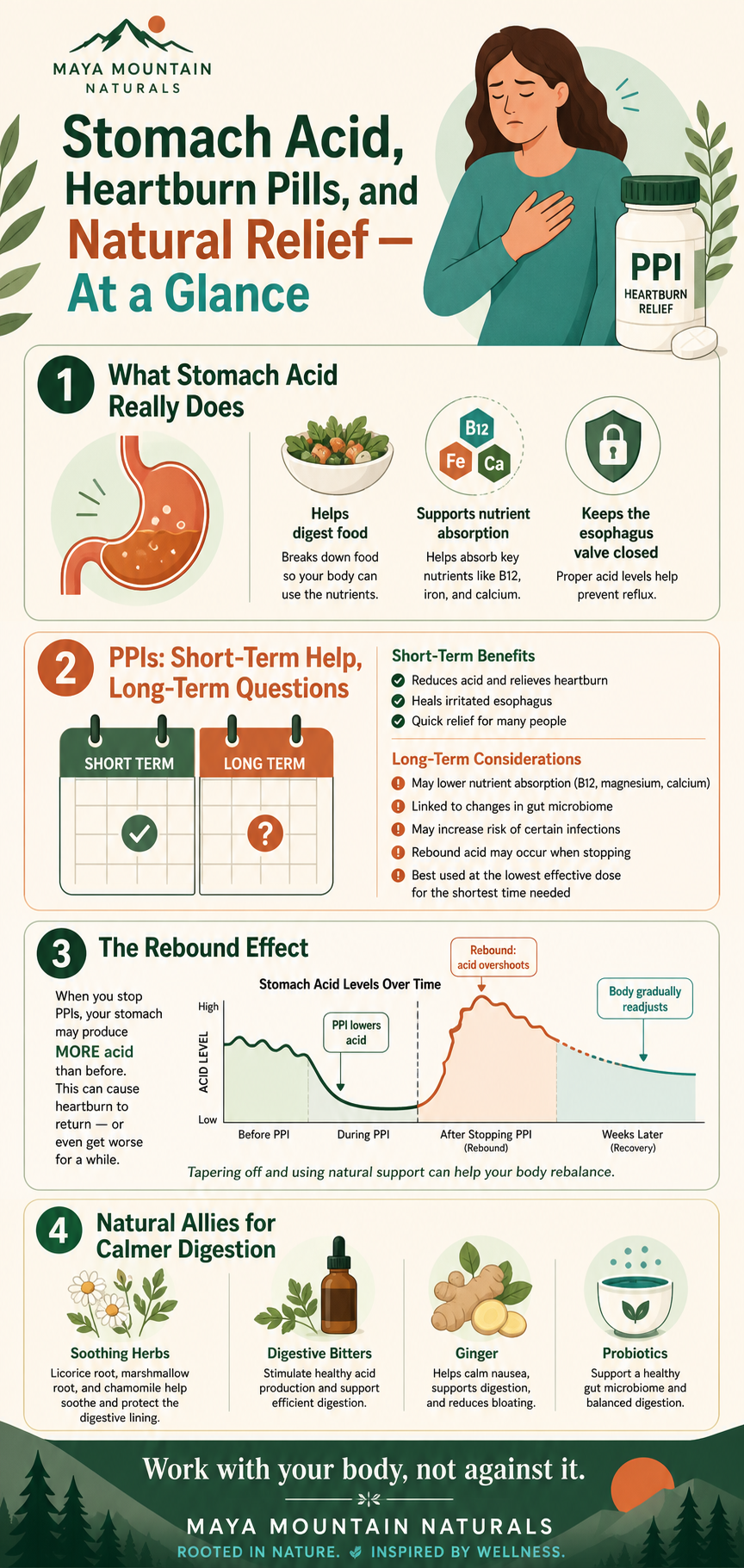
Why You Actually Need Stomach Acid
It's easy to think of stomach acid as the villain. In reality, it's one of your body's most important tools — and you genuinely need it.
Healthy stomach acid quietly does several essential jobs:
- Breaks down protein and food so your body can actually use what you eat.
- Activates enzymes and helps absorb key nutrients like vitamin B12, iron, calcium, magnesium, and zinc.
- Keeps the lower esophageal sphincter (LES) tight — that's the muscular "door" between your stomach and esophagus. Proper acid levels help keep that door closed so food doesn't flow backward.
- Acts as a front-door bouncer, killing many harmful microbes in your food and water before they reach your gut.
Here's where it gets surprising. Many people who feel "acidy" don't actually have too much acid — they have too little, a condition called hypochlorhydria. When acid is low, food sits and ferments, the LES can loosen, and you get the very symptoms you'd blame on excess acid: heartburn, reflux, bloating, gas, belching, and a heavy feeling after meals.
Too little stomach acid can feel just like too much. This is why blindly suppressing acid doesn't always solve the problem — and can sometimes make the root cause worse.
The PPI Trap: Rebound Acid and Why It's So Hard to Stop
If you've ever tried to quit a PPI and felt like your heartburn came roaring back worse than ever, you're not imagining it — and you're not broken.
When you block acid for long enough, your body notices and tries to compensate. It produces more of the hormone that tells your stomach to make acid. So when you suddenly stop the medication, those revved-up signals are still firing — and you can get a temporary surge of extra acid. This is called rebound acid hypersecretion.
What does this feel like in real life? Worse heartburn than before you ever started the pill. Naturally, most people conclude, "See? I clearly need this medication for life."
But often, that flare isn't proof your body is failing. It's withdrawal from the drug. Your stomach is recalibrating.
The reassuring truth: this rebound phase can be intense, but it doesn't last forever when it's managed well — with a slow taper, the right diet, and gentle natural support while your body finds its balance again.
The Hidden Costs of Long-Term PPI Use (In Plain Language)
Used briefly and appropriately, PPIs are a useful tool. The concern researchers have raised is about unquestioned, long-term use. Studies have associated chronic PPI use with several issues worth knowing about:
- Nutrient depletion — lower absorption of vitamin B12, magnesium, calcium, and iron over time.
- Bone thinning and higher fracture risk, likely tied to reduced calcium absorption.
- Changes to the gut microbiome and a higher risk of certain gut infections (because less acid means fewer germs are killed at the "front door").
- Possible links in long-term users to kidney problems, certain stomach cancers, and even dementia (these are associations from research, not proof that PPIs directly cause them).
To be clear: PPIs can be very helpful short-term in the right cases. The real concern is unquestioned long-term use without ever revisiting whether you still need them.
Questions Worth Asking Before Starting (or Continuing) a PPI
This is the part to bring with you to your next appointment. These are simple, respectful questions that put you back in the driver's seat:
- "Do I really have too much acid — or could this be low acid, an H. pylori infection, or something else?"
- "Have I been tested for H. pylori and other possible causes?"
- "What lifestyle or diet changes should I try first?"
- "How long do you expect me to be on this medication?"
- "What is our plan to reevaluate and possibly taper off?"
These aren't confrontational — they're the questions a good clinician will welcome, and exactly the things a busy appointment often doesn't have time to cover.
Lifestyle Foundations for Calmer Digestion
Before reaching for anything stronger, small everyday habits do a surprising amount of heavy lifting:
- Eat slowly, chew well, and don't overeat. Digestion starts in your mouth, and big, rushed meals overload the system.
- Avoid lying down within 2–3 hours of eating. Gravity is your friend — let it keep food where it belongs.
- Raise the head of your bed a few inches for nighttime reflux (a wedge pillow or risers work well).
- Sleep on your left side, which positions the stomach below the esophagus and tends to reduce reflux.
- Identify trigger foods. Common culprits include coffee, alcohol, chocolate, fried foods, tomato, citrus, mint, and ultra-processed foods. Try a 2–4 week elimination, then reintroduce one at a time.
- Support your nervous system. Stress directly affects digestion. Gentle breathwork, daily walks, and time in nature help shift your body into "rest and digest" mode.
Herbal & Natural Allies: Gentle Support for Reflux and Digestion
This is where tradition and science meet. Herbs won't switch off your stomach the way a drug does — instead, they work with your body to soothe, protect, and restore. They can be layered together in teas, tinctures, or custom formulas as part of a holistic plan.
Soothing Coats (Mucilaginous Herbs)
These herbs form a slippery, gel-like layer that coats and calms irritated tissue.
- Slippery elm — the inner bark forms a soothing gel that coats the esophagus and stomach, easing that raw, burning feeling.
- Marshmallow root — offers a similar soothing, protective effect along the entire digestive tract.
- Aloe vera (inner leaf juice) — cooling, calming, and anti-inflammatory for the upper GI. Choose decolorized inner-leaf juice to avoid the harsh laxative compounds.
Mucosal Repair & Protection
- DGL licorice (deglycyrrhizinated licorice) — helps support and protect the stomach and esophageal lining, encouraging healthy mucus production. The "DGL" form removes the compound in whole-root licorice that can raise blood pressure, making it gentler for regular use.
Bitters to Wake Up Digestion (For Low-Acid Types)
If your symptoms come from too little acid, bitters can be a game-changer. Bitter herbs like gentian, artichoke, dandelion, chamomile, and ginger gently stimulate your own stomach acid, bile, and digestive enzymes.
Important note: bitters are taken a few minutes before meals — and they're not for everyone. Use caution (and professional guidance) if you have an active ulcer or severe GERD, since stimulating acid is the opposite of what those conditions need.
Motility & Anti-Nausea Support
- Ginger — helps the stomach empty more efficiently, calms nausea, and eases bloating. A little ginger tea before or after meals can keep things moving in the right direction.
Microbiome Support
- Probiotics and fermented foods — long-term acid suppression can throw off your gut flora. Rebuilding a healthy microbiome with probiotics and gentle fermented foods (like yogurt, kefir, or sauerkraut) supports balanced digestion from the ground up.
Other Helpers Worth Knowing
- Mastic gum — traditionally used for upper-GI support and often explored when H. pylori is suspected.
- Melatonin — beyond sleep, it may support LES tone and ease nighttime reflux. Use this one under professional supervision.
The real power is in layering. A soothing mucilage blend, a thoughtful bitters formula, and ginger support can work together — which is exactly where a customized herbal approach shines.
If You're Already on a PPI: A Gentle Tapering Mindset (Not a Protocol)
Let's be crystal clear: this article does not tell you to stop your medication on your own. Always work with your prescriber. Stopping abruptly is the surest way to trigger a miserable rebound.
What a thoughtful step-down looks like, in broad strokes:
- Reducing the dose slowly rather than quitting cold turkey.
- Spacing out doses over time.
- Sometimes bridging with a milder medication during the transition.
- Using diet, lifestyle, and herbal support while your body readjusts.
Just as important as the plan is the mindset:
- Expect a temporary flare. This is normal rebound — not proof that you're broken.
- The right support — diet, herbs, and lifestyle — makes this transition far more comfortable.
Go slow, be patient with yourself, and lean on your support team.
How Maya Mountain Naturals Supports Your Digestion Naturally
At Maya Mountain Naturals, our approach to reflux and digestion is rooted in one idea: work with your body, not against it.
- We focus on root causes — stomach acid balance, microbiome health, mucosal integrity, and nervous-system calm — rather than just muting symptoms.
- We craft layered herbal tincture formulas — soothing mucilage blends, thoughtful digestive bitters, and ginger-based support — designed to work together.
- We lead with education, because the most powerful thing you can have is a real understanding of your own body.
If you're navigating heartburn, reflux, or life after long-term PPIs, we'd love to help you build a gentle, realistic plan. Explore our digestive support tinctures or reach out for personalized guidance.
Frequently Asked Questions
Frequently asked questions
Are PPIs dangerous?
PPIs are generally safe and very helpful for short-term use in serious conditions like ulcers and severe GERD. The concern is unquestioned long-term daily use, which research has linked to nutrient depletion, bone thinning, microbiome changes, and other risks. The goal is to use them at the lowest effective dose for the shortest time needed — and to revisit whether you still need them.
Can low stomach acid really cause heartburn?
Yes. When stomach acid is too low, food can ferment and the valve between your stomach and esophagus may loosen, producing heartburn, bloating, gas, and belching — symptoms that feel identical to high acid. This is why simply suppressing acid doesn't always fix the underlying problem.
Why does my heartburn get worse when I stop my PPI?
This is usually rebound acid hypersecretion — your body ramped up its acid signals to compensate for the drug, and stopping suddenly unleashes a temporary acid surge. It can feel worse than your original symptoms, but it typically passes with a slow taper and good natural support. It's withdrawal, not proof you need the drug forever.
What natural remedies help with reflux?
Soothing mucilaginous herbs (slippery elm, marshmallow root, aloe inner-leaf juice), DGL licorice for the lining, ginger for motility and nausea, digestive bitters for low-acid types, and probiotics for the microbiome. Lifestyle steps — eating slowly, not lying down after meals, raising the bed, and managing stress — are foundational.
Can I just stop taking my PPI cold turkey?
No — stopping abruptly is the most common reason people experience severe rebound heartburn. Always taper gradually with your prescriber, ideally while using diet, lifestyle, and herbal support to ease the transition.
How do I know if I have low or high stomach acid?
The symptoms overlap heavily, so it's hard to tell on your own. Clues like feeling worse on an empty stomach, multiple food sensitivities, or symptoms that improve with bitters can point to low acid — but the best step is to ask your provider about testing (including for H. pylori) rather than guessing.
---
This content is for educational purposes only and does not replace personalized medical care. Always consult with your healthcare provider before changing any prescription medications or starting new supplements.